
A university runs multi-area OSPF with a backbone data center that redistributes Internet routes, while campus ABRs see hundreds of building /24s that churn during maintenance. The design must shrink tables and hide churn without hiding external policy. Which OSPF summarization at ABRs and ASBRs best achieves stable scaling?
Select an answer to reveal the explanation.
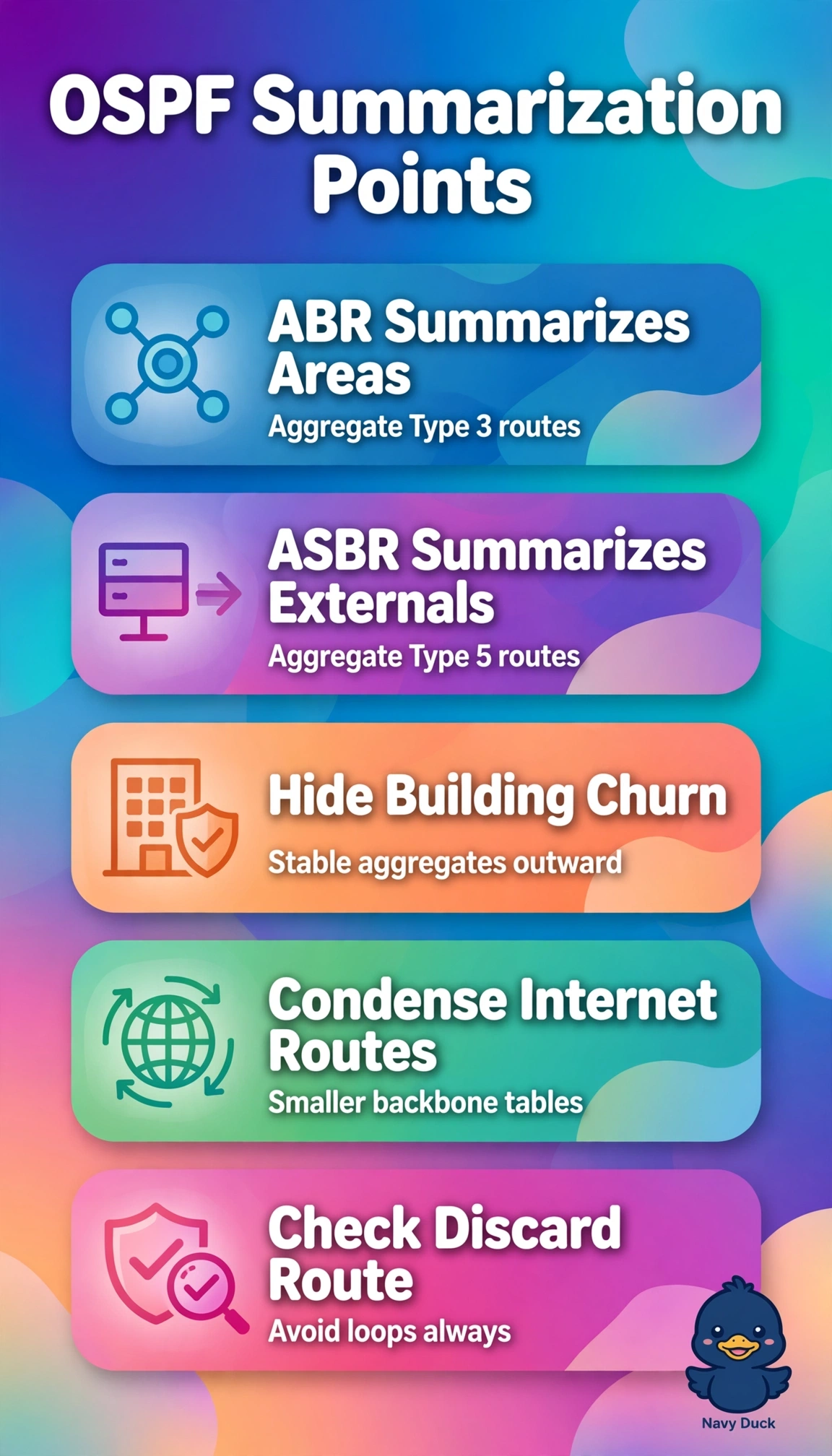
Short Explanation
You sort mail at the right post office, not across town. ABRs bundle area routes, ASBRs bundle externals, and that boundary discipline keeps tables slim. Swapping their jobs just leaves both piles messy.
Full Explanation
ABRs summarize Type 3 inter-area routes between areas and ASBRs summarize Type 5 external routes at redistribution, so placing inter-area aggregates at campus ABRs hides building churn while placing external aggregates at the data center ASBR condenses Internet prefixes without obscuring internal topology, jointly reducing LSDB size and SPF load. Summarizing externals at ABRs and buildings at the ASBR fails by concept because it reverses OSPF roles, as ABRs cannot summarize Type 5 and the ASBR lacks visibility to aggregate campus internal prefixes correctly. Summarizing at access routers while flooding externals fails by concept because access devices are not area boundaries and unsummarized externals still flood instability and bloat tables across all areas. Disabling all summarization fails by concept because faster SPF only reacts quicker to churn rather than hiding it, leaving table size and flooding scope unscaled. For the exam, remember inter-area summarization lives only on ABRs and external summarization lives only on ASBRs, and in practice verify aggregate masks and discard routes to avoid suboptimal routing or loops.