
A bank plans IPv6 for 12 large sites with 300 VLANs each, needing aggregation at the WAN core and room for future sites and technologies. Which IPv6 prefix hierarchy with /48 sites and /64 subnets provides scalable allocation?
Select an answer to reveal the explanation.
Short Explanation
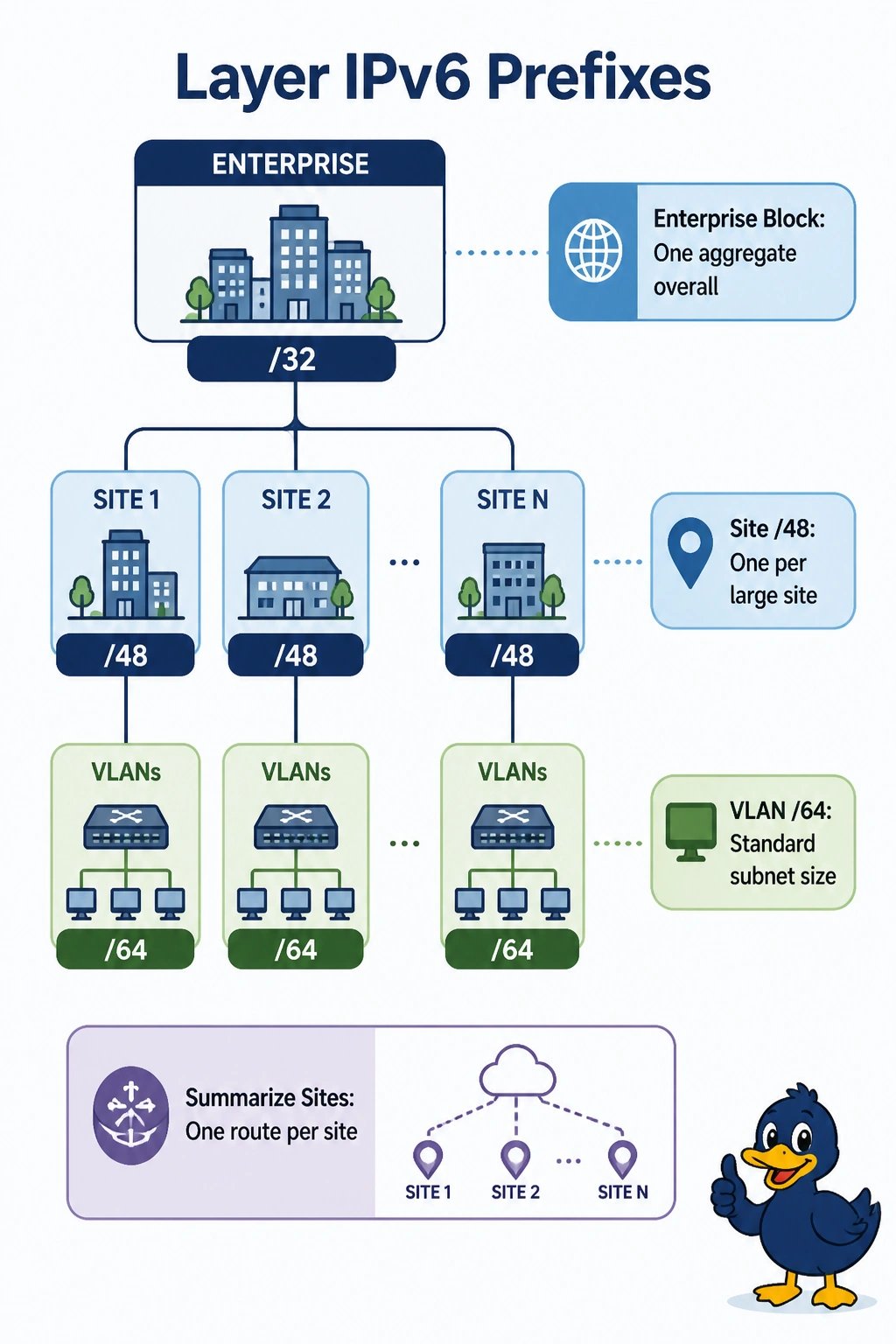
You have oceans of IPv6 space, so stack it neatly from big to small. A clean hierarchy lets the core see one route per site.
Full Explanation
A global /32 provides 65536 /48s, so 12 large sites fit in a small summarized range with ample room for future sites, regions and new technologies, while each /48 provides 65536 /64s which easily covers 300 VLANs per site plus infrastructure, loopback and growth, and keeping /64 on every LAN preserves SLAAC, EUI-64 and host autoconfiguration while enabling nibble-aligned summarization of each site toward the WAN core for scalability and stability. An enterprise /48 with /56 per site is a legitimate small-branch and residential ISP pattern but yields only 256 /64s per site, so it cannot support 300 VLANs and fails the large-site sizing and growth requirement despite correct hierarchy. Using /80 per VLAN applies valid IPv4 conservation logic to IPv6 but violates the /64 LAN standard, breaking SLAAC, privacy addressing and many stacks while providing no routing benefit. Deploying correctly sized /48s and /64s without summarization is operational in flat lab networks yet fails the explicit aggregation need by propagating many specifics toward the core, inflating tables and reducing containment. For exams, do not narrow a LAN below /64 to save space and distinguish routable capacity from summarized assigned blocks. In practice, group site /48s into nibble-aligned regional summaries such as a /44 or /40 and verify the WAN core sees one aggregate per site or region while each VLAN interface carries a distinct /64.