
A branch office uses a primary MPLS path and a backup Internet VPN with dynamic routing, and tellers cannot tolerate long blackholes when the primary degrades silently without interface down. Designers need fast failure detection and automatic path switchover. Which backup connectivity and failover trigger design best meets availability needs?
Select an answer to reveal the explanation.
Short Explanation
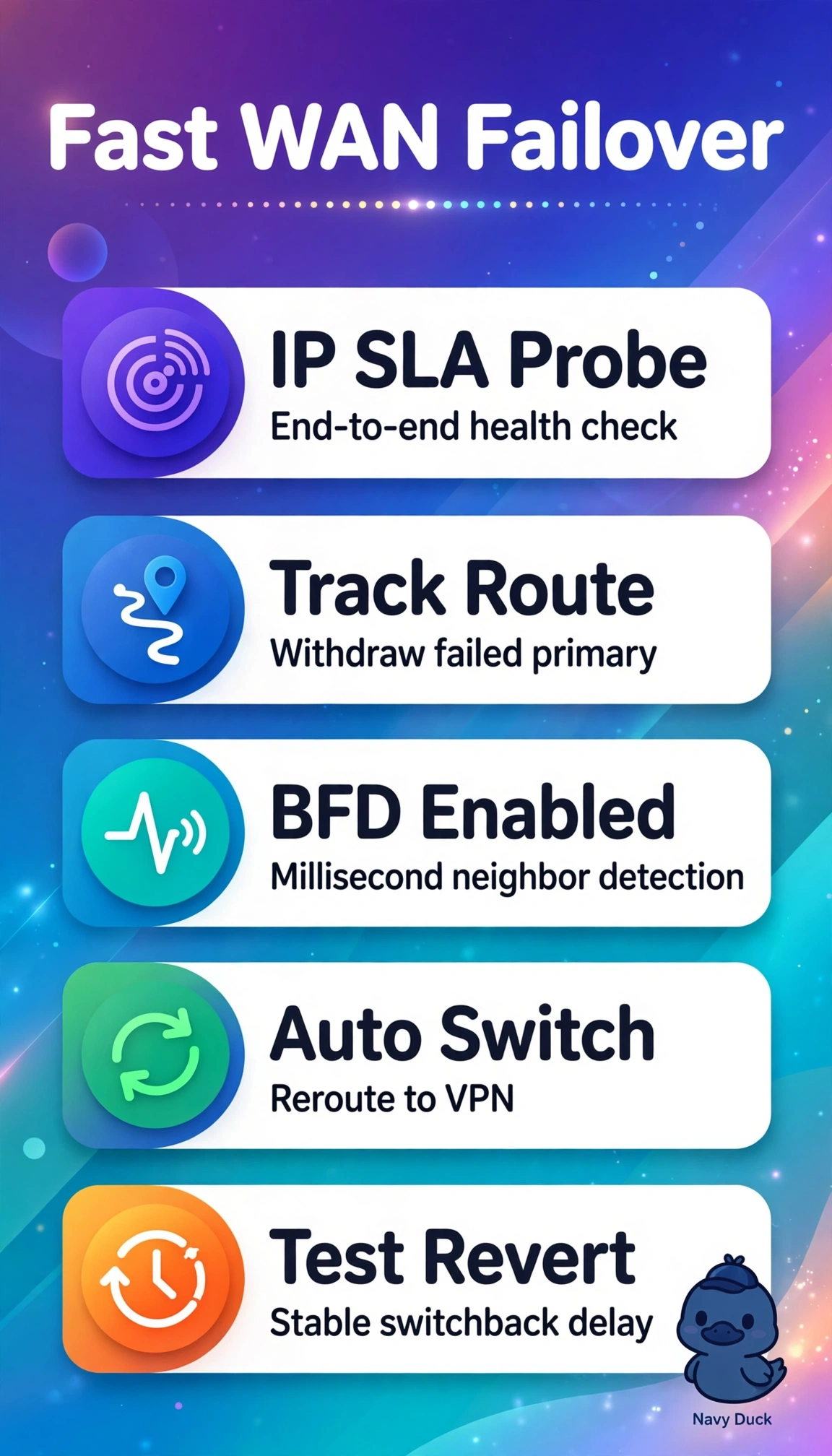
You're adding both a heartbeat and a health checkup. Layered detection catches silent degradation end-to-end while BFD drops the failed neighbor in milliseconds.
Full Explanation
IP SLA probes measure end-to-end reachability, latency, and loss beyond local interface state so tracked static routes or policy-based routing can withdraw the primary when the MPLS core degrades silently, while BFD provides subsecond hello-based neighbor failure detection to accelerate IGP or BGP reconvergence without waiting for long dead timers. Relying solely on interface status fails detection because carrier and MPLS issues often leave the local Ethernet up while end-to-end forwarding is broken, causing prolonged blackholing on the primary. Manual ping testing fails automation and speed because human initiation is inconsistent, lacks integration with routing, and cannot provide deterministic switchover or switchback for teller transactions. Using only default BGP hold timers fails responsiveness because defaults are tens of seconds and only detect neighbor loss, not degraded performance or upstream path faults that IP SLA would expose. Exam caveat: pair fast BFD for neighbor down with IP SLA for path quality and define hysteresis for revert. Practical check: simulate upstream loss with interface up, confirm probe failure triggers reroute, and measure failover time.