
A media firm streams live events to two data centers with Anycast RP inside each site and needs RP redundancy plus shared active sources between sites for fast failover without a single point of failure. PIM domains must stay interconnected. Which design provides RP redundancy with inter-domain source sharing?
Select an answer to reveal the explanation.
Short Explanation
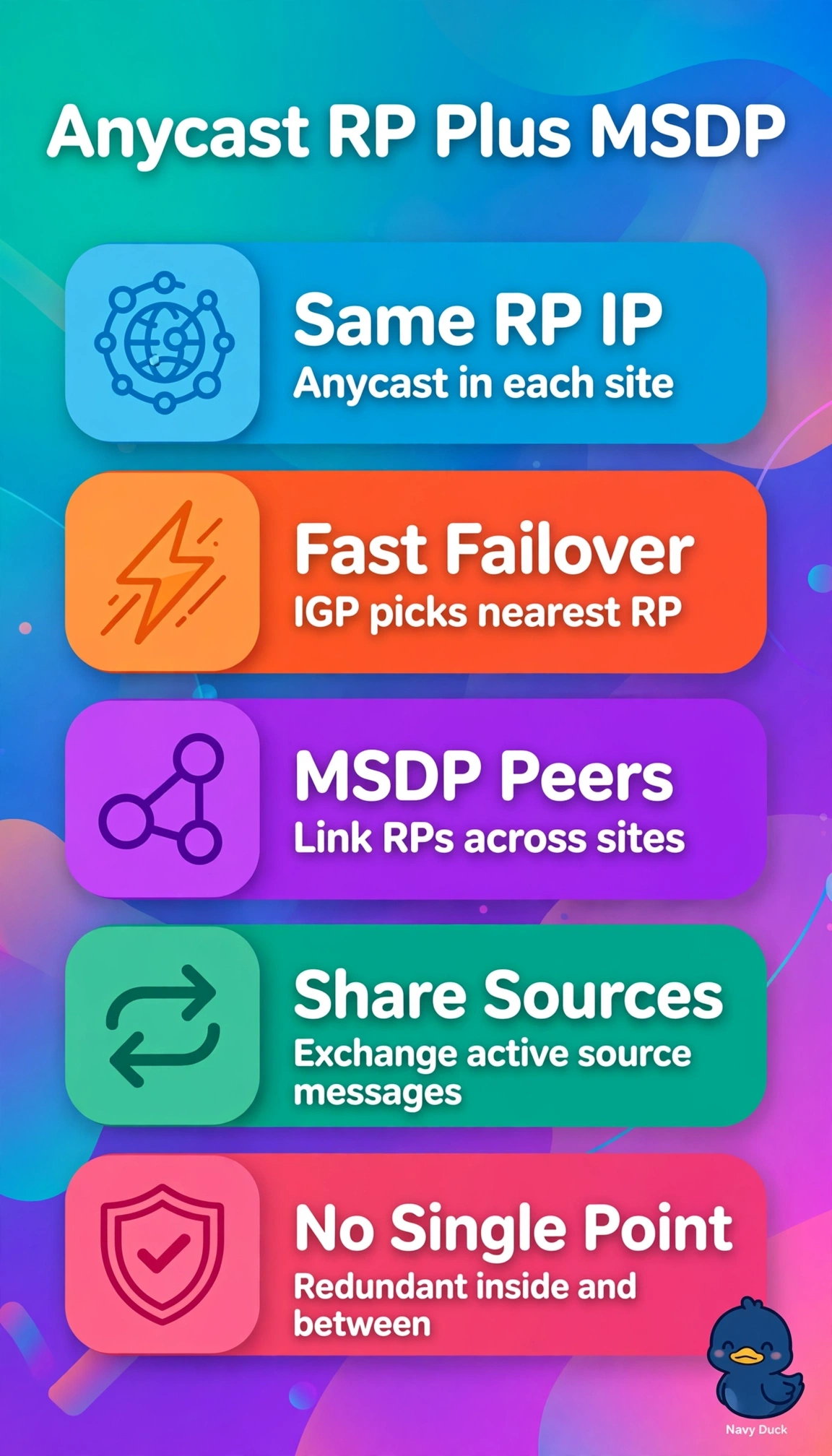
You'll love how smoothly this works — it’s like your co-hosts sharing cue cards so there’s no awkward pause. You get a shared RP address, while MSDP peering keeps both sites informed about active sources.
Full Explanation
The design combines two mechanisms: Anycast RP advertises the same RP address from multiple routers, directing PIM joins to the nearest healthy RP for fast local failover without a single point of failure; MSDP peering exchanges Source Active messages so each interconnected PIM domain learns about active sources in the other and can build short-path trees without waiting for new source discovery. Using identical Anycast RP addresses without MSDP leaves each site with only locally registered sources, so a receiver failing over to the remote data center may not find the stream until the source re-registers. A Bootstrap Router with redundant candidate RPs provides dynamic RP election and redundancy within a PIM domain, but does not share active-source state between separate domains. MSDP peering between single RPs shares sources across domains, but one dedicated RP per site creates a single point of failure and removes Anycast fast failover if that RP fails. Exam caveat: BSR, Auto-RP, and Anycast RP can all suggest redundancy, but only Anycast RP with MSDP provides both RP redundancy and inter-domain source sharing. Practical check: verify Anycast reachability with ping and RP mapping, then use show ip msdp peer and show ip msdp sa-cache to confirm remote Source Active entries before simulating an RP failure.