
An e-commerce firm has two eBGP exit links from one border router to the same ISP, one 1 Gbps and one 400 Mbps, and needs both links to carry egress traffic roughly proportional to capacity without complex policies. Which BGP load-sharing design best achieves efficient use of unequal links?
Select an answer to reveal the explanation.
Short Explanation
You're letting the router share work fairly based on muscle size. Link bandwidth signaling extends multipath so unequal links carry proportional loads instead of equal shares.
Full Explanation
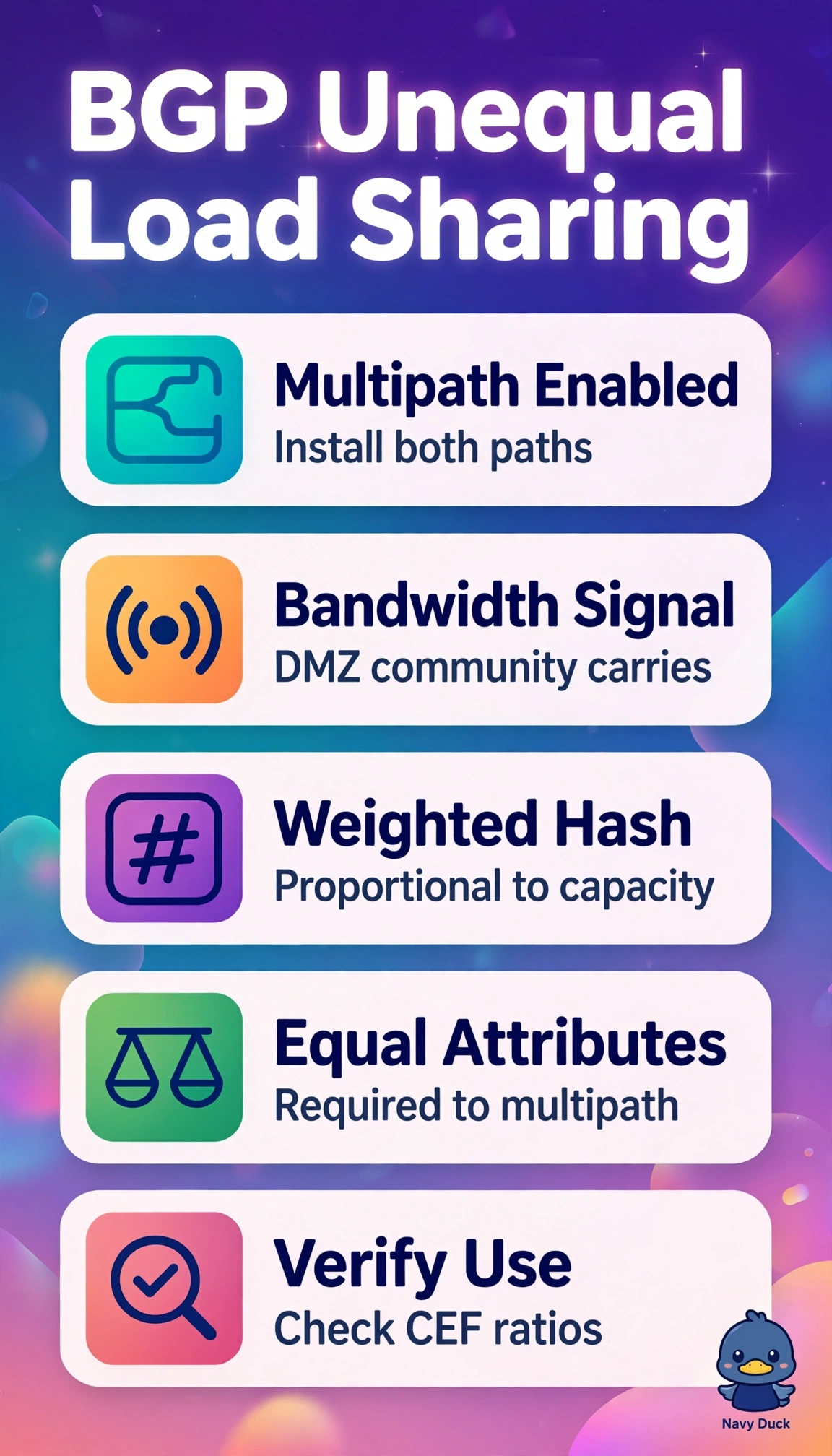
BGP multipath allows installation of multiple equally preferred eBGP paths for load sharing, and the DMZ link-bandwidth extended community propagates the egress interface capacity so the forwarding distribution can be weighted proportionally between 1 Gbps and 400 Mbps links rather than splitting evenly. Equal static defaults fail precision because they ignore BGP best-path state and capacity ratio, often causing equal hashing, polarization, and loss of BGP resiliency and inbound symmetry. Differential AS-path prepending fails direction because prepending influences inbound path selection by remote ASes and does not control local egress forwarding ratios from the border router. Manual prefix splitting with local preference fails efficiency because coarse grouping cannot track capacity proportions dynamically, requires constant retuning as traffic shifts, and increases policy complexity and outage risk. Exam caveat: multipath needs equal BGP attributes to multipath, bandwidth proportion comes from DMZ community. Practical check: confirm both paths installed in BGP and CEF, verify bandwidth community advertised, and measure per-link utilization ratios.