
A healthcare system must interconnect two data centers 80 km apart with sustained 100 Gbps encrypted replication, deterministic latency, and full control of wavelengths for future growth. Packet services share fate and oversubscribe at peak. Which DWDM and leased optical design choice addresses the capacity requirement?
Select an answer to reveal the explanation.
Short Explanation
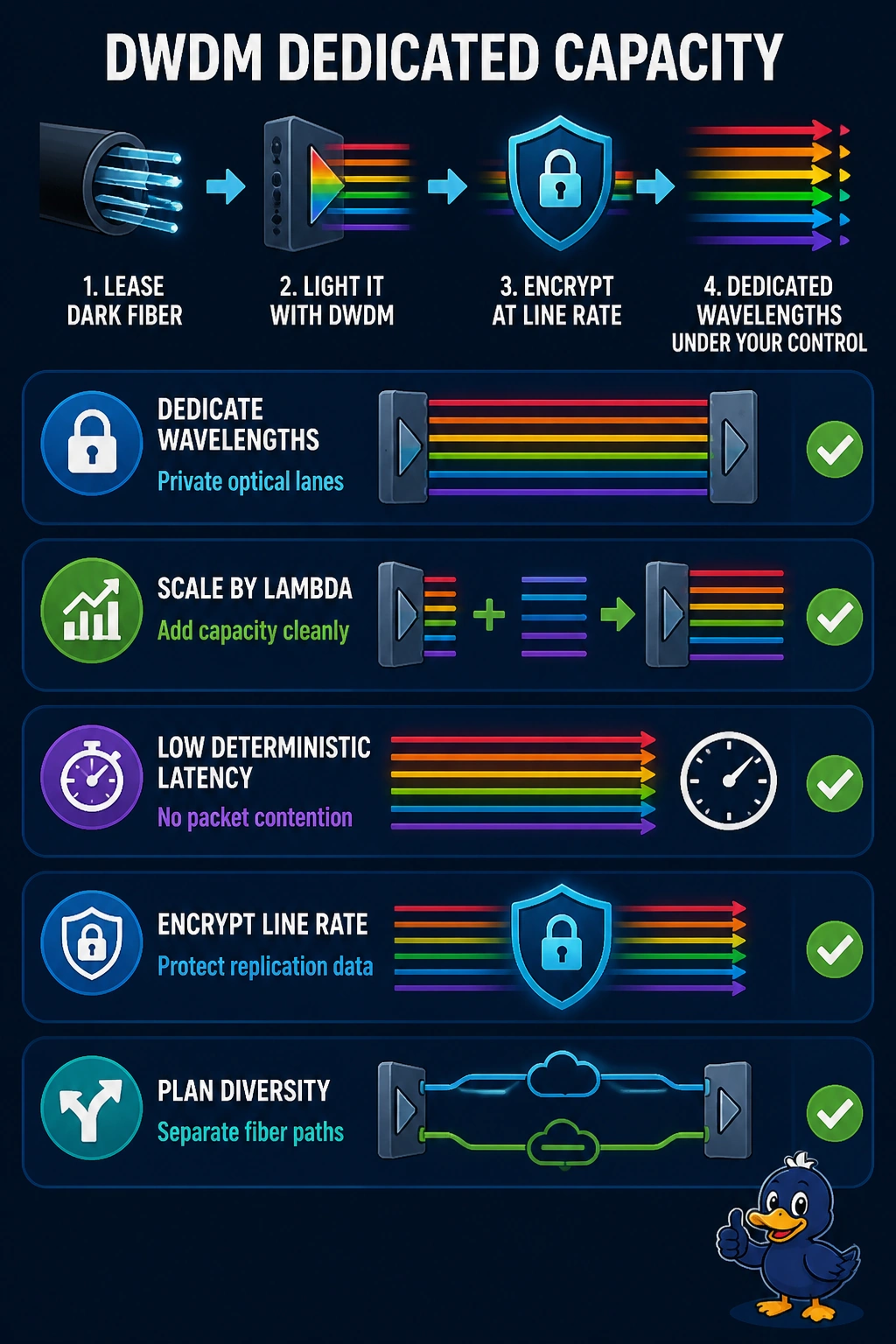
You need a dedicated lane for steady, high-volume replication. DWDM gives you controlled wavelengths for deterministic 100 Gbps capacity that you can expand as your needs grow.
Full Explanation
Leased dark fiber lit with DWDM and encrypted at line rate provides dedicated optical capacity, deterministic latency, sustained 100 Gbps throughput, and control of additional wavelengths for future growth. Unlike shared packet services that can oversubscribe at peak, this design gives you control of the wavelengths carrying replication traffic while protecting it with encryption. A carrier-lit 100G managed wavelength with encryption can provide deterministic replication, but the carrier controls the wavelengths, so it does not meet the requirement for full control and growth. DWDM on leased dark fiber without bulk encryption can provide scalable transport, but it leaves replication traffic unencrypted and fails the stated security requirement. Passive CWDM over dark fiber offers cost-effective transport, but it does not provide the dense channel capacity and reach needed to sustain 100 Gbps over 80 km. Exam caveat: distinguish a managed wavelength service, which supplies capacity, from dark fiber lit with DWDM, which gives you wavelength control. Practical check: verify the 80 km fiber loss budget, confirm the DWDM system supports the required capacity and line-rate encryption, and document how additional wavelengths can be added.