
A retailer connects data centers and 80 branches to workloads in two public cloud regions with steady ERP traffic plus bursty analytics and strict segmentation. Which WAN integration with public cloud regions meets performance and isolation needs?
Select an answer to reveal the explanation.
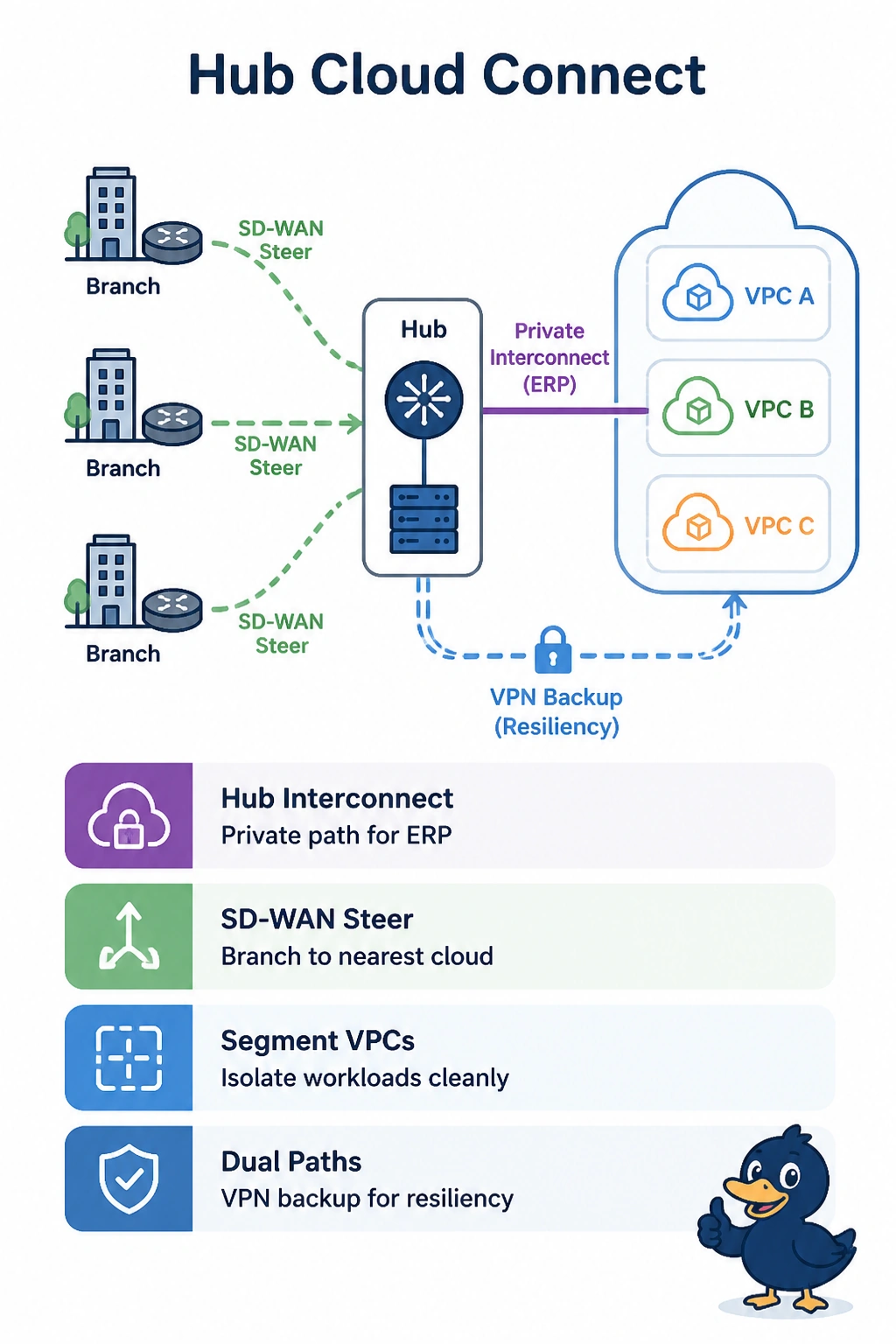
Short Explanation
Anchor steady workloads on private pipes and let branches take smart on-ramps. Hub-based interconnect gives you speed, segmentation, and cleaner bills.
Full Explanation
The correct design succeeds because hub-colocated private interconnects provide dedicated capacity with SLA-backed latency and jitter for steady ERP flows, dual regional attachments keep traffic local to each cloud region to avoid tromboning, while SD-WAN with centralized policy enables dynamic path steering for bursty analytics across broadband, MPLS and interconnect underlays and enforces strict segmentation through VRFs, security zones and cloud route table isolation. A hub design that consolidates all workloads into a flat shared VPC meets performance and steering goals but violates isolation by concept because flat routing allows lateral movement and prevents separate ERP versus analytics policy, failing strict segmentation. A DIA-based SD-WAN design with IPsec and segmented VRFs preserves steering and segmentation logic but fails performance by concept because best-effort internet cannot guarantee throughput and latency for steady ERP, unlike private interconnects. A dual-region interconnect design with static routing and a single table provides private performance but fails agility and isolation by concept because static paths cannot react to bursts and a single table collapses segmentation. Exam caveat: distinguish private Layer 3 interconnect attachment from Layer 2 VLAN stretching, which is deprecated for scale and loop risk. Practical check: validate hub BGP advertisements per VRF, SD-WAN application-aware policies for ERP priority, and per-region interconnect diversity before cutover.