
A regional retailer has 60 small branches with one MPLS link and one router, where a recent carrier cut isolated six stores for hours and the business now wants bounded failure domains and sub-minute recovery for high-revenue sites while keeping small sites cheap. Which single-homed versus dual-homed branch design best balances resilience and cost?
Select an answer to reveal the explanation.
Short Explanation
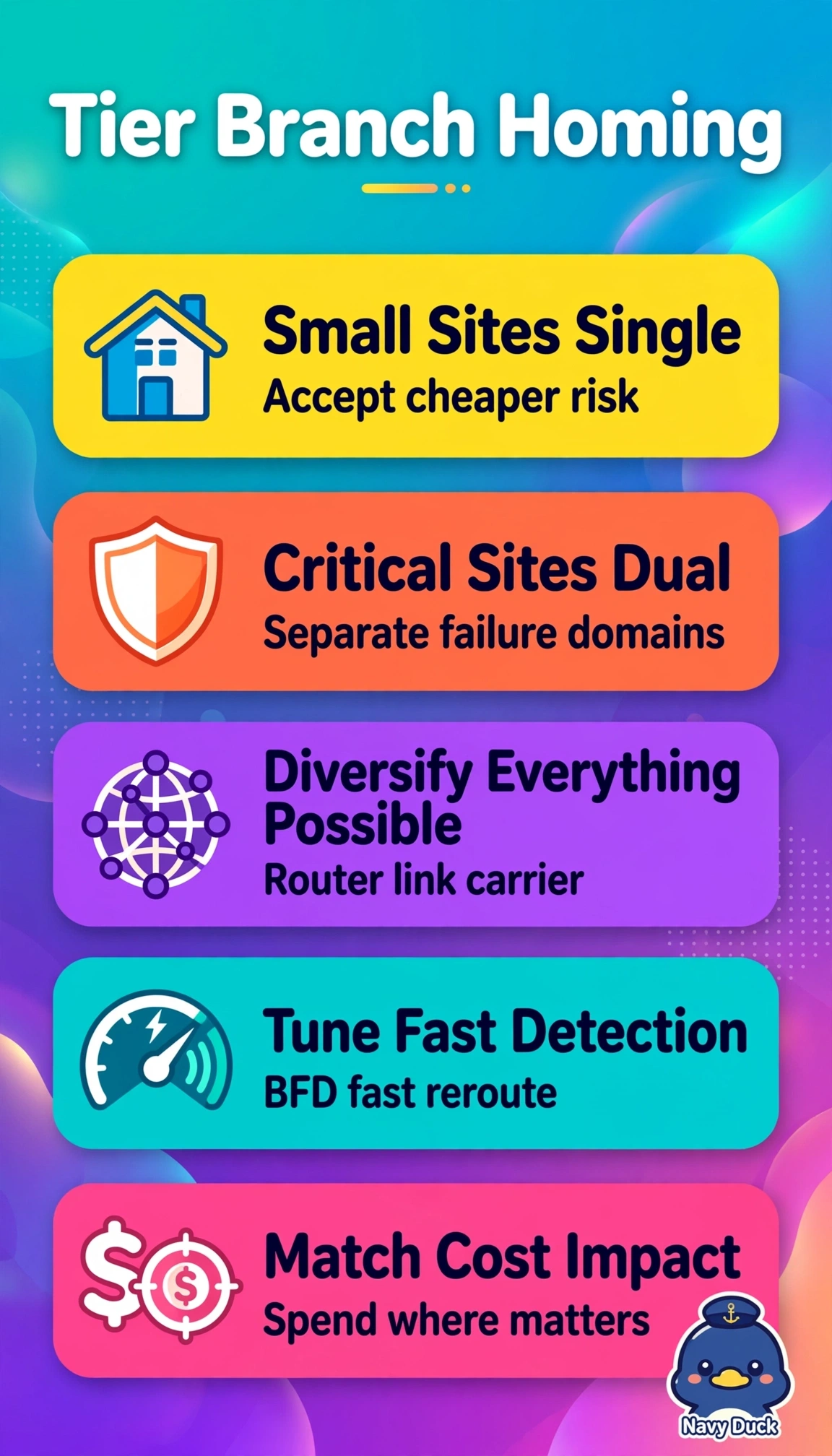
You buy airbags for the race car, not every bicycle. Tiering resilience by revenue bounds blast radius where it hurts, with diversity as the real lifesaver. Same-box, same-carrier dual links still share fate.
Full Explanation
Tiered homing matches failure domains to business impact by retaining cheap single-homed designs where outage tolerance allows it while dual-homing critical sites with diverse carriers, links, and routers for independent failure domains and fast reroute, optimizing cost versus availability. Keeping all branches single-homed fails by concept because it preserves a single point of failure and carrier fate-sharing for high-revenue sites that just demonstrated unacceptable outage cost. Dual-homing every branch fails by concept because it overbuilds resilience where business impact does not justify doubling hardware, carrier, and operational cost. Dual-homing with two links on the same router and carrier fails by concept because it shares router, power, and provider fate, so a single device or carrier event still isolates the site and failure domains are not actually separated. For the exam, remember true high availability requires diversity across device, link, and carrier, and in practice verify routing convergence, BFD timers, and carrier path independence for dual-homed sites.