
A retail chain will interconnect four large multicampus sites across a metro area requiring subsecond failover, bounded latency for voice, and clean summarization boundaries as new stores are added. Existing daisy-chained links cause cascading outages and unpredictable hop counts. Which multicampus Layer 3 interconnect topology best meets resilience and scaling needs?
Select an answer to reveal the explanation.
Short Explanation
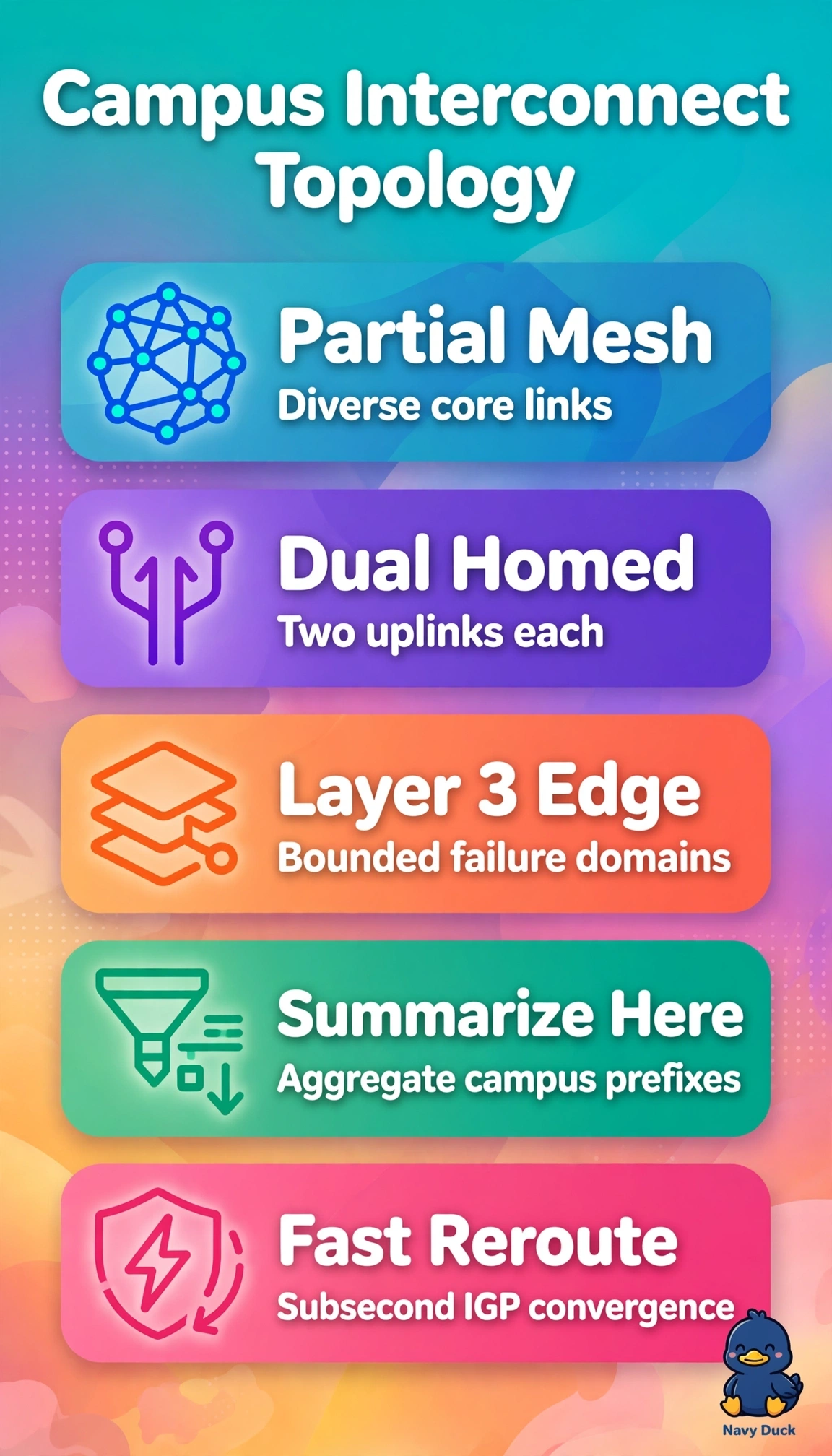
You're giving each campus two strong roads plus clear city limits. Hierarchical partial mesh balances fast reroute and predictable routing without paying for every possible link.
Full Explanation
The resilient partial-mesh core is correct because dual-homing removes any single link or campus node as a cascading failure point while diverse mesh paths with BFD and a tuned IGP or BGP reconverge in well under a second, near-direct paths keep hop count low and jitter bounded for voice when combined with QoS, and hierarchical addressing with summarization at campus boundaries keeps tables and flooding stable as stores are added. The redundant dual-hub design is attractive for growth and policy control but fails the latency requirement by concept because spoke-to-spoke voice must trombone through hubs, adding hops and queuing variation even with centralized QoS. The single-area full-mesh OSPF design offers fast flooding and low hop count but fails scaling by concept because a single area cannot provide summarization boundaries, so every new store prefix increases LSA flooding, SPF load and churn across all large campuses. The dual-homed eBGP mesh with summarization is scalable and redundant but fails timing by concept because reliance on default BGP keepalive and hold timers yields minute-scale detection, not subsecond failover, unless BFD and tuned timers are added. Exam caveat is to separate redundancy from performance guarantees: dual homes or dual hubs alone do not promise bounded latency or fast convergence, look for explicit mesh paths, BFD, summarization and QoS mechanisms. Practical check is to inject single link and node failures in pilot while measuring voice loss, reconvergence time and jitter, and verify only summaries are advertised at boundaries before scaling to new stores.