
A distribution design uses EIGRP over mixed 10G fiber and 1G backup links, requiring controlled use of the backup without equalizing path costs and simplified config across address families. Which EIGRP named mode design with metrics and load-sharing behavior satisfies the requirement?
Select an answer to reveal the explanation.
Short Explanation
You've got a fast highway and a slow side road, so you don't want them treated the same. With variance in named mode, you'll let your 1G backup share load only when it's a loop-free feasible successor within your cost limit.
Full Explanation
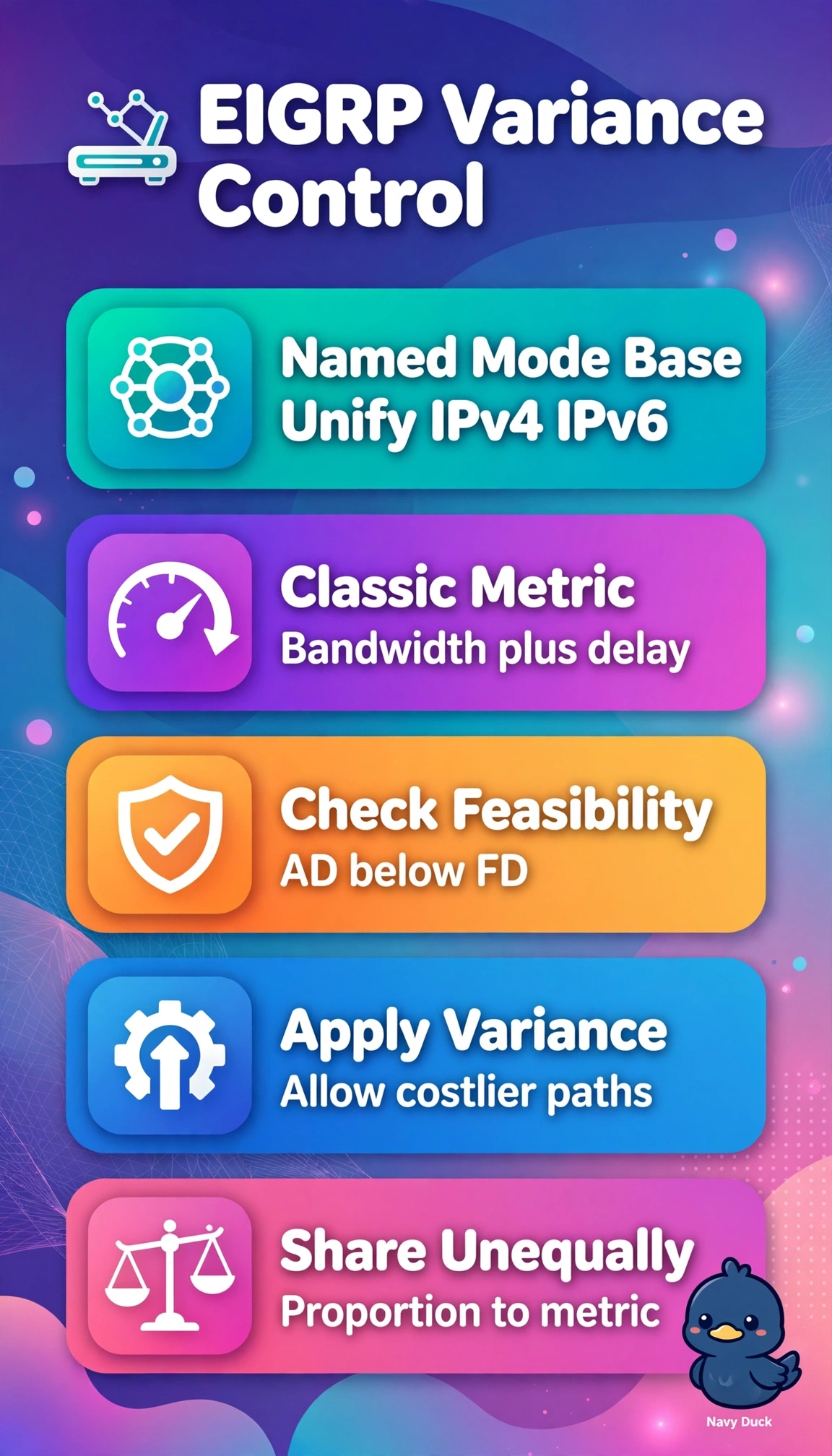
EIGRP named mode unifies IPv4 and IPv6 configuration under address families while preserving classic metrics based on bandwidth and delay, and variance permits unequal-cost load sharing strictly through feasible successors that satisfy the feasibility condition, ensuring loop-free backup use without equalizing costs. Using named mode with equal-cost paths only restricts forwarding to identical-metric paths, which leaves the 1G backup idle and misses the controlled backup-use requirement. Using named mode with maximum-paths raised alone misunderstands the mechanism because maximum-paths only widens the number of parallel paths while variance and feasibility determine eligibility, so raising it alone does not enable unequal-cost sharing. Using classic mode with static redistribution fragments policy, forfeits named-mode hierarchy and address-family simplicity, and relies on administrative distance rather than EIGRP feasibility for loop prevention. On the exam, link variance to feasible successors and feasibility condition, never to arbitrary neighbors, and in practice verify delay tuning, variance multiplier, and traffic-share behavior before activating backups.