
A media company streams a CEO broadcast from one encoder to 500 branch receivers with sparse membership, plus a few dense trading-floor feeds needing shortest-path delivery. Bandwidth and join latency matter. Which multicast design using source versus shared trees and PIM sparse mode fits these flows?
Select an answer to reveal the explanation.
Short Explanation
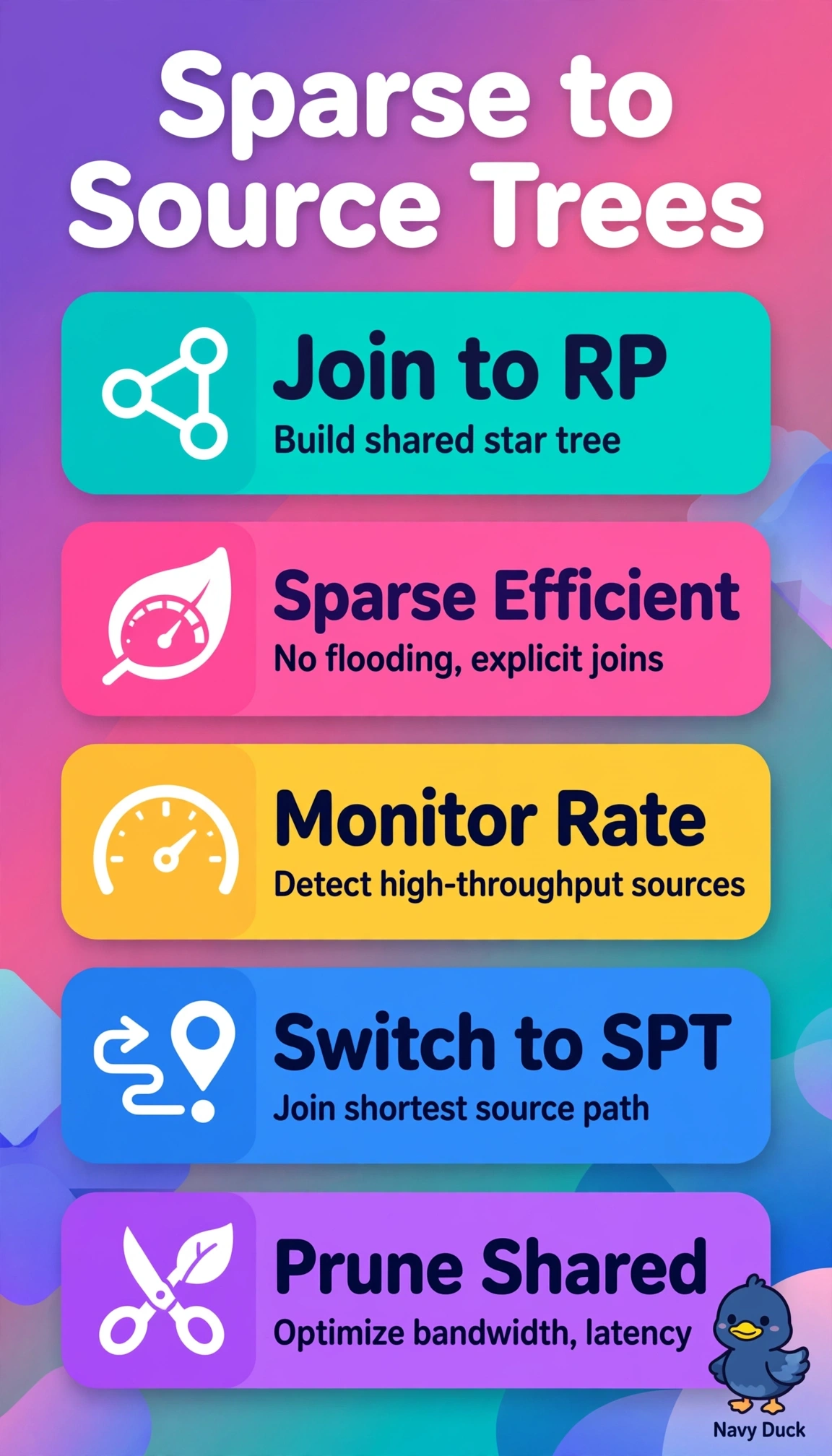
You don't need a private highway for every viewer at first. Starting on a shared meeting-point tree then moving heavy hitters to direct paths balances scale and speed. Lean on shared to source switchover.
Full Explanation
PIM sparse mode uses explicit joins toward a rendezvous point on a shared (,G) tree for sparse receivers, conserving state and bandwidth, then typically switches high-throughput flows to (S,G) source trees for shortest-path forwarding, which suits both a large sparse broadcast and demanding local feeds. Staying forever on the shared tree forces suboptimal paths through the rendezvous point and risks congestion. Dense mode floods everywhere then prunes, which wastes bandwidth across 500 branches with few receivers and scales poorly. Building source trees immediately for every receiver maximizes state and control overhead without benefit for idle or low-rate groups. For the exam, link shared trees to (,G) and rendezvous efficiency, and source trees to (S,G) shortest-path optimality with SPT switchover. In practice, check rendezvous placement, redundancy, and SPT thresholds on high-rate streams.