
A retail chain has a single 10.20.0.0/16 block to number 80 point-to-point WAN links and 30 store server VLANs with up to 45 hosts each, and must reserve room for growth without requesting more space. The design must minimize waste on links while keeping server broadcast domains efficient. Which VLSM plan for point-to-point and server links best conserves addresses?
Select an answer to reveal the explanation.
Short Explanation
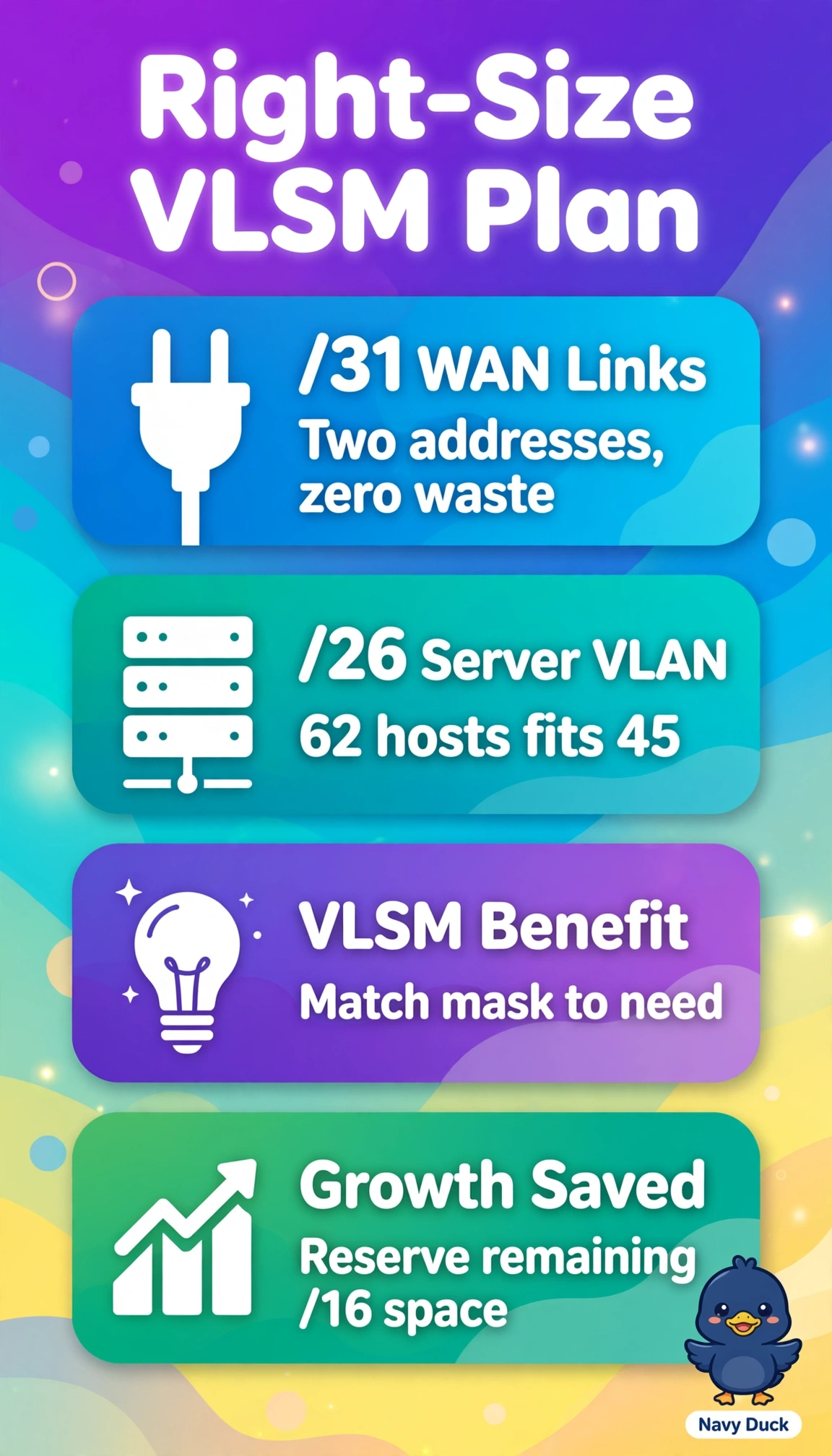
You're stretching one block across lots of links, so every spare address counts. Fitting tiny links with /31s and right-sized server blocks with /26s keeps waste low without starving hosts. That careful fit is right-sizing, like packing boxes that just fit instead of using huge crates.
Full Explanation
A /31 provides exactly two usable addresses with no network or broadcast address per RFC 3021, which is ideal for a true point-to-point link needing only two router interfaces, while a /26 provides 62 usable host addresses, which closely fits the stated need for up to 45 hosts per server VLAN with modest growth and limited broadcast overhead. This combination consumes only 160 addresses for 80 links plus about 1920 addresses for 30 server VLANs, preserving most of the /16 for future growth. Using /30 subnets for point-to-point links fails by concept because it consumes four addresses per link and doubles the waste compared with /31 while providing no functional benefit on modern point-to-point links. Using /25 subnets for server VLANs fails by concept because it allocates 126 usable hosts per VLAN, far beyond the 45-host need, and quickly exhausts the limited block when multiplied across 30 stores. Using /27 subnets fails by concept because it provides only 30 usable hosts, which cannot accommodate 45 hosts and would force renumbering or secondary subnets. For the exam, remember /31 is preferred for point-to-point conservation and server VLANs should use the smallest mask that fits hosts plus growth, and in practice verify router /31 support and reserve contiguous blocks for summarization before assigning VLANs.