
A logistics firm with 60 sites needs any-to-any branch routing, centralized Internet breakout, and minimal in-house routing operations. The carrier offers a managed MPLS Layer 3 VPN and a Layer 2 VPLS service. Scale and staffing drive the decision. Which WAN choice correctly reflects routing ownership and scaling for this enterprise?
Select an answer to reveal the explanation.
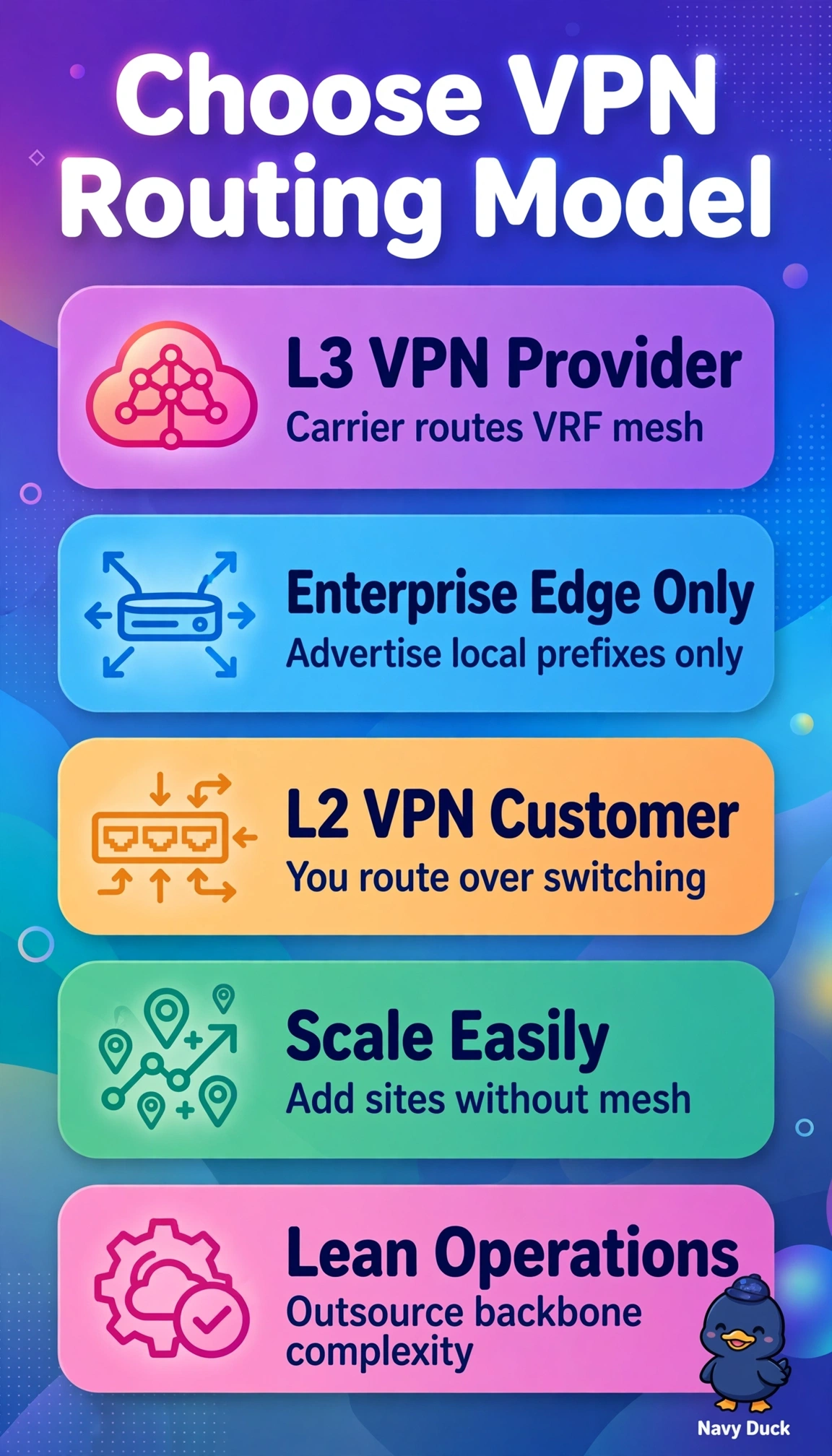
Short Explanation
Routing ownership decides who gets paged at 2 a.m. With Layer 3 VPN the carrier handles the mesh and you just hand off routes, like outsourcing highway maintenance. Keep provider routing in mind for lean teams.
Full Explanation
In an MPLS Layer 3 VPN the provider maintains VRFs, MP-BGP, and PE-CE routing, so the enterprise only manages CE peering and its own prefixes, which scales any-to-any connectivity and offloads backbone operations ideal for a lean staff with centralized breakout. A Layer 2 VPN leaves all routing to the enterprise over a switched service, requiring the customer to design, scale, and troubleshoot full-mesh or hub-spoke routing and broadcast behavior. Expecting provider routing over a pure Layer 2 service confuses the models, because VPLS provides Ethernet switching, not IP VPN routing. Running full enterprise IGP end to end over a Layer 3 VPN defeats the offload benefit and adds complexity without control gains. For the exam, link Layer 3 VPN to provider-owned routing and VRF scaling, and Layer 2 VPN to customer-owned routing. In practice, confirm PE-CE protocol options, route-target design, and who filters and summarizes at the edge.