
A two-tier campus core uses two Catalyst chassis with dual 40G interconnects, requiring sub-second gateway and link failover for 1,000 users without tuning FHRP timers. Complexity and dual control planes must be reduced. Which platform abstraction choice removes the need for an FHRP in this design?
Select an answer to reveal the explanation.
Short Explanation
Two boxes acting as one simplifies your life. StackWise Virtual merges control planes like twins sharing one brain, so one gateway IP needs no FHRP dance.
Full Explanation
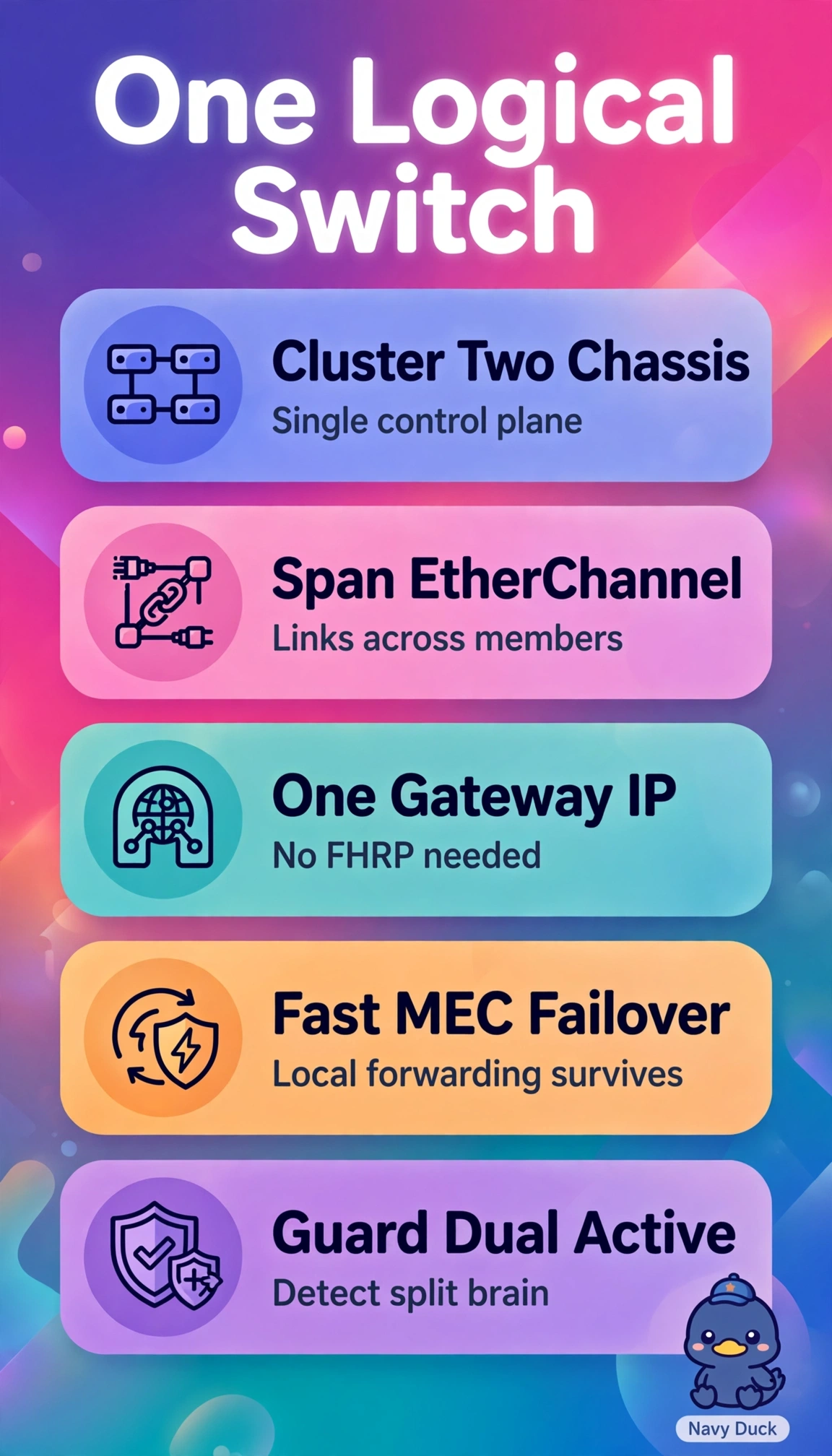
Virtualizing the pair with VSS or StackWise Virtual creates one logical switch with a single control plane, one gateway address, and multichassis EtherChannel over the dual 40G links, eliminating FHRP peering while SSO and NSF deliver sub-second gateway and link failover for 1000 users without timer tuning and reducing spanning-tree and management complexity. Keeping independent chassis with standard first-hop redundancy offers familiar gateway resilience but retains dual control planes and default hello and hold timers that converge in seconds, so it fails the sub-second without tuning and simplification requirements and still needs FHRP. Adding standby redundancy atop a virtualized pair is a common resilience habit but reintroduces peering and state that serve no purpose when the virtual switch already provides one highly available gateway, violating the remove-FHRP requirement. Moving to routed links with ECMP and BFD achieves excellent sub-second Layer 3 convergence without a shared gateway, yet it is a routing redesign that keeps two control planes and separate management, missing the required platform abstraction to one logical switch. For exams, separate true single-control-plane virtualization that removes FHRP from dual-control-plane peer-link designs that still need it; practically confirm with show stackwise-virtual, show redundancy, and sustained gateway pings during an active supervisor switchover to validate loss time and MEC behavior.