
A hospital has a central campus with data center external routes and 40 small clinics with single ABRs, stub routers and no local ASBRs, where clinic routers have limited memory and need minimal LSAs plus a default exit. Which OSPF multi-area design with area types best scales the clinics while preserving data center reachability?
Select an answer to reveal the explanation.
Short Explanation
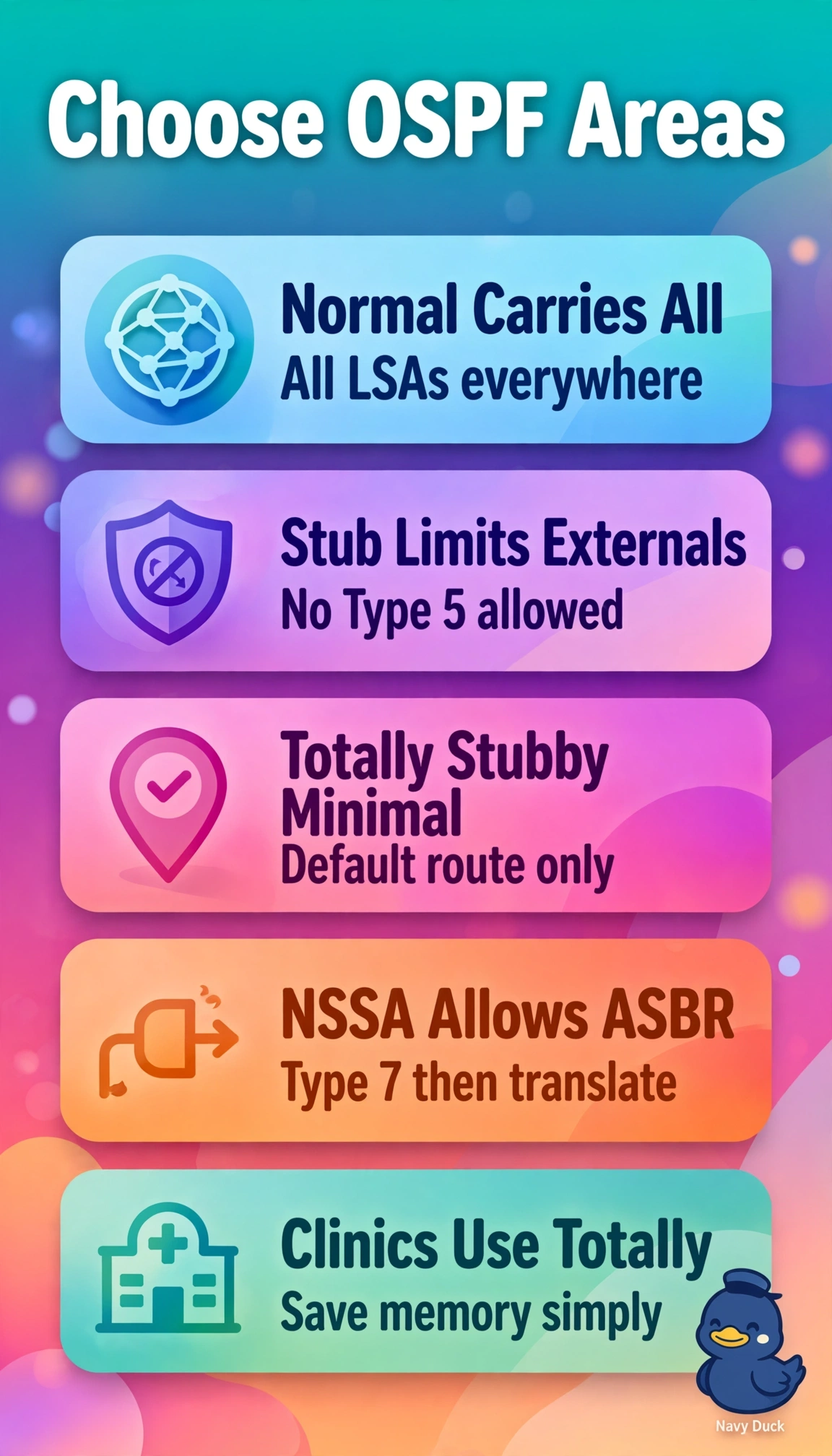
You're keeping those little clinic routers happy by giving them just an exit sign instead of the whole highway map. Make each clinic a totally stubby area so its ABR hands out only a default route, and you'll keep memory lean with full reach to the data center without the LSA clutter.
Full Explanation
Totally stubby areas are optimal here because the single ABR blocks Type 3 inter-area and Type 5 data-center externals while injecting only a default route, which minimizes database and memory load on constrained clinic routers while preserving full reachability via the ABR next hop. The stub design retaining inter-area summaries fails the minimal-LSA need because Type 3 summaries for campus and other clinics still flood all 40 areas, leaving significant overhead compared to default-only forwarding. The NSSA design with Type 7 translation fails the no-local-ASBR fact because NSSA exists to import and translate clinic-local externals, adding unneeded configuration and troubleshooting complexity when no redistribution is planned. The dual-ABR totally stubby design fails the single-ABR constraint because a second ABR changes flooding, default redundancy and cost assumptions explicitly excluded for these small sites. On exams distinguish stub which blocks Type 5, totally stubby which blocks Type 3 and 5, and NSSA variants which allow Type 7, since default origination is the usual discriminator. Practically verify with show ip ospf database for only router, network and default summaries plus show ip route for the default via the ABR and compare memory before and after.