
A bank campus expands OSPF across new fiber links that include broadcast Ethernet segments and point-to-point dark fiber, with strict requirements to block spoofed adjacency formation and to reduce DR election delays on stable links. Which OSPF authentication and network type combination secures and stabilizes the design?
Select an answer to reveal the explanation.
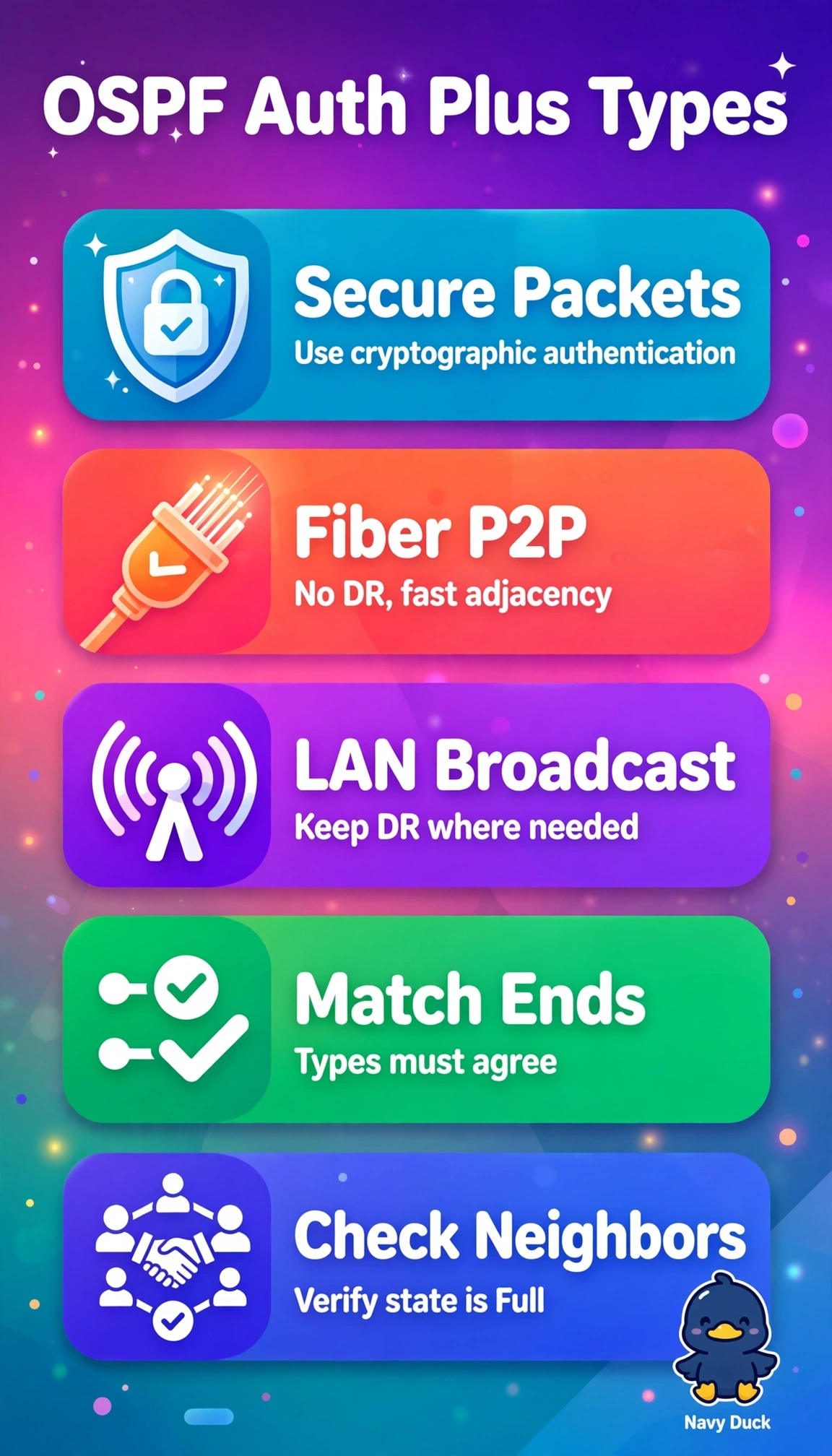
Short Explanation
You'll want cryptographic authentication to keep spoofed neighbors off your fiber, like a secret handshake just for your routers. You'll also calm things down by setting your quiet dark fiber to point-to-point and saving broadcast for where you've really got multiple neighbors talking.
Full Explanation
Cryptographic message-digest authentication validates every OSPF packet to prevent spoofed hellos and adjacency hijacks, while matching network type to media lets point-to-point dark fiber form adjacency without DR and BDR election and retains broadcast type only where true multi-access Ethernet needs designated router function. Null authentication with all-broadcast fails by concept because although it simplifies deployment, it leaves adjacencies unauthenticated and forces unnecessary DR elections on point-to-point fiber. Plain-text with NBMA fails by concept because clear-text keys are easily captured and NBMA behavior adds manual neighbor and polling overhead inappropriate for native Ethernet and fiber. Cryptographic with ubiquitous virtual links fails by concept because virtual links are a transitional backbone repair tool, not a general design type, and overuse complicates topology and stability. For the exam, remember authentication must match per area or interface and network type controls hellos and DR behavior, and in practice verify with show ip ospf interface and neighbor states after enabling digests.