
A manufacturer uses Cisco SD-WAN across MPLS and Internet underlays with voice, ERP, and regional video feeds needing prioritization and efficient delivery. Which QoS and multicast design suits traffic treatment over the SD-WAN fabric?
Select an answer to reveal the explanation.
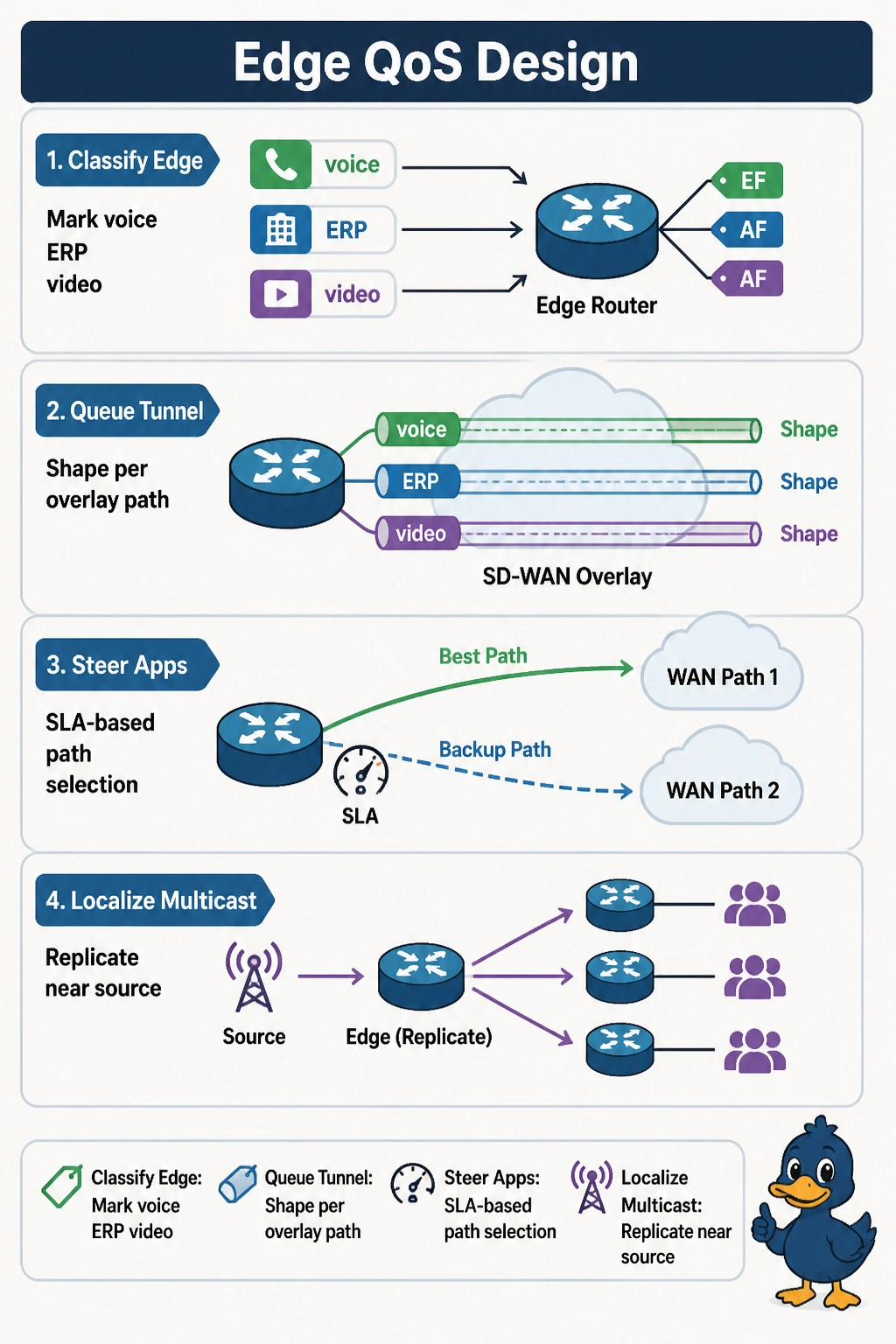
Short Explanation
You've got no control over the middle of the Internet, so you'll handle the important stuff right at your doorstep. It's like sorting packages before they leave your porch, with edge queuing giving voice first dibs while local multicast keeps video from clogging your tunnels.
Full Explanation
Cisco SD-WAN enforces QoS on edge routers through classification, queuing, shaping and application-aware routing per tunnel, because underlay DSCP treatment is inconsistent across MPLS and Internet and controllers do not forward data-plane traffic. Cisco SD-WAN carries multicast over the unicast IPsec overlay using overlay multicast routing, with replication performed at designated WAN Edge replicators rather than native underlay multicast, which preserves bandwidth and avoids depending on the transport. Relying on provider queuing end to end fails when Internet transport re-marks or ignores DSCP and when path selection changes tunnels dynamically. Forwarding native multicast transparently across Internet tunnels assumes underlay multicast support that public Internet transport does not provide, whereas SD-WAN replicates multicast over the unicast overlay. Centralizing queuing in controllers confuses control and data planes because Manager and Controller distribute policy but edge devices apply scheduling and drops. Exam caveat: choose edge-applied QoS plus explicit multicast placement. Practical check: map voice and ERP to forwarding classes at WAN edges, verify tunnel SLA steering, and document where multicast sources and receivers meet.