
A manufacturer connects its data center to two different ISPs for high availability and must keep voice and ERP outbound on the low-latency ISP during normal operation while allowing inbound customers to reach its public prefix through either ISP if one fails. Which multihomed BGP inbound and outbound path control design provides resilient high availability?
Select an answer to reveal the explanation.
Short Explanation
You're managing two doors separately so one jam doesn't block the building. Policy separation lets local preference handle your exits while prepending and prefix design handle how the world enters.
Full Explanation
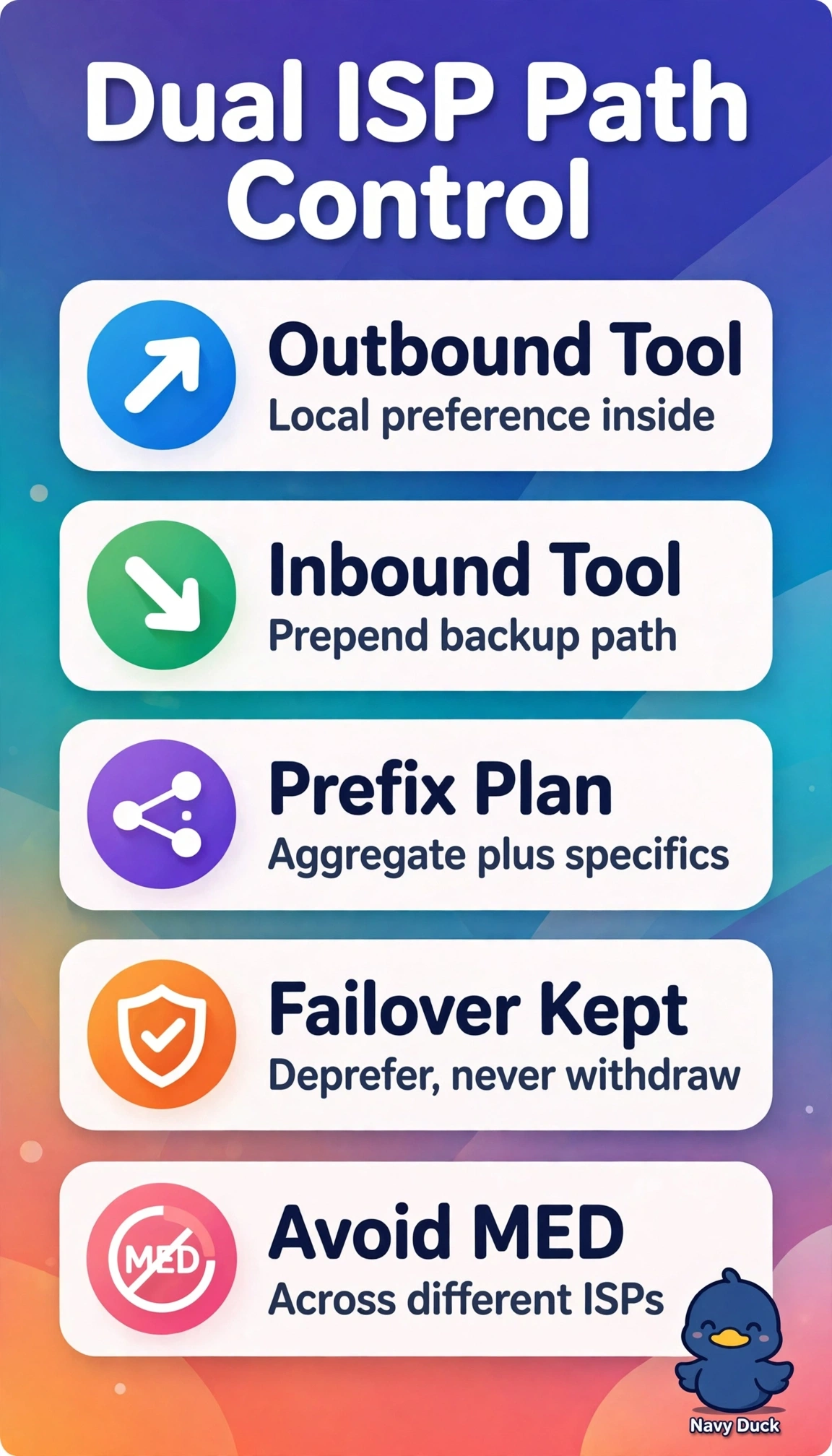
Outbound control belongs inside the enterprise where local preference deterministically prefers the low-latency ISP across all iBGP speakers, while inbound control must signal to the Internet where AS-path prepending de-preferences one entry without withdrawing it, preserving it for failover, and careful origination of aggregate plus more-specific prefixes enables traffic engineering and fast convergence. Relying only on MED fails scope because MED is compared at best between links to the same neighboring AS and is commonly reset or ignored between different ISPs, so it cannot guarantee either direction across two providers. Accepting only default routes plus weight fails both scale and direction because weight is local to one router and inbound Internet routers never see it, leaving inbound failover dependent on ISP behavior rather than enterprise advertisement design. Prepending equally on all paths plus removing local preference fails intent because equal prepending provides no preference signal and loss of local preference leaves outbound selection to arbitrary tie-breakers, causing unpredictable voice quality and suboptimal failover. Exam caveat: match attribute scope to direction, local preference outbound and prepending or communities inbound. Practical check: confirm primary and backup paths appear in BGP tables and test ISP failure to validate withdraw and reroute timing.