
A university distribution block has two Catalyst gateways serving 800 hosts in one VLAN, requiring subsecond failover and active load sharing across both uplinks. Multivendor firewalls in the VLAN act only as hosts using the virtual gateway address, so only the Catalyst pair participates in first-hop redundancy. Which first-hop redundancy choice best balances load sharing and failover for this VLAN?
Select an answer to reveal the explanation.
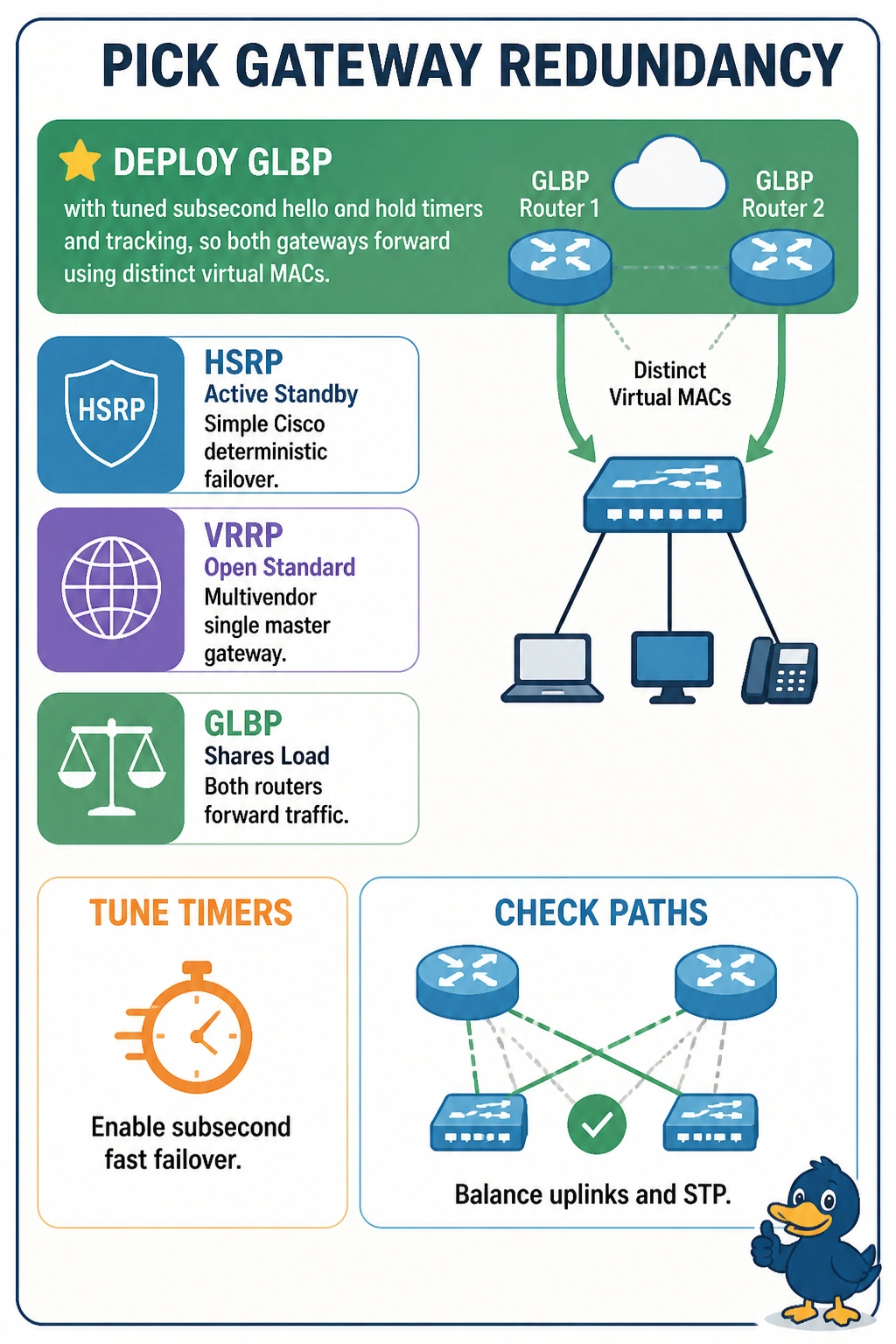
Short Explanation
You've got 800 hosts counting on you, so you'll want both uplinks working at once. GLBP gives you that load sharing while still covering failures, like having two cashiers open instead of one waiting on break.
Full Explanation
GLBP fits this Catalyst block because its Active Virtual Gateway answers host ARP requests with different Active Virtual Forwarder virtual MACs, distributing 800 hosts across both uplinks at once, while tuned millisecond hello and hold timers plus object tracking provide subsecond failover without host changes. Because the firewalls are ordinary hosts that only use the virtual gateway IP, GLBP's Cisco-proprietary nature does not affect them; only the two Catalyst gateways run the protocol. HSRP with a single active gateway is deterministic and simple, but it leaves the second uplink idle, so it fails the active load-sharing requirement unless extra groups are manually staggered. VRRP with one master is the open-standard choice, yet a single group elects one forwarder, so it also leaves the second uplink idle and fails simultaneous load sharing. GLBP with a single forwarder and default timers (3-second hello, 10-second hold) fails twice: it forgoes load sharing and cannot meet subsecond detection. Exam caveat: distinguish simultaneous forwarding from standby readiness, and check whether timers were tuned, since defaults never satisfy subsecond targets. Practical check: inspect show glbp, confirm both forwarders are active with distinct virtual MACs in host ARP tables, and measure ping loss during a gateway reload.