
A retailer has four regions with 30 stores each and dual distribution switches per region back to a campus core. Growth requires adding stores without renumbering and keeping core tables small. Which hierarchical IPv4 allocation enables clean route summarization at distribution boundaries?
Select an answer to reveal the explanation.
Short Explanation
You win by keeping addresses neighborly, so each region shouts one route upward. That tidy grouping is summarization working like zip codes for whole neighborhoods.
Full Explanation
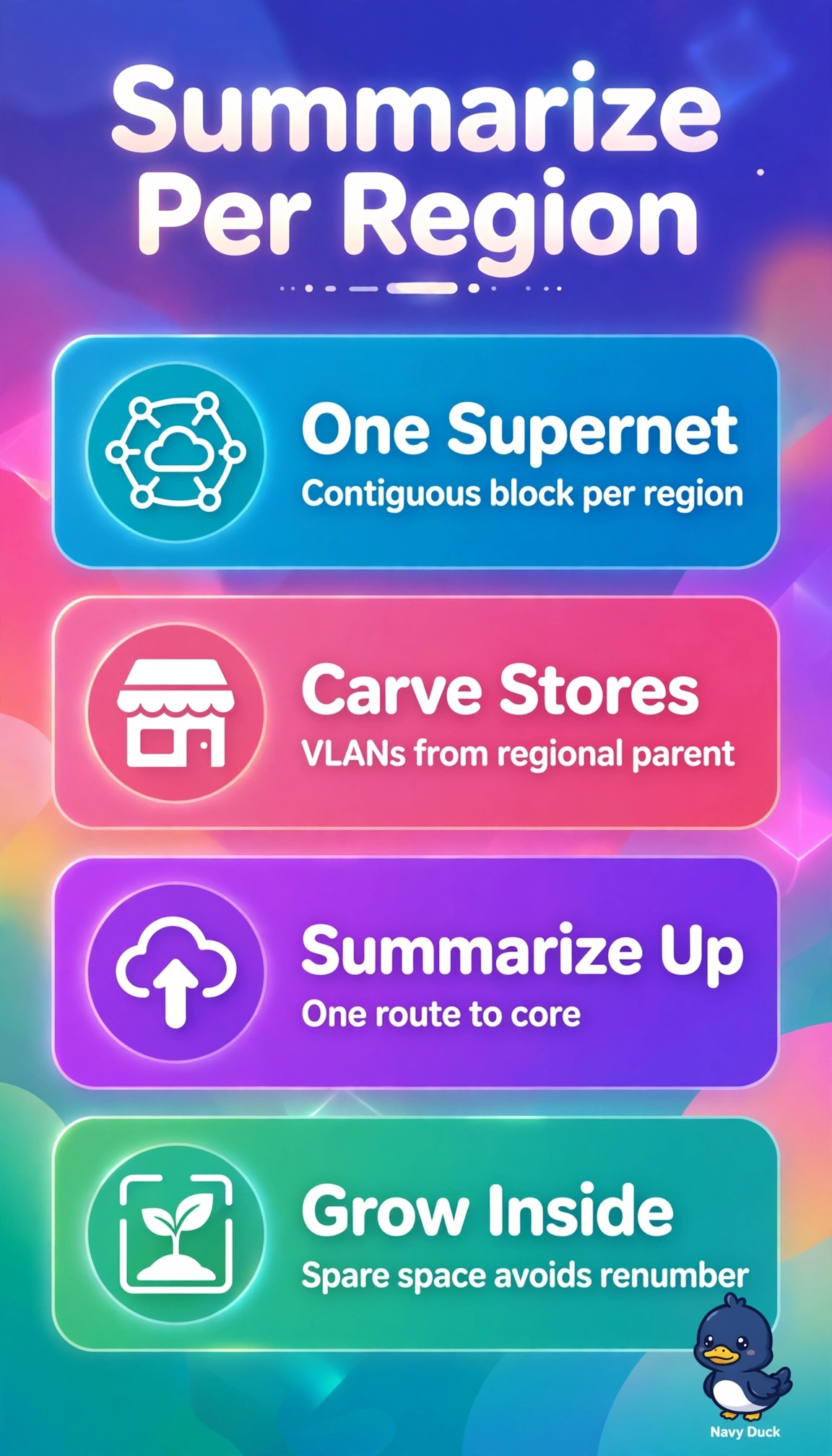
The correct allocation succeeds because a contiguous supernet anchored to each region aligns addressing with topology, so the dual distribution layer can advertise a single aggregate toward the core while still carving distinct VLAN subnets for local stores, which keeps the core table to four regional routes and leaves unassigned space inside each block for new stores without renumbering or redistribution changes. Announcing the regional summary while also leaking store specifics for optimized routing undermines that benefit by reintroducing more-specific prefixes into the core, a valid traffic-engineering technique that directly violates the small-table requirement through prefix bloat and increased churn during flaps. Sizing each store VLAN tightly to preserve IPv4 space is operationally sound for conservation and still permits clean summarization, yet it fails the growth requirement because any store expansion beyond the exact-fit mask forces resizing and renumbering of VLANs, DHCP scopes, and ACLs. Carving sequentially per new store from one campus-wide supernet simplifies central tracking and is common in small flat networks, but it disperses each region stores across noncontiguous space and prevents a single meaningful aggregate at the distribution boundary, forcing many advertisements or awkward filters. For exam purposes, remember that requirements favoring minimal core state outweigh more-optimal path selection whenever summarization is explicitly requested, so prefer hiding detail over leaking detail. As a practical check, inspect the core routing table to confirm only the four regional aggregates appear and audit the IP plan to confirm each region retains spare store blocks plus VLAN growth slack before approving deployment.