
A university has three large campuses linked over Layer 3 cores with OSPF, and a link flap in one building currently floods LSAs everywhere and destabilizes all campuses. Each campus must hide internal topology and advertise only aggregates while blocking rogue subnets at borders. Which route summarization and filtering design best stabilizes the multicampus boundaries?
Select an answer to reveal the explanation.
Short Explanation
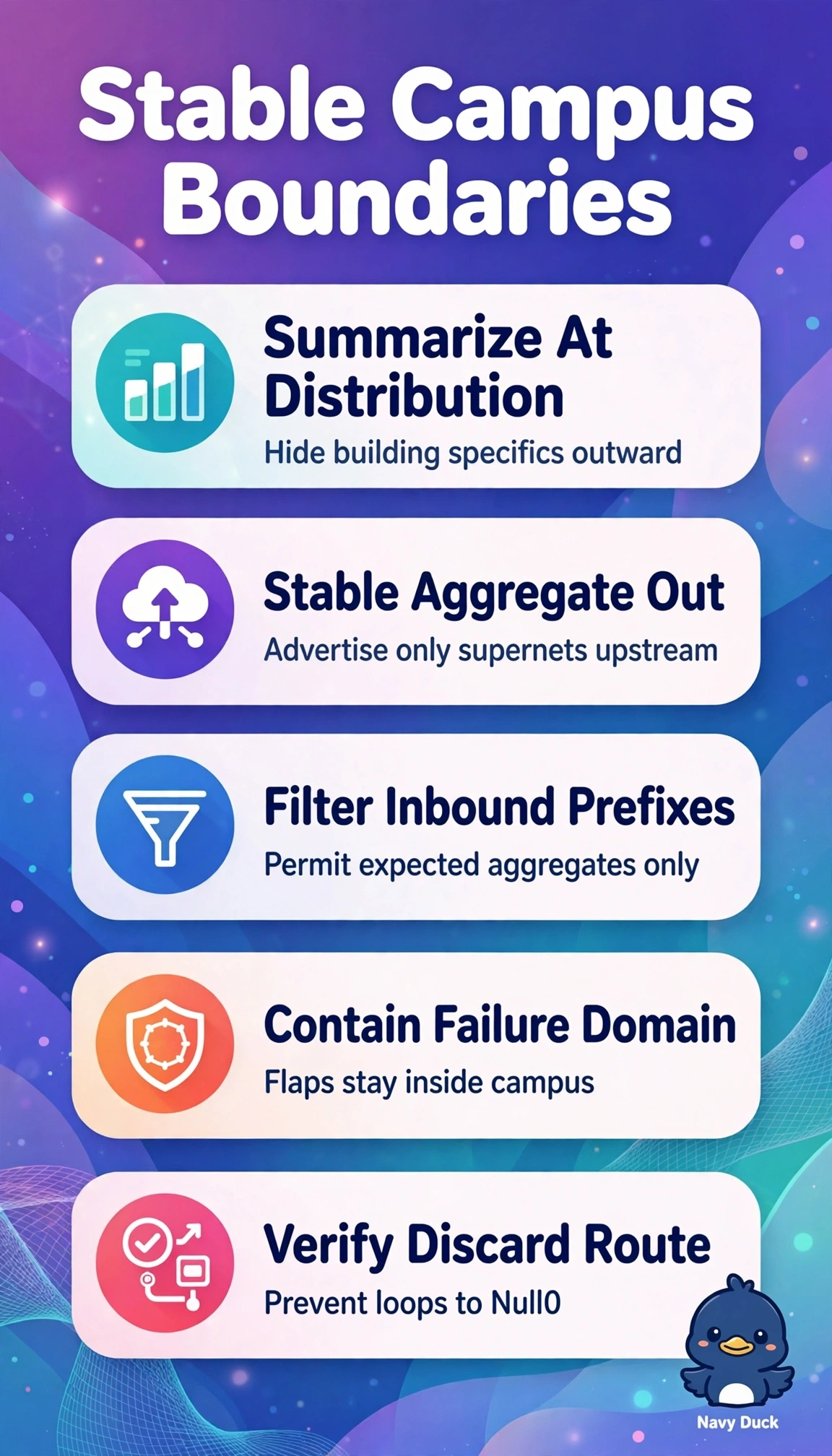
You win by choking chatter at the border, not in the basement. Summarizing at distribution keeps flaps local, like soundproofing each rehearsal room with aggregation. Filtering there stops stragglers from leaking across campuses.
Full Explanation
Summarization at the campus distribution or boundary toward the core contains topology changes because more-specific flaps are hidden behind a stable aggregate, reducing LSA flooding, SPF runs, and routing table size across campuses, while inbound prefix-list filtering at the same boundary enforces address policy and blocks unexpected or rogue more-specifics. Summarizing only at the central data center core fails by concept because failures still traverse campus-to-campus links and every campus still sees all instability before aggregation occurs. Filtering inside the access layer fails by concept because access switches lack topological vantage and CPU to enforce inter-campus policy, and originating defaults outward breaks optimal egress and hides reachability detail needed locally. Advertising every /24 everywhere for optimal pathing fails by concept because it maximizes control-plane load and blast radius for zero stability benefit, with filtering only during failures being reactive rather than designed containment. For the exam, remember summarization hides instability but does not replace filtering for policy, and in practice verify aggregates cover only allocated space and that discarded component routes still have local discard to prevent loops.