
A university distribution block has two Layer 3 switches serving 400 wired hosts in one VLAN, both with equal-cost uplinks to the core. The design requires automatic gateway failover, continued use of both uplinks during normal operation, and no host-side changes. Which first-hop redundancy choice meets the load-sharing requirement?
Select an answer to reveal the explanation.
Short Explanation
You nailed the giveaway: both uplinks must forward at once. GLBP works like two cashiers sharing one line, so traffic balances while failover stays invisible to hosts.
Full Explanation
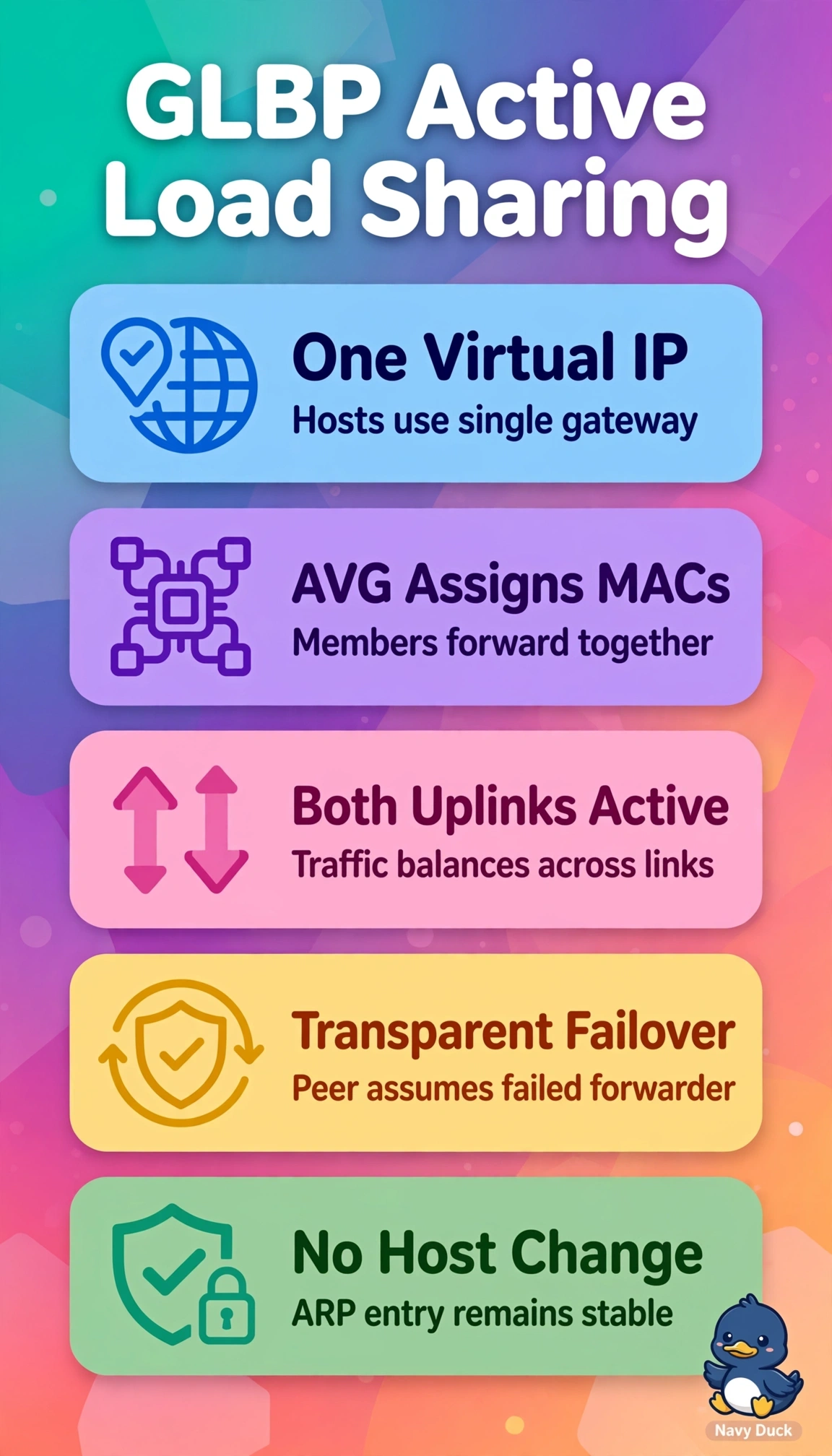
GLBP elects an Active Virtual Gateway that assigns different virtual MACs to group members, allowing both distribution switches to forward simultaneously while presenting one virtual IP to hosts, which directly satisfies the requirement to use both uplinks and fail over without host changes. Deploying HSRP with one active gateway provides deterministic failover and preemption but forwards through only one device at a time, leaving the second uplink idle for routed traffic and missing the load-sharing requirement. Deploying VRRP with a single virtual address provides standards-based multivendor failover with backup priority, yet like HSRP it operates active-standby for a given virtual address and does not natively load-balance across gateways. Deploying HSRP with interface tracking and tuned timers improves failure detection and failover speed on uplink loss but still preserves the active-standby forwarding model and therefore fails the stated need to utilize both paths concurrently. On the exam, remember HSRP and VRRP solve availability while GLBP adds active-active forwarding, and in practice verify load-balancing method, weighting, and that spanning-tree and routing costs actually permit both paths to be used.