
A retail enterprise runs OSPF across 300 stores with a flapping IoT VLAN causing repeated SPF calculations and high CPU, plus hundreds of unneeded transit link addresses bloating the RIB. Convergence must stay fast for real failures while damping instability and hiding infrastructure prefixes. Which OSPF LSA throttling, SPF timer and prefix suppression design meets all requirements?
Select an answer to reveal the explanation.
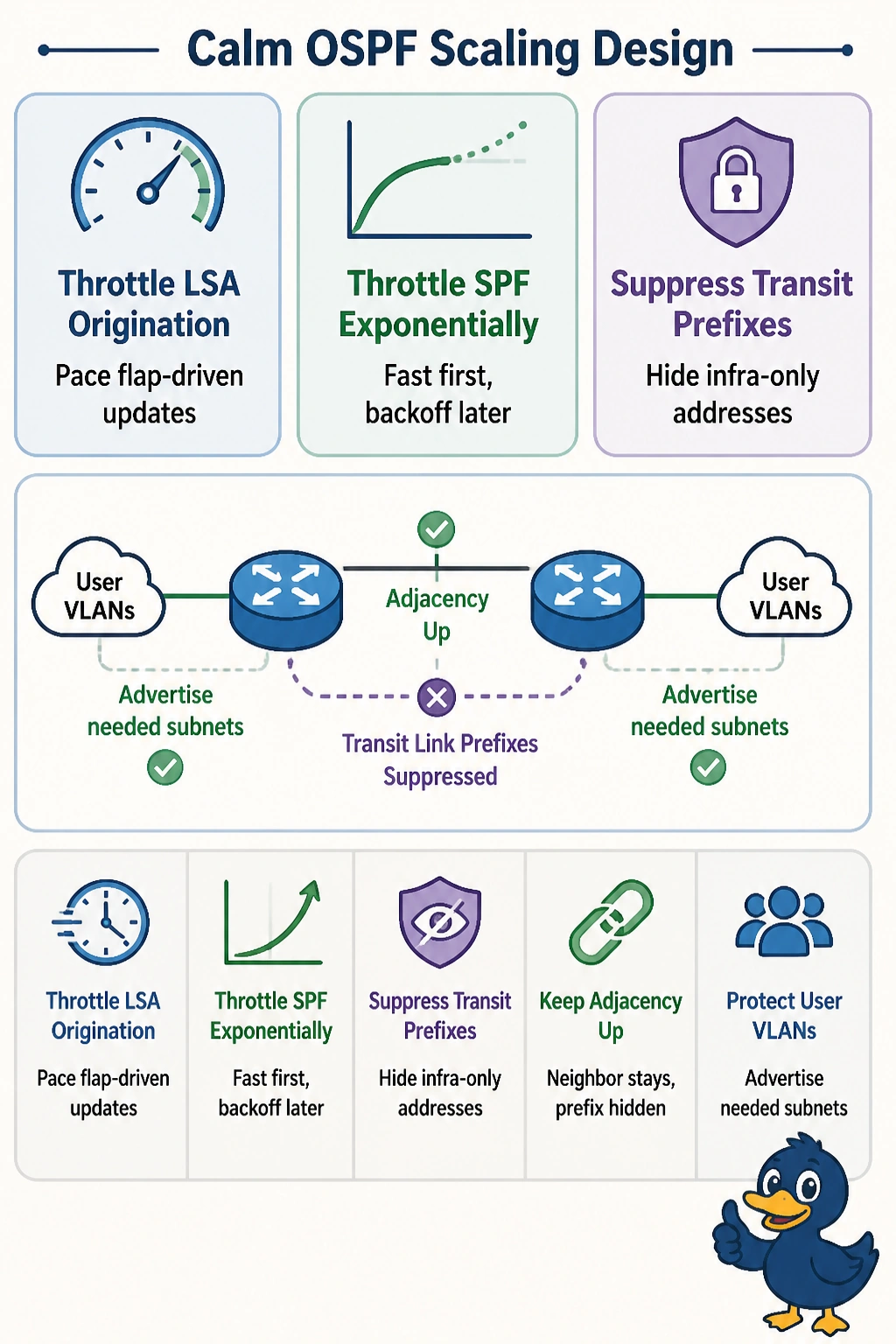
Short Explanation
You want shock absorbers, not a hair trigger. Exponential backoff still reacts fast at first, then calms flaps, while prefix-suppression hides those noisy transit links.
Full Explanation
The correct design works because exponential LSA throttling with hold and maximum intervals paces LSA origination during a flap storm, exponential SPF throttling runs SPF quickly for the first event then backs off to protect CPU while preserving fast convergence for isolated failures, and prefix-suppression on transit-only point-to-point links keeps OSPF adjacency up while withholding the interface prefixes to shrink LSAs, RIB and churn. Fixed short timers fail by concept because static aggressive pacing never adapts and forces full SPF on every flap, trading stability for marginal speed. Advertising every transit address fails by concept because retaining infrastructure host and link prefixes preserves bloat and update load despite correct timer damping. Applying prefix-suppression to user VLANs fails by concept because suppressing prefixes that endpoints need removes reachability even though timers and transit hiding are correct. For the exam, remember throttling delays computation without dropping topology information, unlike filtering, and in practice confirm with show ip ospf timers rate-limit and verify suppressed prefixes still allow neighbor formation but no longer appear as stub links.