
A stadium with 15,000 fans needs efficient IPTV delivery in an SD-Access fabric where the zones are separate fabric sites, some of which lack underlay multicast support, and RP reachability varies by zone. Which multicast design chooses head-end versus native forwarding for this fabric?
Select an answer to reveal the explanation.
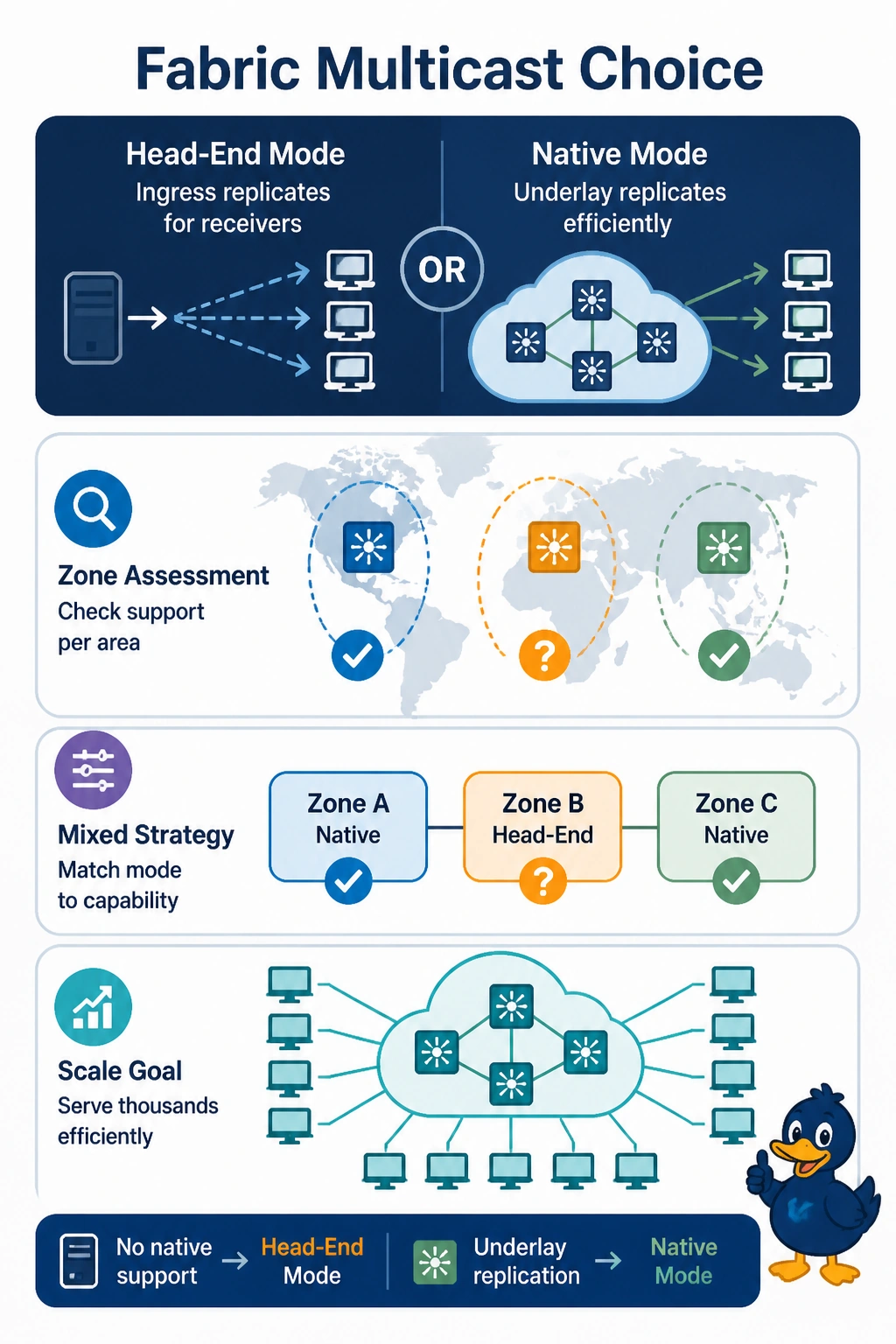
Short Explanation
You're feeding a roaring crowd without clogging every aisle. Adaptive forwarding matches delivery to capability, like mixing bulk trays and plated service at a banquet.
Full Explanation
SD-Access fabrics support native multicast (underlay PIM-SSM) and head-end replication, selected per fabric site, so mixed zones need to be separate fabric sites; native multicast where the underlay can replicate efficiently and head-end replication where the ingress edge replicates for receivers, trading ingress load for underlay simplicity. Using head-end where native is unavailable and native where the underlay supports it optimizes load and efficiency across mixed zones. Using head-end for all zones works but overloads ingress nodes and wastes bandwidth where native replication would be efficient, ignoring capability differences. Using native for all zones minimizes ingress load in theory but fails where edge nodes or underlay lack multicast support and RP reachability varies. Using unicast tunnels for all flows simplifies group handling but multiplies copies per receiver and scales poorly for 15,000 fans. Exam caveat is to assess underlay multicast and RP placement before selecting mode per zone. Practical check is to map receiver density and underlay capability to choose replication points.