
A convention center has high-density auditoriums needing seamless roaming and location analytics, plus historic halls where controllers cannot be rewired and guest turnover is extreme. Budget favors reuse where possible but performance cannot suffer in auditoriums. Which wireless choice weighs over-the-top versus fabric wireless trade-offs?
Select an answer to reveal the explanation.
Short Explanation
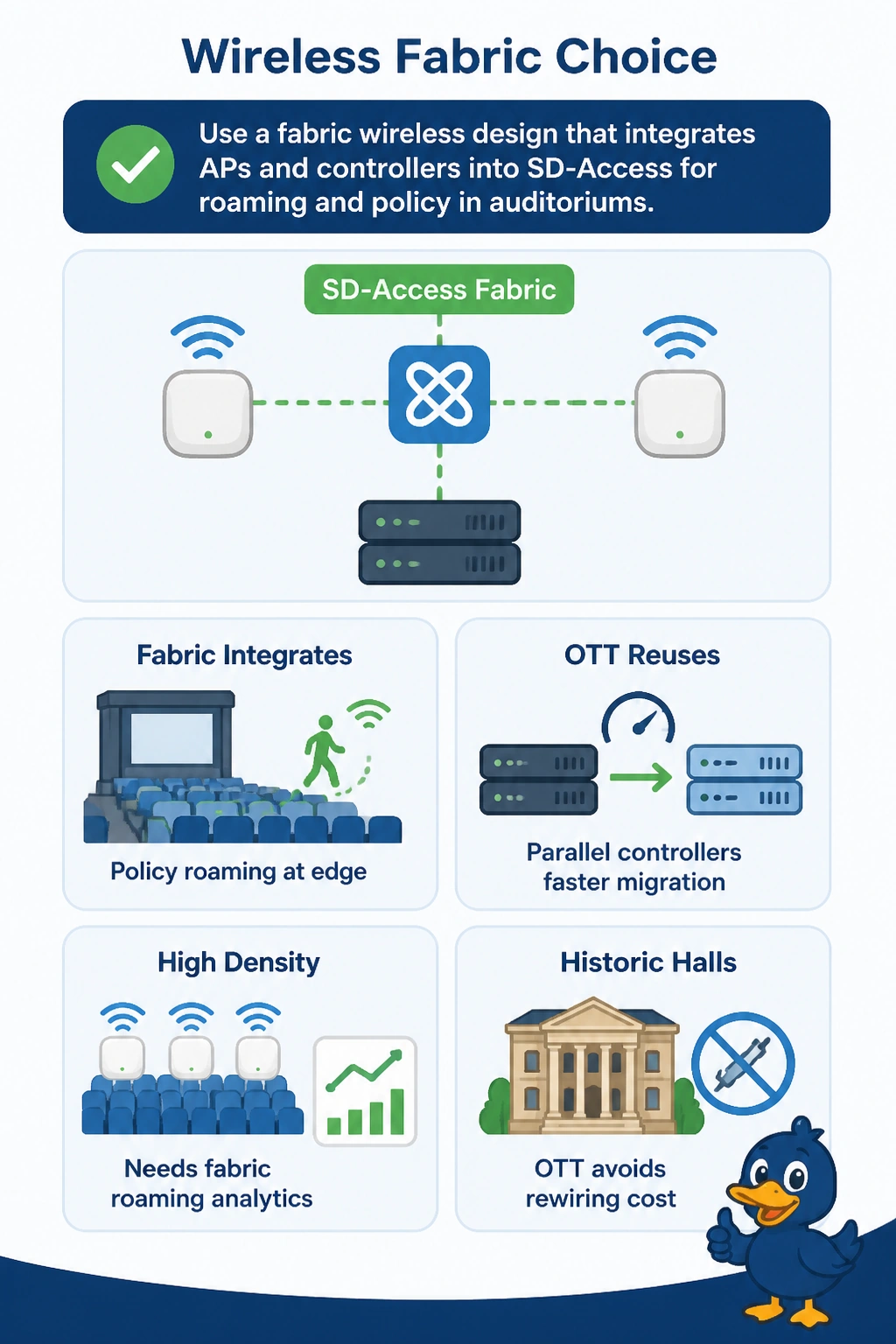
When you’re supporting high-density auditoriums, you need roaming and policy to keep pace with every guest. Fabric wireless integrates APs and controllers into SD-Access, while location analytics help you understand crowd flow.
Full Explanation
Integrating APs and controllers into SD-Access is the right choice for the auditoriums: APs attach to fabric edge nodes, roam state is synchronized through the fabric control plane, and policy follows users through segmentation and assurance. This supports high-density seamless roaming while enabling location analytics through Catalyst Center and Cisco Spaces. Retaining existing controllers in an over-the-top design can preserve investment and lower upgrade costs, but it keeps RF management, roaming, and policy outside the fabric, so it does not meet the requirement that auditorium performance cannot suffer. Centralizing historic-hall guest traffic at border nodes can provide consistent policy and inspection, but it assumes controller and underlay reachability and reconfiguration that conflict with the halls’ rewiring constraint and need for minimal-disruption onboarding amid extreme guest turnover. Fabric roaming without location analytics can support high-density voice and data, but it misses the auditorium crowd-flow requirement. Exam caveat: prioritize explicit, non-negotiable performance and functional needs over budget reuse; apply reuse to the historic halls while the auditoriums require native fabric. Practical check: validate auditorium AP density with predictive and active surveys, confirm fabric-enabled controller scale and Catalyst Center and Cisco Spaces licensing for location, and pilot over-the-top reuse only where rewiring is prohibited.