
A bank must keep trading systems in its own data centers for compliance, run its public website on shared provider capacity for elasticity, and burst analytics into both during quarter-end. Leadership asks for the cloud model labels. Which private, public, and hybrid description best fits this deployment requirement?
Select an answer to reveal the explanation.
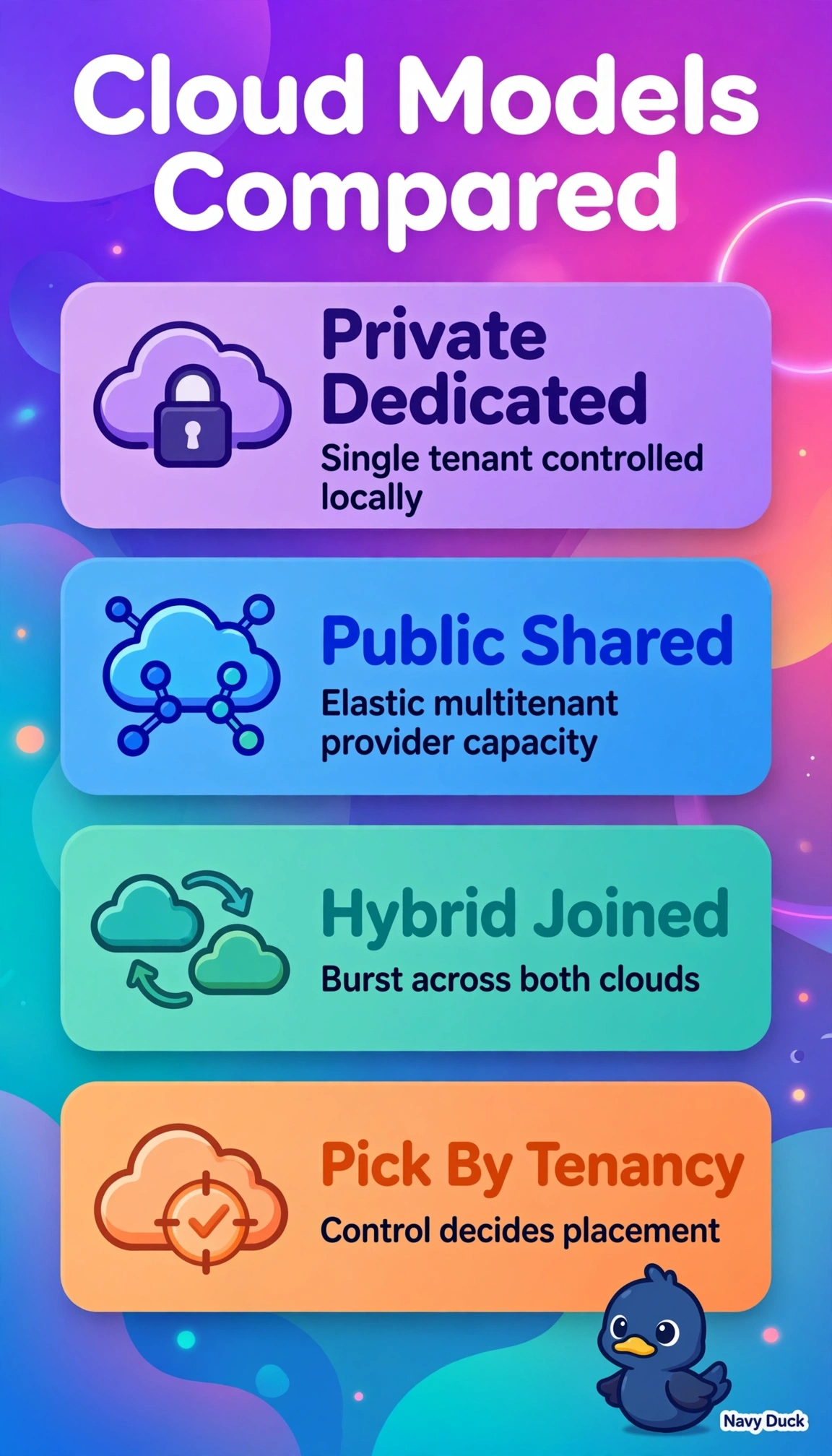
Short Explanation
Own vault, rented hall, and a bridge between them covers all needs. Hybrid ties your dedicated private capacity to elastic public resources for bursting.
Full Explanation
The correct description fits because private cloud means single-tenant infrastructure controlled in the bank's own data centers, which satisfies the compliance mandate to keep trading systems on-premises, while public cloud means multi-tenant shared provider capacity that provides elasticity for the public website, and hybrid means integrated orchestration that lets analytics burst across both environments for quarter-end peaks. The description stating hybrid keeps systems fully separate fails on integration concept because isolated environments describe concurrent use of private plus public without portability, which cannot support bursting analytics across both as required. The description stating public uses dedicated bank servers fails on tenancy concept because dedicated bank-owned hardware is single-tenant private capacity, not shared provider capacity, which removes the elasticity and economies of scale required for the website. The community cloud description fails on scope concept because community shares governance and infrastructure among multiple regulated organizations, not dedicated control by one bank on-premises, which violates the stated compliance requirement for trading. An exam caveat is to distinguish hybrid integration from merely using two clouds side by side and to avoid confusing deployment models with service models, since hybrid requires interconnectivity, identity federation, and workload portability. A practical check is to verify contracts and audit evidence for data residency, dedicated on-premises controls for trading, autoscaling limits and cost alerts for the shared website, plus tested VPN or dedicated interconnects, burst policies, and reversible scale-down after quarter-end.