
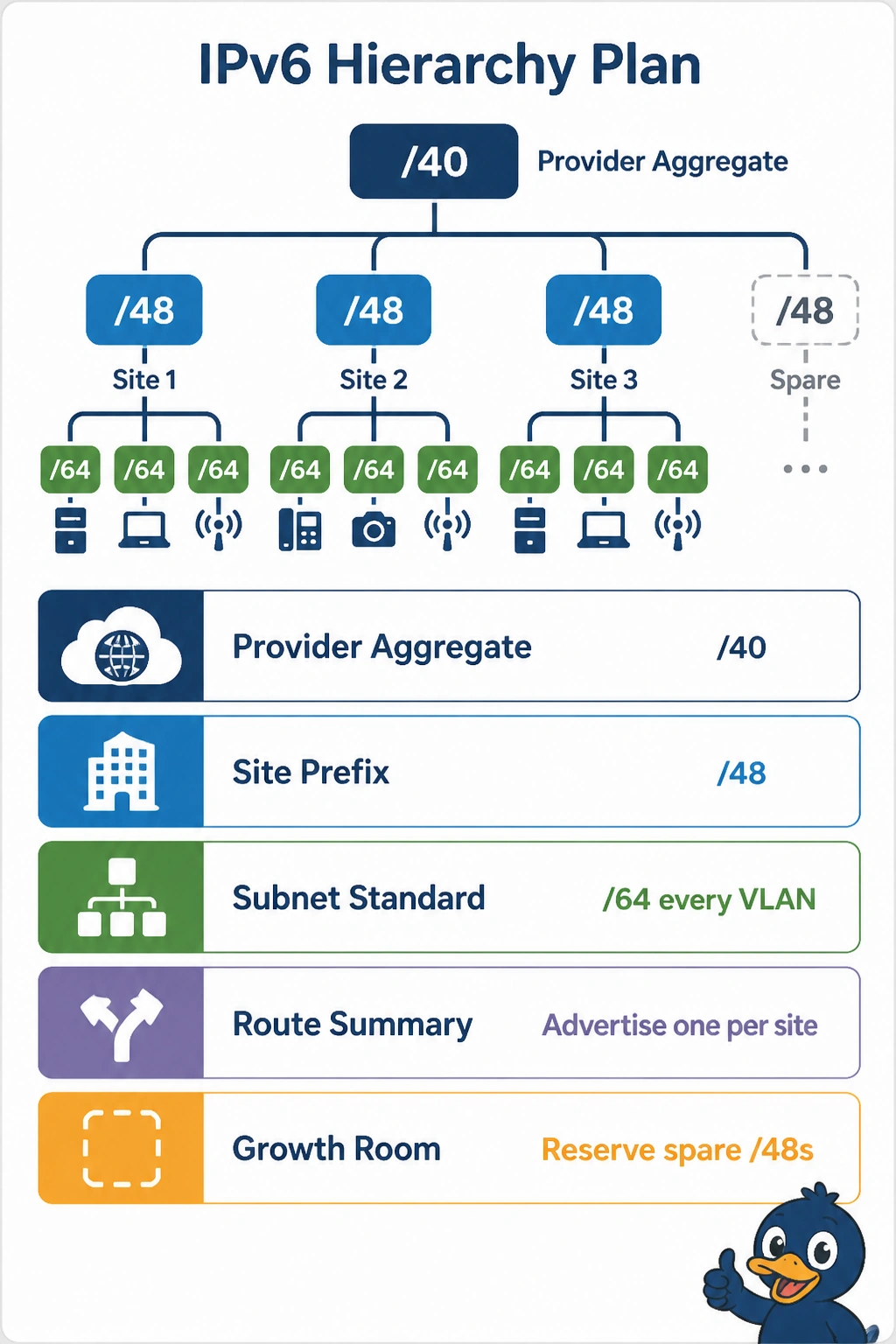
An enterprise received 2001:db8:1000::/40 from its RIR and must serve eight regional sites with room for growth, each site needing many user and data center subnets. The design standard is a uniform /64 for every VLAN and every router-to-router link. Which IPv6 allocation implements prefix hierarchy with /48 sites and /64 subnets for this enterprise?
Select an answer to reveal the explanation.
Short Explanation
You're building an address family tree that can keep branching. Hierarchical nesting keeps routes tidy and subnets plentiful, like giving each region its own zip code range.
Full Explanation
The correct allocation follows the guidance in RFC 6177, which replaced RFC 3177 and still recommends a /48 per site. A /40 contains 256 /48s, so eight regional sites each get their own /48 and 248 are left for growth, while the aggregate stays summarizable at the regional boundary. Inside each site you carve /64 subnets for every VLAN and link, which is the size SLAAC and Neighbor Discovery are designed around and keeps one uniform plan for users, data center and WAN. The distractor that uses /127 for links is real practice (RFC 6164 allows /127 on point-to-point links), but this stem sets a uniform /64 for every VLAN and link, so it does not match the required plan. The distractor that carves /56 subnets for VLANs fails because a /56 is a prefix delegated to a small site, not a LAN segment, and hosts on it could not use SLAAC. The distractor that gives each site a /52 departs from the /48 site standard and shrinks per-site growth room without any need, since the /40 already has spare /48s. For the exam, /56, /52 and /127 are all real prefix lengths in other contexts, so they look plausible. As a practical check, confirm that the plan divides the /40 on a nibble boundary into /48s per site and that every site lists /64s for user, data center and WAN segments.