
A university links its main and research campuses with 10-Gbps fiber and a 2-Gbps microwave backup running EIGRP named mode. The design must use both paths in proportion to capacity, remain loop-free, and keep metrics stable during congestion. Which EIGRP named-mode metric design enables proportional unequal-cost load sharing?
Select an answer to reveal the explanation.
Short Explanation
You've got a fast lane and a slow lane and you want both used fairly. Variance lets feasible successors carry traffic in proportion to their metrics while the feasibility condition keeps you loop-free.
Full Explanation
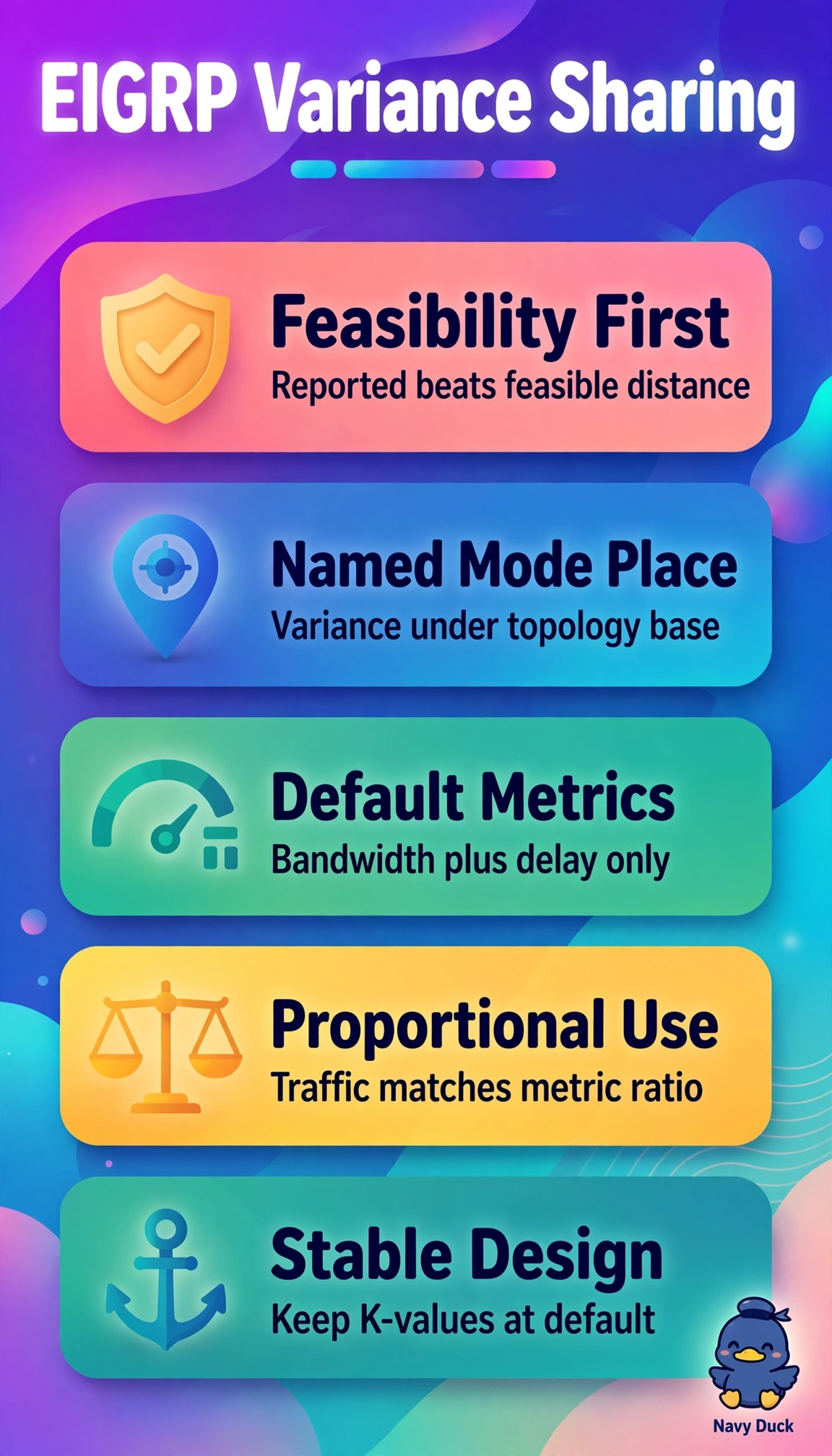
EIGRP only installs a loop-free backup as a feasible successor when its reported distance is strictly less than the successor feasible distance, which enforces the feasibility condition and prevents loops, and named-mode variance configured under the address-family topology base then allows those feasible successors into the routing table with CEF sharing traffic in proportion to the composite metric built by default from bandwidth and delay. Maximum-paths alone only widens equal-cost multipath and leaves the higher-metric feasible successor unused, so the backup stays idle despite available capacity. Equalizing metrics by tuning delay forces equal-cost sharing that over-subscribes the smaller link and discards proportional use while distorting capacity planning and troubleshooting. Changing K-values to add load and reliability makes the metric flap with congestion and risks K-value mismatch and neighbor instability rather than enabling controlled sharing. For the exam, remember variance never overrides the feasibility condition, so unequal-cost sharing requires a feasible successor first. In practice verify with show ip eigrp topology that a feasible successor exists before setting variance and confirm installation with show ip route and traffic ratios.