
A manufacturing company runs factories with MPLS VPN and internet, plus growing IaaS workloads that need predictable performance for replication and burst internet offload for dev teams. Security wants private paths for production and flexible paths for dev. Which cloud connectivity option aligns Direct Connect, MPLS direct connect and cloud on-ramp to these needs?
Select an answer to reveal the explanation.
Short Explanation
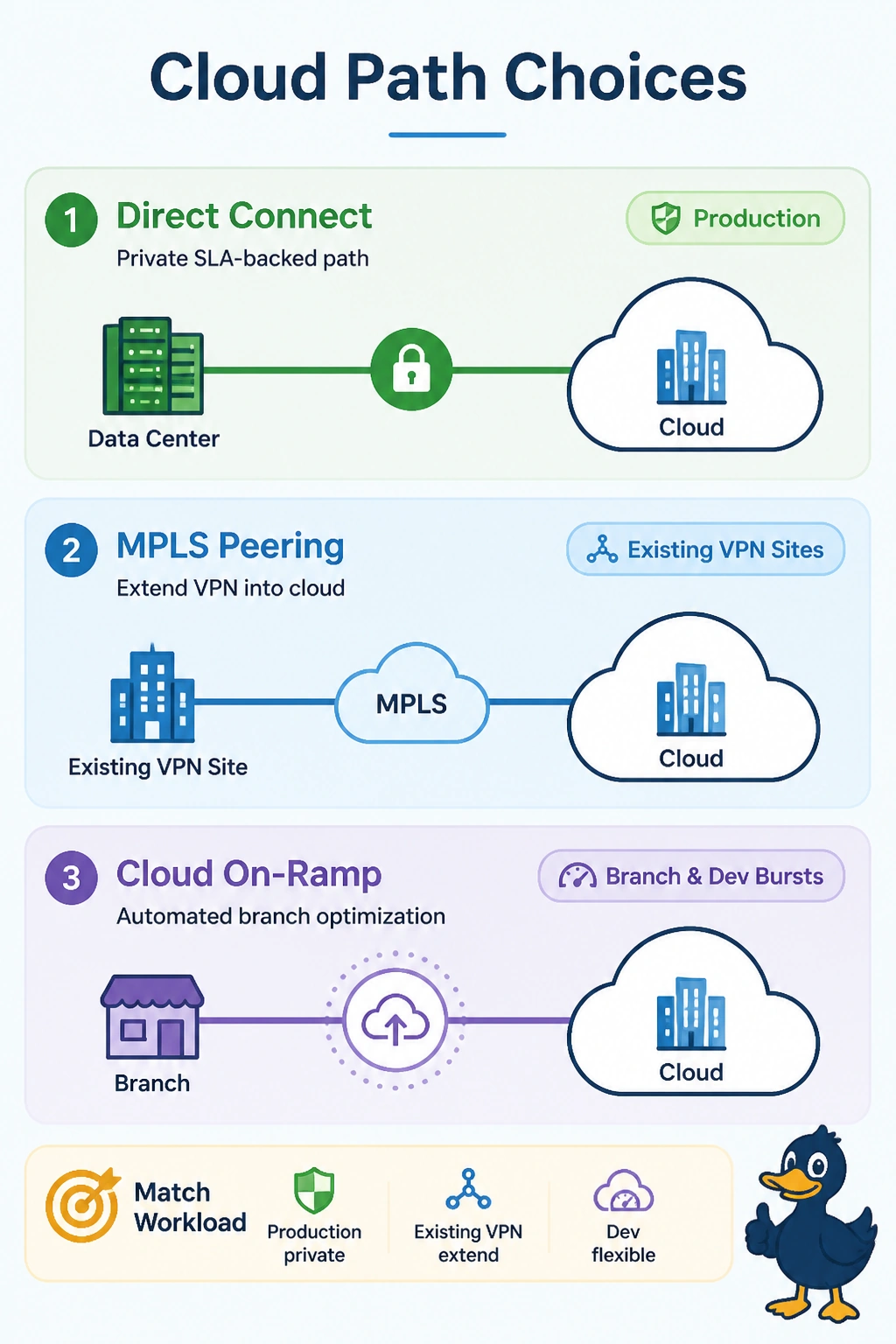
You are matching each workload to its right road. On-ramp choices let steady production ride private links while dev bursts take the flexible path without clogging the plant.
Full Explanation
The correct design matches each transport to its explicit requirement by reserving private Direct Connect for production replication needing predictable low-loss throughput, retaining MPLS-based cloud peering to extend existing factory VPNs into IaaS without rearchitecting the WAN, and adding cloud on-ramp for localized optimized branch access with flexible policy for dev bursts, thereby satisfying private for production and flexible for dev at once. The centralized data center breakout design is a legitimate inspected-egress pattern but fails this scenario on optimized access because hairpinning branch cloud traffic through the central firewall increases latency, creates a bottleneck during bursts, and negates the locality benefit that on-ramp is specified to provide. The internet VPN for MPLS sites design is common for fast cloud adoption but fails on reuse and assurance because replacing MPLS adjacency with best-effort encrypted internet discards the existing VPN investment and cannot meet predictable performance and private-path mandates for replication. The internet VPN for both production and dev design preserves peering and on-ramp concepts but fails on isolation because running replication over public internet, even encrypted, lacks dedicated capacity and private adjacency required by security. Exam caveat is to map every clause in the stem before choosing, since attractive patterns satisfy two of three transports and only careful requirement tracing exposes the missing element. Practical check is to confirm replication throughput and jitter budgets, provider peering locations, Direct Connect capacity, and pilot on-ramp routing to prove production remains private while dev offloads locally under load.