
A university research park uses SD-Access to send lab telemetry multicast to receivers on only four edge nodes a few times per day, with no PIM in the underlay and a desire to avoid enabling multicast routing there. Which multicast-in-fabric design suits this sparse, low-scale requirement?
Select an answer to reveal the explanation.
Short Explanation
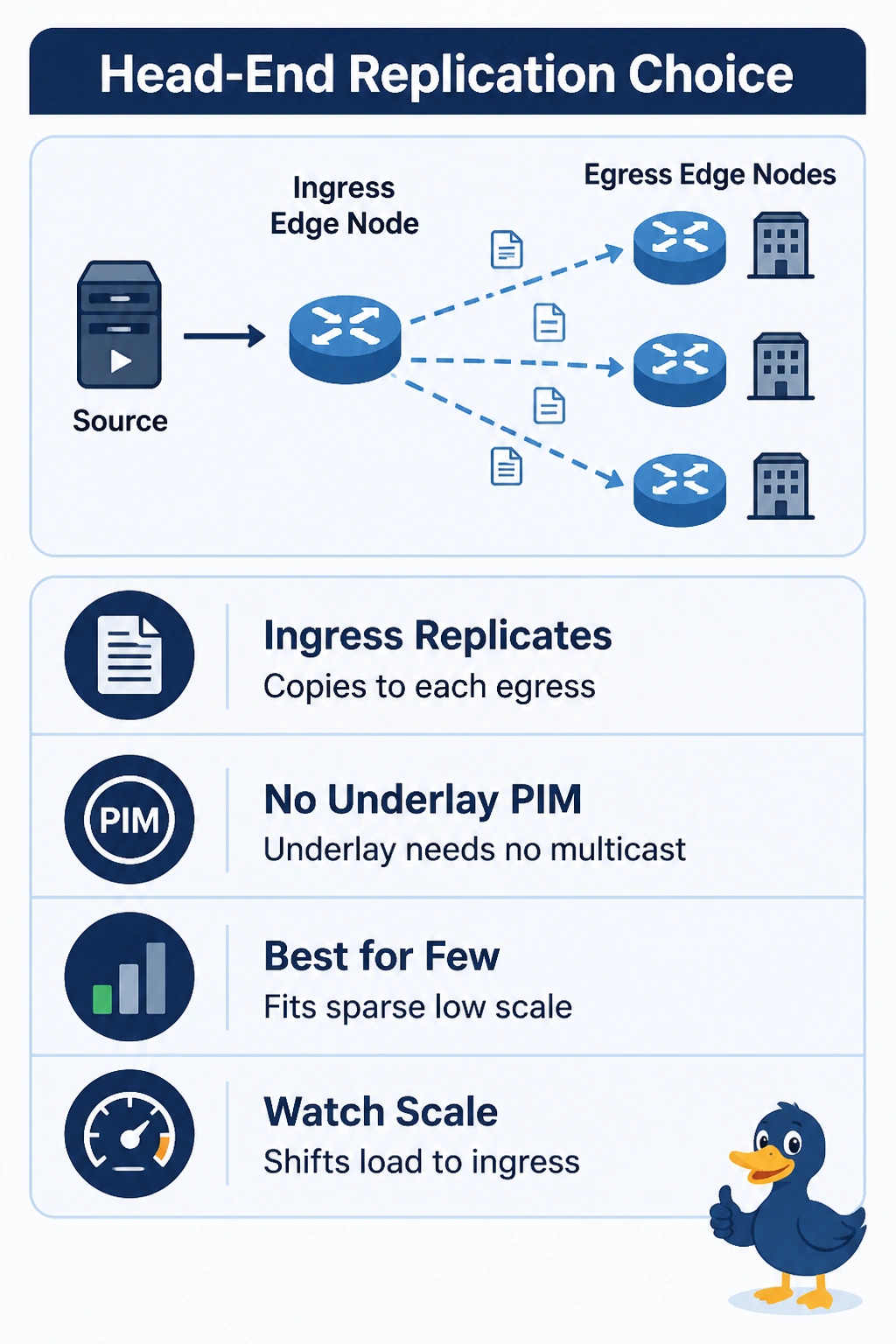
You’re hand-delivering four letters, not hiring a mail truck fleet. Replication at the ingress edge keeps this tiny, rare multicast simple with no extra plumbing.
Full Explanation
Head-end replication fits because SD-Access can encapsulate overlay multicast in VXLAN and have the ingress fabric edge unicast-replicate it to only the four edge nodes that have receivers, which needs no multicast routing in the underlay and suits a sparse, low-scale, occasional flow. The native multicast option with an underlay rendezvous point and shared tree requires enabling PIM in the underlay, which the stem rules out. The native multicast option using source-specific joins is efficient for many frequent receivers and high-volume flows, but it also depends on underlay PIM and is unwarranted for four occasional receivers. The underlay design with native PIM forwarding and shortest-path trees fails on the same stated fact of no PIM in the underlay. As an exam caveat, SD-Access offers two overlay multicast transport modes, head-end replication (no underlay multicast) and native multicast (underlay PIM SSM), and the overlay still uses a rendezvous point for any-source groups in either mode, so the deciding clue here is the absence of underlay PIM. As a practical check, select the replication mode for the fabric site in Catalyst Center, confirm the overlay rendezvous point and receiver edge membership, and watch ingress edge load as receiver edges grow.