
An enterprise OSPF domain has Area 5 with 200 branch subnets behind one ABR and a data-center ASBR redistributing 300 external routes. Tables are large and flaps in branches ripple into Area 0. Which OSPF summarization design at ABRs and ASBRs best improves stability and scale?
Select an answer to reveal the explanation.
Short Explanation
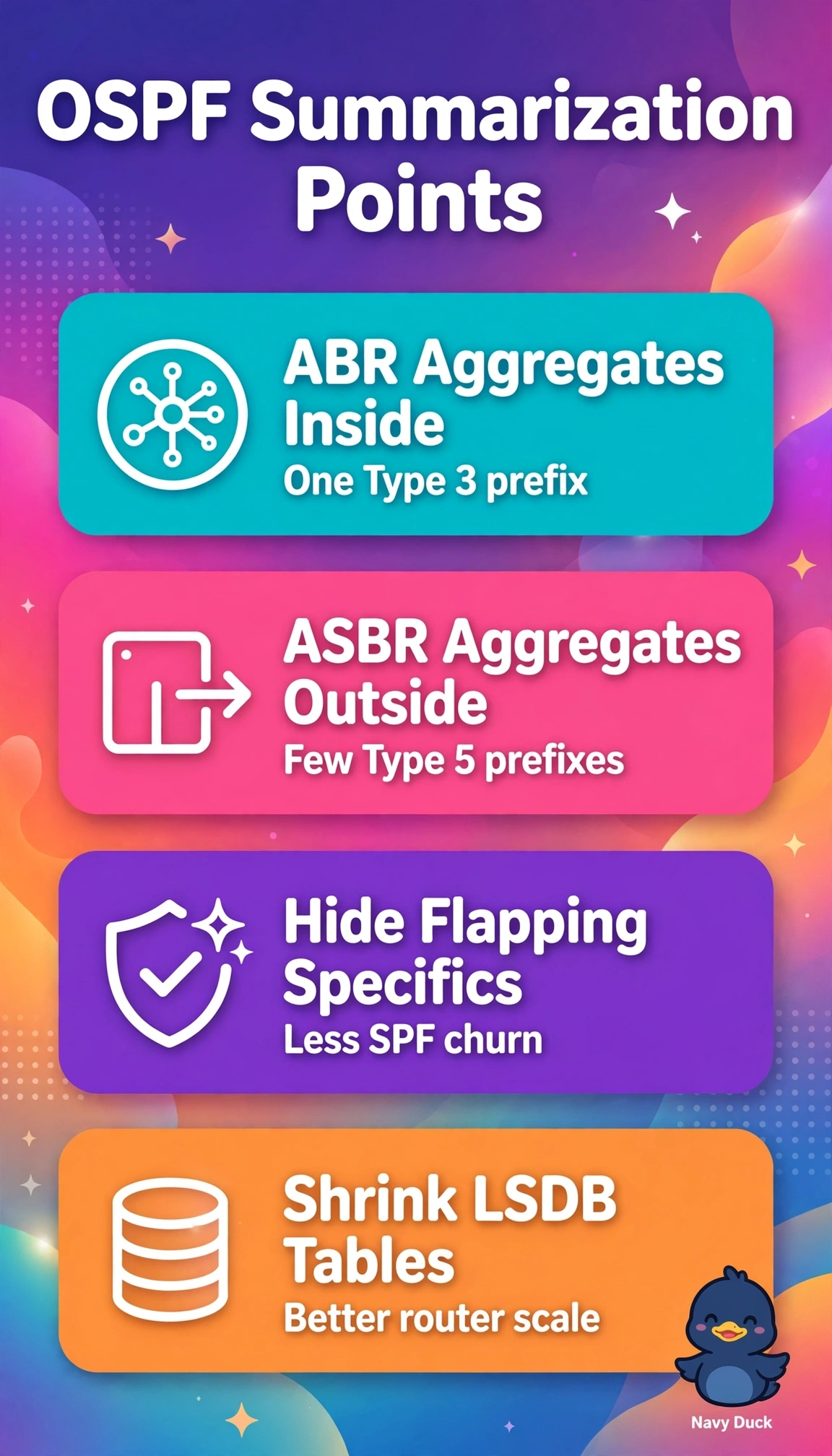
You'll get cleaner tables and calmer Area 0 when you roll those 200 branches into one aggregate at your Area 5 ABR, like zipping a bulging suitcase shut, and bundle the ASBR externals too. That boundary summarization hides the flaps behind stable prefixes so changes don't ripple everywhere.
Full Explanation
Only Area Border Routers can summarize interarea Type 3 LSAs for their attached areas and only Autonomous System Boundary Routers can summarize redistributed Type 5 or Type 7 externals, so aggregating branch prefixes at the Area 5 ABR and externals at the data-center ASBR reduces link-state database size, SPF work, and flap propagation into Area 0 while preserving reachability. Summarizing branch subnets as Type 5 at the ASBR fails by concept because intra-area routes cannot be converted to externals at an unrelated ASBR and Type 1 LSAs never cross area boundaries to be filtered at an ABR. Summarizing backbone prefixes at internal routers fails by concept because internal routers lack authority to create interarea summaries and filtering externals belongs at the originating ASBR, not a transit ABR. Summarizing at internal routers and at the wrong border fails by concept because summarization capability is tied to ABR and ASBR roles and must align with LSA type originated. For the exam, memorize ABR equals Type 3 summarization and ASBR equals Type 5 and Type 7 summarization; in practice verify aggregate masks, contributor coverage, and that more-specific flaps are hidden.