
A healthcare campus plans SD-Access for 400 edge switches and 8000 endpoints across a main hospital and two clinics, with redundant data centers and strict uptime for clinical devices. Latency is low, but control signaling must survive a data center loss without re-architecting, and control plane load must be isolated from border forwarding. Which control plane node placement and scale approach meets these resilience needs?
Select an answer to reveal the explanation.
Short Explanation
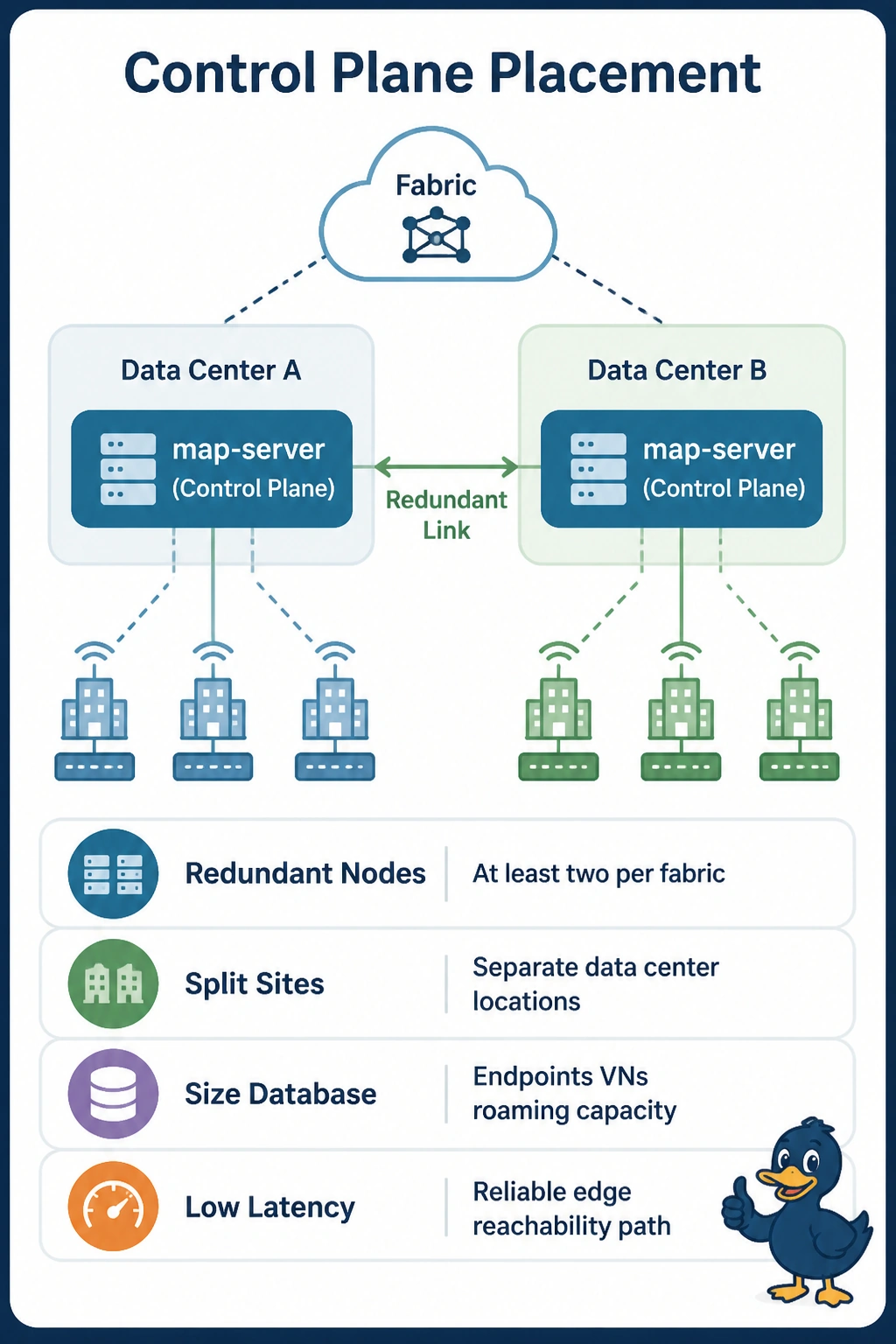
You can't let your clinical uptime depend on a single room staying powered. You'll want redundant map-server nodes split across data centers, like keeping copies of patient charts in two buildings so care never skips a beat.
Full Explanation
The correct design is right because SD-Access separates LISP map-server control from forwarding, so redundant nodes across two data centers give fate separation for registrations and queries if one site fails, and sizing for 8000 endpoints ensures state and query headroom for strict clinical uptime. One incorrect design sizes the redundant pair only for switch count, which keeps site redundancy but violates host-scale engineering since load follows endpoints and roams, causing drops under churn. Another incorrect design colocates control on border nodes in both sites, which is valid for small branches to save hardware but fails at 400-switch scale where dedicated nodes isolate query load from border forwarding and allow independent scaling. A third incorrect design offers dual-site placement but needs manual repointing after loss, which looks redundant on paper but misses survival without re-architecting since edges should fail over automatically via multiple configured peers. Exam caveat: do not equate border reachability with control availability because cached maps may forward briefly while new roams fail. Practical check: confirm every edge lists both data-center nodes, check endpoint plus growth against scale tables, and test isolation failover with roaming devices.