
A hospital is adding SD-Access in a building with an existing autonomous wireless controller, strict medical-device roaming requirements, and a desire to keep current APs and controller config while phasing fabric migration. Which wireless integration trade-off guides the choice between over-the-top and fabric wireless for this phased rollout?
Select an answer to reveal the explanation.
Short Explanation
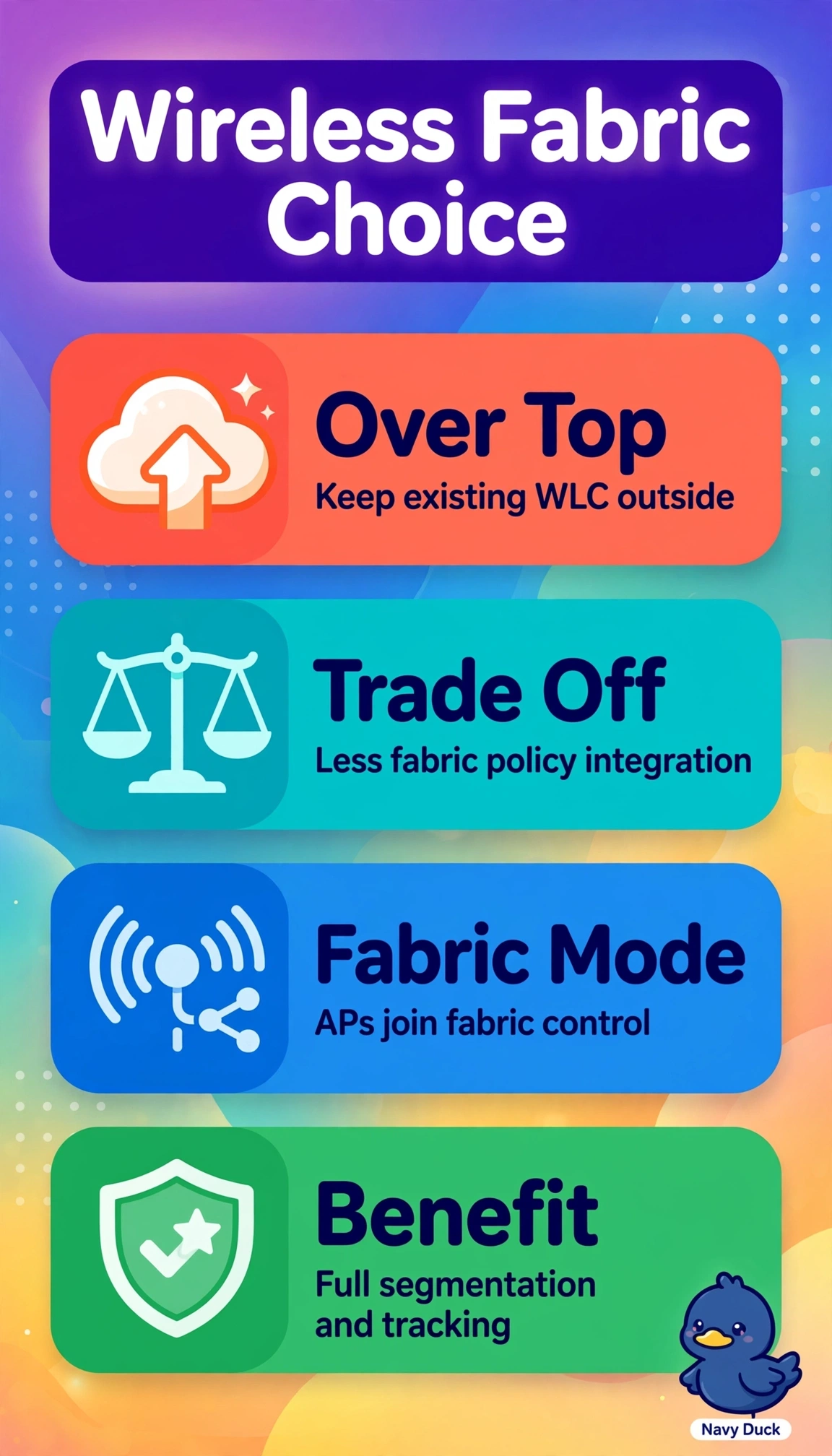
You're not ready to rip out a working wireless brain, just to coexist for now. Over-the-top keeps your controller alive at the cost of integration, like renting upstairs while the downstairs remodel finishes.
Full Explanation
Over-the-top wireless keeps the existing wireless LAN controller outside the fabric, tunneling client traffic over it, so the hospital preserves APs, roaming behavior, and operational familiarity during migration but sacrifices deep SD-Access integration such as fabric host tracking, segmentation, and policy enforcement at the fabric edge. That trade-off fits a phased rollout with roaming sensitivity. Fabric wireless fails as described when it claims to retain the legacy controller without change, because fabric wireless integrates APs and controller function with the fabric control plane and requires migration effort. A shared-SSID fabric option that preserves autonomous mobility without integration misstates the mechanism, since fabric wireless centralizes control and identity rather than leaving mobility untouched. Over-the-top providing full fabric tracking also misstates the mechanism, because policy and location remain outside the LISP-based fabric database. For the exam, map over-the-top to fast coexistence with limited policy and fabric to full integration with migration cost; in practice validate roaming, segmentation needs, and AP compatibility.