
A national logistics firm with 250 branches needs dual-transport SD-WAN with no single controller failure isolating sites and room to add 150 more sites without redesign. Which SD-WAN high availability and scale design meets dual-transport redundancy for these branches?
Select an answer to reveal the explanation.
Short Explanation
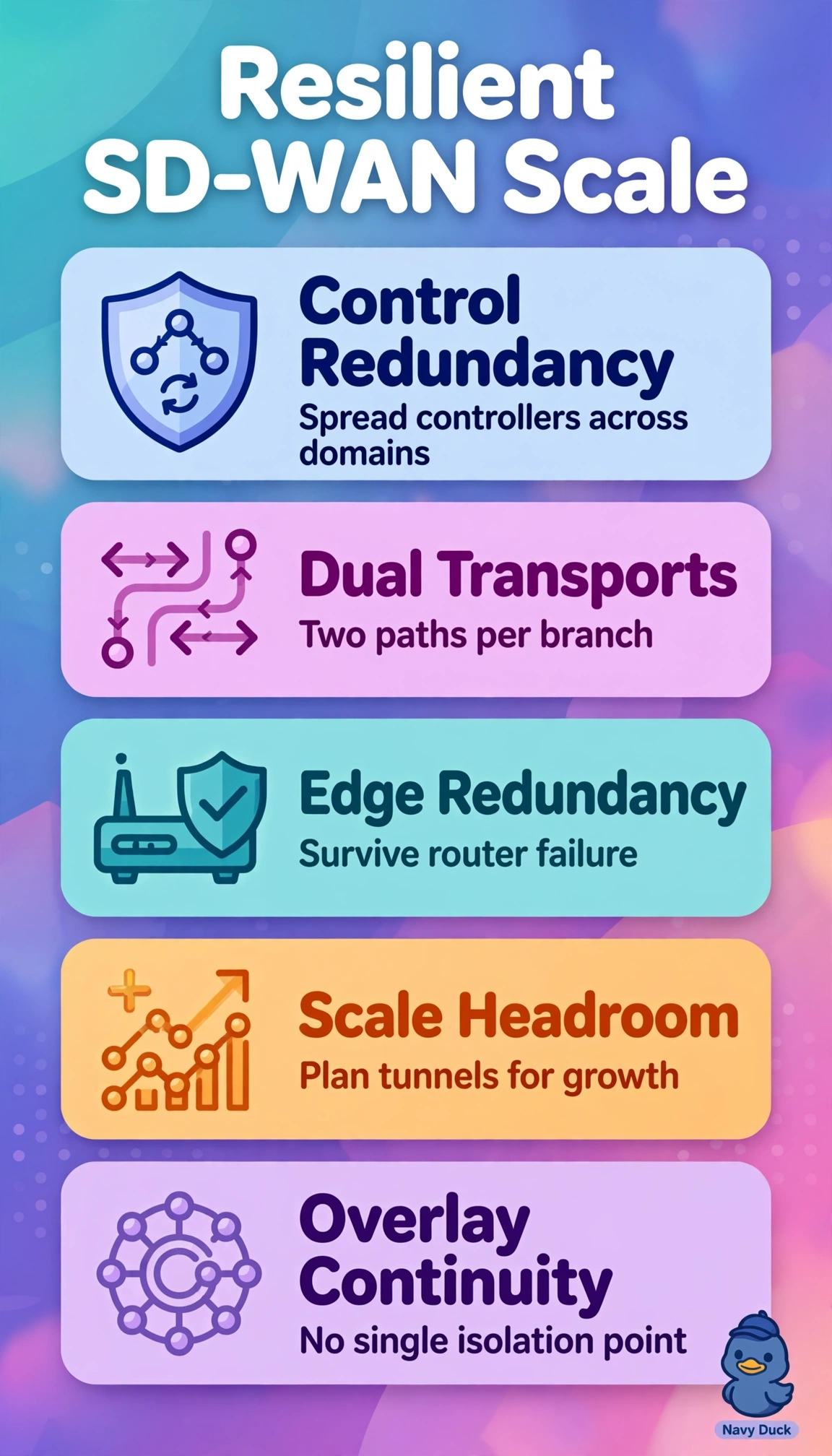
You're built for storms and growth at once. Distributed redundancy keeps control and data alive together, like having backup dispatchers and two roads to every depot.
Full Explanation
The correct design is right because it simultaneously satisfies device redundancy, control-plane survivability, transport diversity, and future scale: paired controllers avoid isolating branches on one failure, dual edge devices with two independent transports maintain forwarding when a link or node fails, distribution across failure domains removes geographic fate-sharing, and sizing beyond 250 accommodates 150 additional sites without redesign. The design optimized for efficient operation of the current 250 branches is architecturally sound for steady-state cost control but fails scalability because capacity, licensing, and control-plane sizing for present load alone will require redesign or forklift upgrade to reach 400 sites. The design relying on MPLS transport across failure domains with dual routers is a common high-capacity enterprise pattern but fails transport diversity because two devices sharing one underlay still fate-share on provider or backbone outages, losing the independent second path required for dual-transport redundancy. The design using a centralized regional controller cluster with dual-transport edges is operationally attractive for management simplicity but fails survivability because loss of that single domain suspends policy, keying, and new session establishment despite data-plane diversity and adequate 400-site sizing. As an exam caveat, do not conflate two boxes with two paths or a local cluster with geographic redundancy, as many stems test that distinction. As a practical check, verify published scale for 400 nodes, confirm diverse carriers per site, and test loss of an entire controller site while adding a branch.