
Two university campus blocks connect over diverse 10G routed links with similar delay, carrying voice and research traffic that must survive a single fiber cut in under a second and use both links. Which convergence and load-sharing design between campus blocks best meets both resiliency and utilization?
Select an answer to reveal the explanation.
Short Explanation
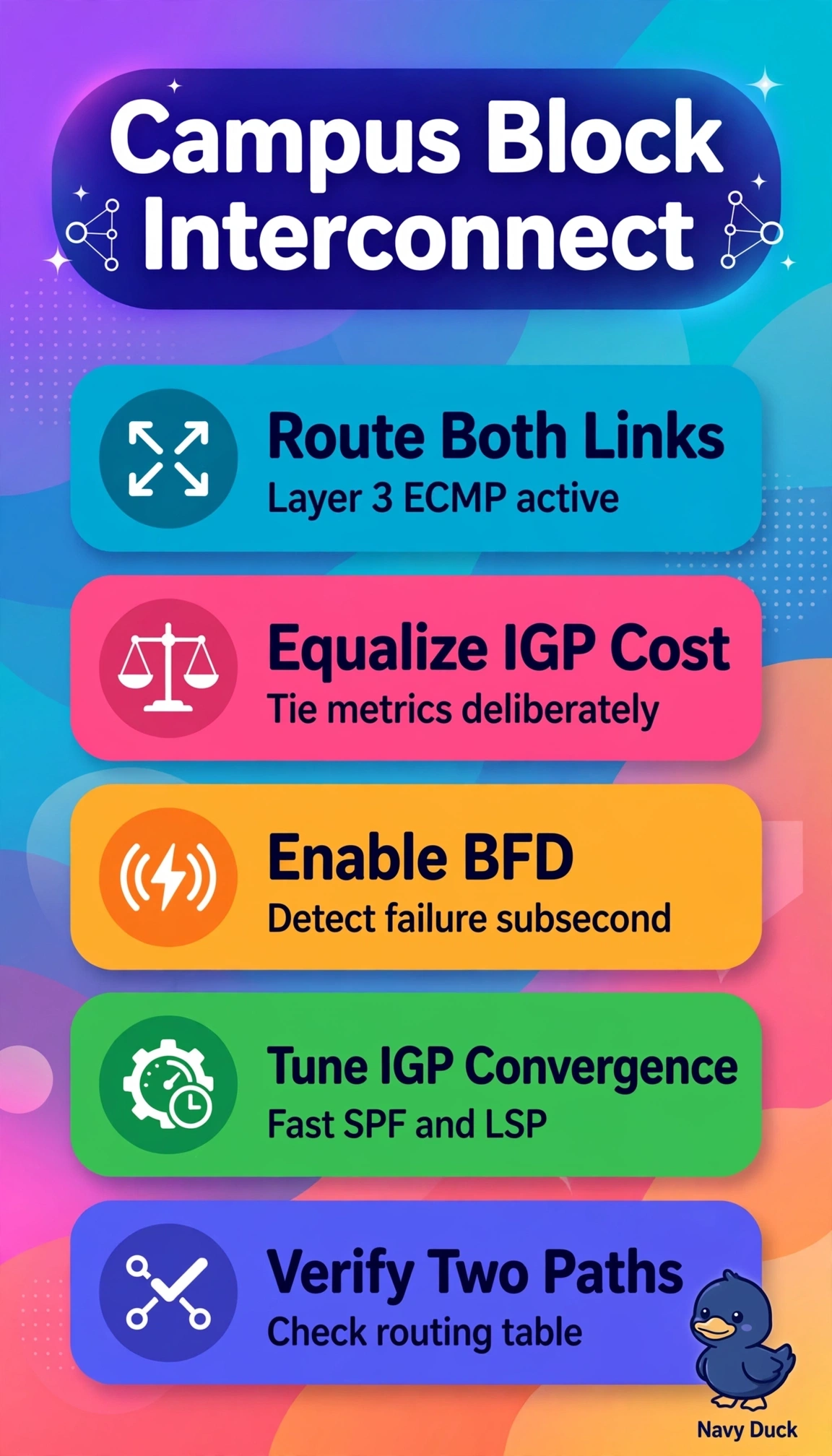
You're chasing two rabbits at once: use both fibers and heal in a blink. ECMP routing with BFD spreads flows across equal paths and spots a cut far faster than hello timers alone.
Full Explanation
A routed Layer 3 interconnect with equal-cost multipath installs both diverse paths in the routing table when metrics tie, shares load flow by flow, and pairs fast IGP convergence with sub-second Bidirectional Forwarding Detection to withdraw the failed path quickly without spanning-tree blocking or first-hop gateway dependence. A Layer 2 trunk with Rapid PVST+ and HSRP fails by concept because spanning tree logically blocks one diverse link and gateway failover adds delay, so utilization and convergence goals are both missed. A single routed link with floating static backups fails by concept because only one path forwards at a time and static detection without BFD converges slowly, wasting capacity. Unequal-cost load balancing with stateful switchover fails by concept because the two links have similar delay so there is no unequal-cost need (OSPF and IS-IS do not support unequal-cost sharing, and EIGRP needs variance and a feasible successor) and chassis SSO protects against supervisor failure, not a fiber cut between blocks. For the exam, associate inter-block load sharing with Layer 3 ECMP and convergence with BFD plus IGP timers; in practice verify equal metrics, ECMP maximum paths, and BFD operation on both links.