
A retail chain with 120 stores needs any-to-any inventory traffic with provider-managed routing, guaranteed latency, and isolation from Internet threats. The provider offers MPLS L3VPN and the team also considered Internet IPsec overlay. Which enterprise VPN choice best fits this MPLS versus overlay requirement?
Select an answer to reveal the explanation.
Short Explanation
You're renting a private highway with patrols instead of driving back roads yourself. MPLS L3VPN keeps routing in the provider core with VRF separation and contracted performance.
Full Explanation
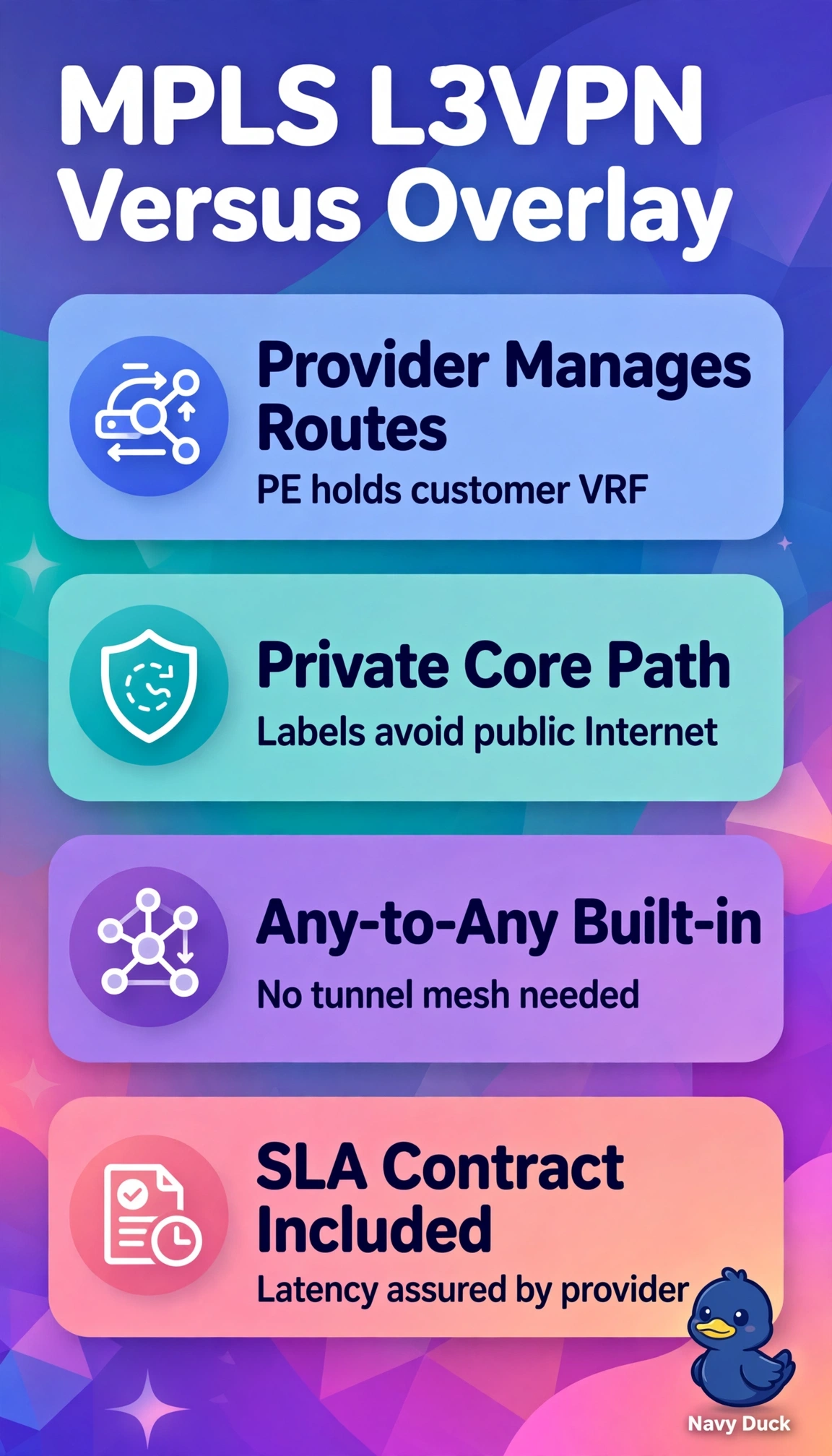
Provider MPLS L3VPN fits because the provider maintains VRF-based routing per customer, distributes store prefixes via MP-BGP, and forwards across a private core that never traverses the public Internet, enabling contractual SLA for latency, jitter and availability for any-to-any inventory flows while offloading routing operations for 120 sites. The provider-managed Internet IPsec overlay is attractive for encrypted mesh with outsourced operations, but by concept it rides best-effort Internet transport where end-to-end latency and loss cannot be guaranteed, so it cannot meet the guaranteed-latency private-transport need despite satisfying management and encryption. The hub-and-spoke MPLS L3VPN variant preserves managed routing, isolation and SLA-backed transport, yet by concept it forces inter-store traffic through central hubs for policy or inspection, creating tromboning delay and hub dependency that violates the direct any-to-any requirement while looking otherwise identical. The VPLS L2VPN service also offers managed private SLA-backed multipoint transport, but by concept it provides Ethernet bridging only and leaves IP routing to customer routers, so it fails the provider-managed L3 routing function essential to simplifying operations. Exam caveat is to distinguish logical encryption from private transport and mesh capability from configured topology, since IPsec encrypts but does not create SLA or off-Internet isolation, and MPLS can be built either way. Practical check is to verify contract and design for PE-managed VRF with any-to-any route-targets, explicit latency SLA and no Internet hop, plus CE handoff.