
A manufacturer has a backbone Area 0 and a remote plant in Area 10 with one ABR, low-memory routers, and flapping WAN prefixes causing churn. The plant must redistribute one local partner static route while hiding backbone interarea routes and outside externals. Which OSPF area type design gives stable, minimal tables with local redistribution?
Select an answer to reveal the explanation.
Short Explanation
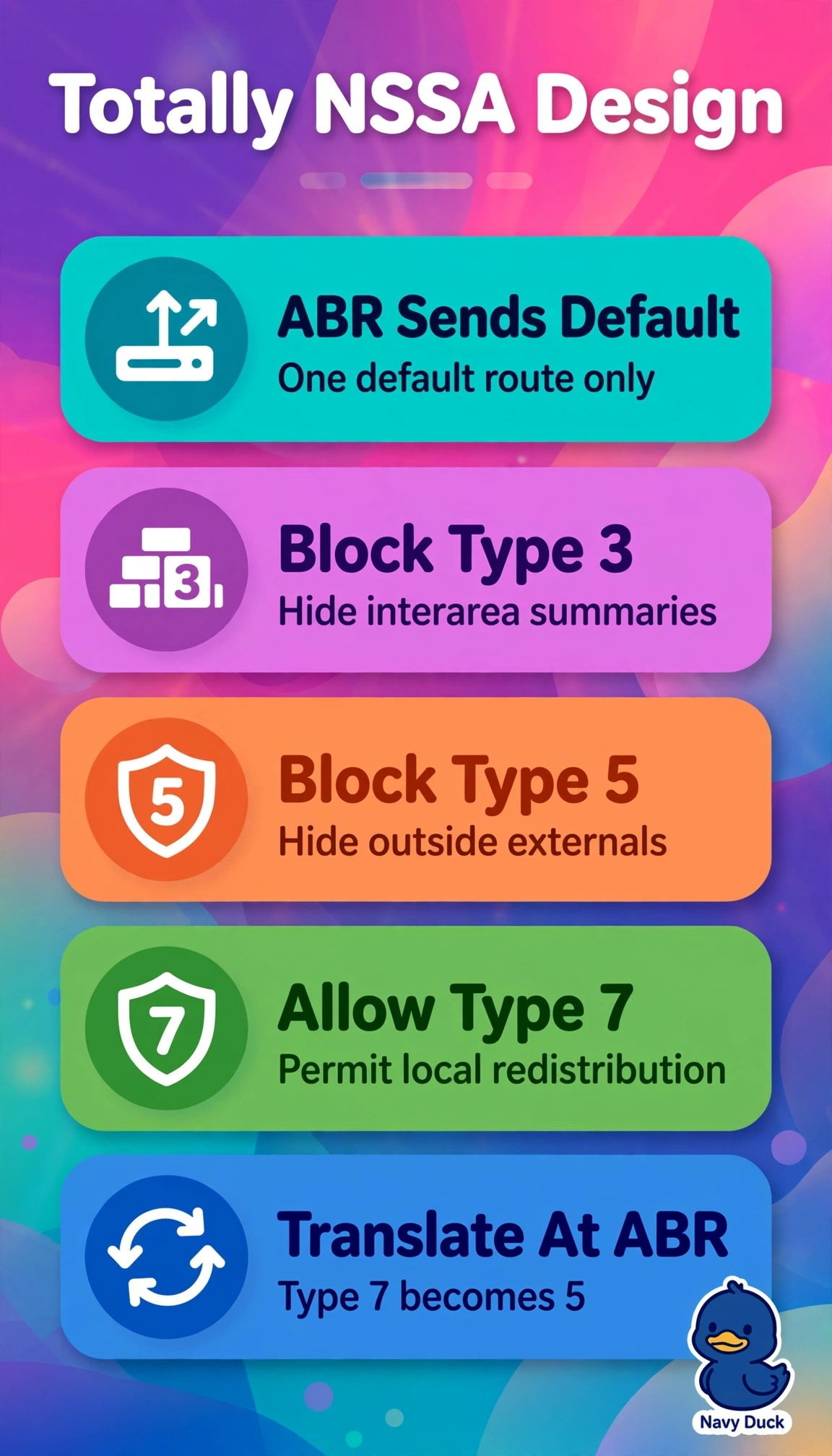
You've got a classic tight spot: hide almost everything but still leak one local route. Totally NSSA is your bouncer with a VIP list, blocking Types 3 and 5 while letting that Type 7 slip through.
Full Explanation
A totally NSSA, configured with no-summary on the ABR, injects a default route while filtering Type 3 summary LSAs and Type 5 external LSAs and converts permitted Type 7 LSAs from the ASBR into Type 5 toward the backbone, which keeps the low-memory plant database tiny yet preserves required local redistribution and shields it from backbone churn. Configuring the area as a totally stubby area fails by concept because totally stubby filtering also blocks externals without any Type 7 permission, so the partner static redistribution would be dropped at the ABR. Configuring the area as a standard stub fails by concept because stub filtering permits all interarea Type 3 LSAs, leaving the routers exposed to backbone prefix churn and larger tables. Configuring the area as a regular NSSA fails by concept because regular NSSA filtering still floods all interarea summaries, so stability and scale goals are missed even though redistribution works. For the exam, remember NSSA means not-so-stubby allowed to originate externals as Type 7 and totally means also hide interarea summaries; in practice verify area type consistency on all routers and check the Type 7 to Type 5 translator on the ABR.