
A regional bank connects a headquarters campus to 25 branches on one flat IS-IS domain today, with dual core routers linking to a data center backbone. Each branch becomes its own area and branches should hide their LAN prefixes from each other and forward inter-branch traffic through the cores. Which IS-IS level design achieves hierarchical scaling for this topology?
Select an answer to reveal the explanation.
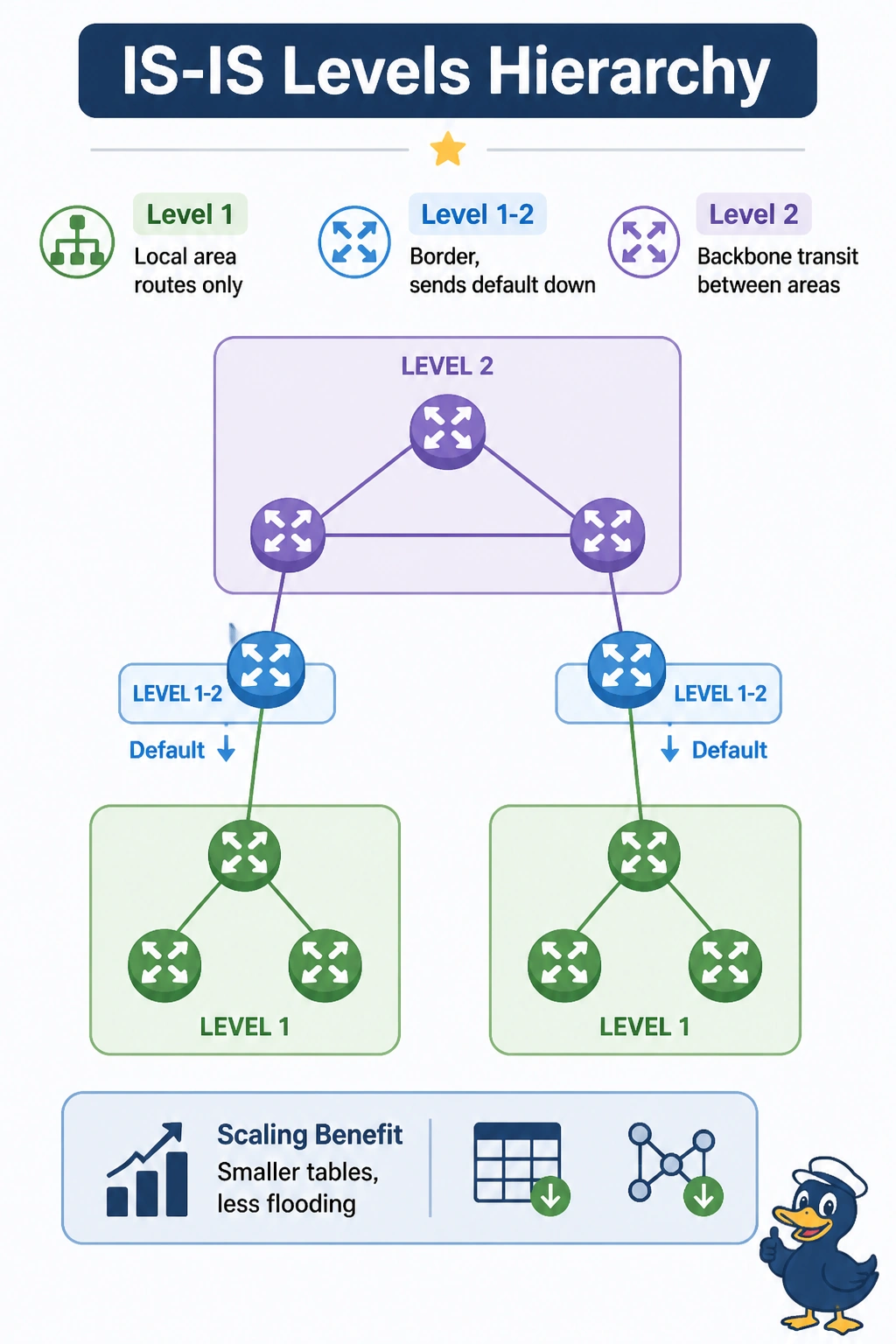
Short Explanation
You've got spokes that shouldn't see everything, so let the cores do the heavy lifting. Keeping branches Level 1-only with a default route is hierarchy at work, like using area codes instead of memorizing every number.
Full Explanation
IS-IS hierarchy separates Level 1 intra-area routing from Level 2 backbone routing, and Level 1-2 border routers inject a default route into Level 1 so leaf routers need only local state plus one exit. That matches the requirement to hide branch LANs from each other while forcing transit through the cores, reducing LSP flooding and SPF scope at branches. A single flat Level 2-only domain fails by concept because every router carries every prefix and link, which harms stability and scaling as branches grow. Putting branches in Level 2 with cores in Level 1 inverts the hierarchy and breaks backbone continuity, since Level 1 cannot transit between areas and the cores would lose backbone adjacency. Making every branch Level 1-2 also fails because it floods backbone LSPs everywhere and removes summarization boundaries. For the exam, remember Level 1 routers never form Level 2 adjacency and depend on the closest Level 1-2 router; in practice verify levels per interface and confirm branch tables show only local routes plus default.