
A county government has 12 buildings aggregated by two distribution switches per region, with frequent moves and new subnets straining routing tables. The design must limit updates and simplify growth while preserving resiliency. Which hierarchical IPv4 plan best enables route summarization at distribution and region boundaries?
Select an answer to reveal the explanation.
Short Explanation
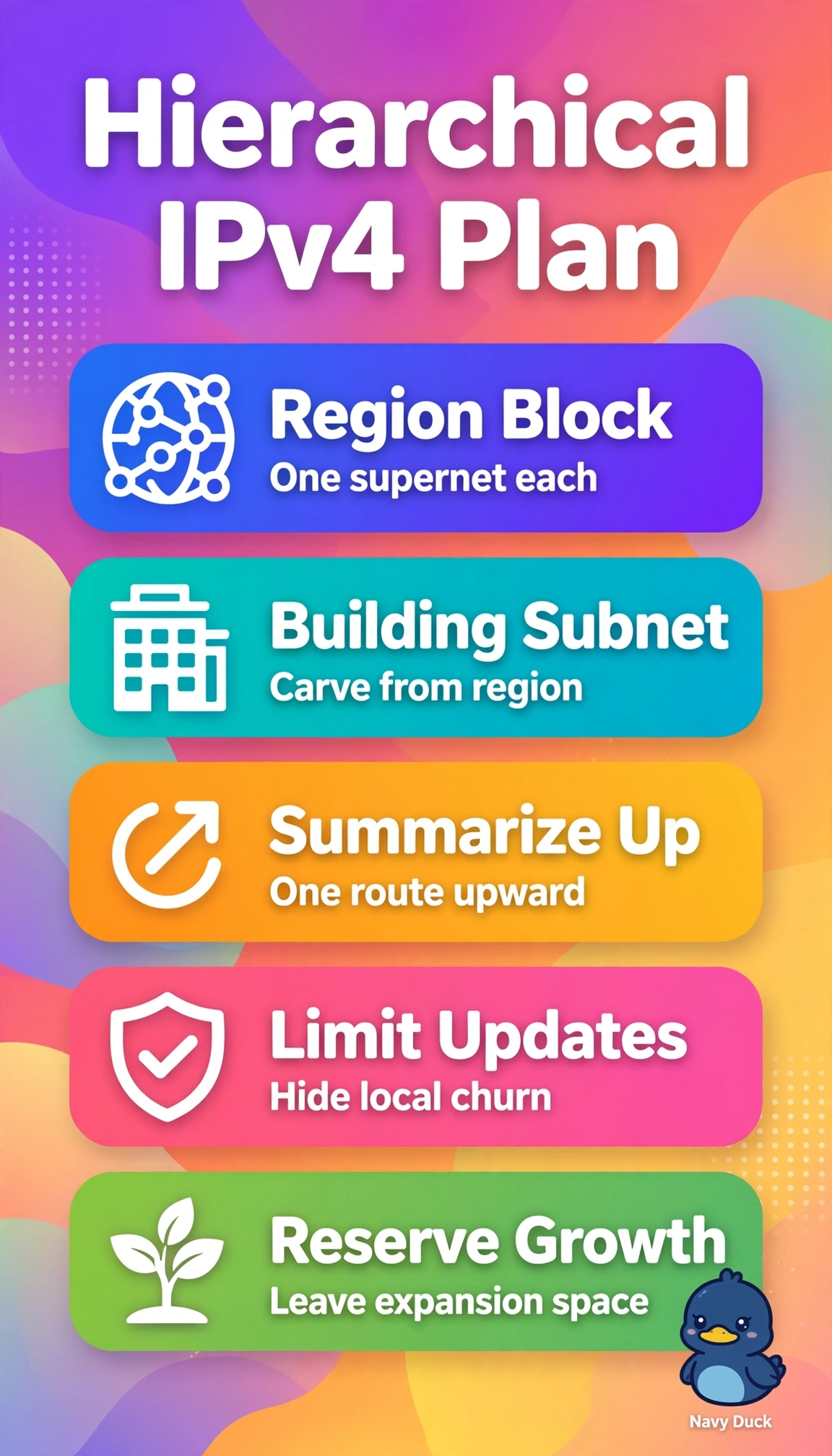
You're stacking addresses like tidy nesting boxes. Contiguous blocks let you advertise one summary instead of dozens, making summarization effortless.
Full Explanation
The correct plan works because contiguous per-region blocks subdivided into contiguous per-building blocks create topological addressing that aligns with the physical hierarchy, allowing distribution switches to advertise a single building aggregate and region edges to advertise a single region aggregate, thereby hiding frequent moves and new subnets inside the local aggregate, stabilizing tables, simplifying growth by subnetting locally, while dual distribution nodes can advertise the same summary for redundancy. Allowing building VLANs to span multiple buildings supports seamless mobility without readdressing, a valid design for wireless roaming, but it breaks building-level contiguity so distribution cannot summarize and every move leaks updates upward. Issuing uniform /24s sequentially from a central county pool as buildings request space simplifies utilization and administration, yet it scatters each region's prefixes across the overall range and prevents aggregation at either boundary. Advertising the hierarchical blocks plus all more-specifics upward for path control improves traffic engineering and failure visibility, but it intentionally defeats summarization and keeps table churn high. On exams, do not select a generally best-practice design unless it meets both summarization points and the limit-updates goal together. To validate, list every planned subnet and confirm each building and each region summarizes to a single prefix without gaps.