
A university runs a 4000-user main campus in Austin, a 500-user research park 40 km away with its own policy domain, and a small European office over Internet VPN with high latency. Each location must survive control-plane isolation while keeping consistent access policy. Which fabric site and transit design best meets scalability and survivability needs?
Select an answer to reveal the explanation.
Short Explanation
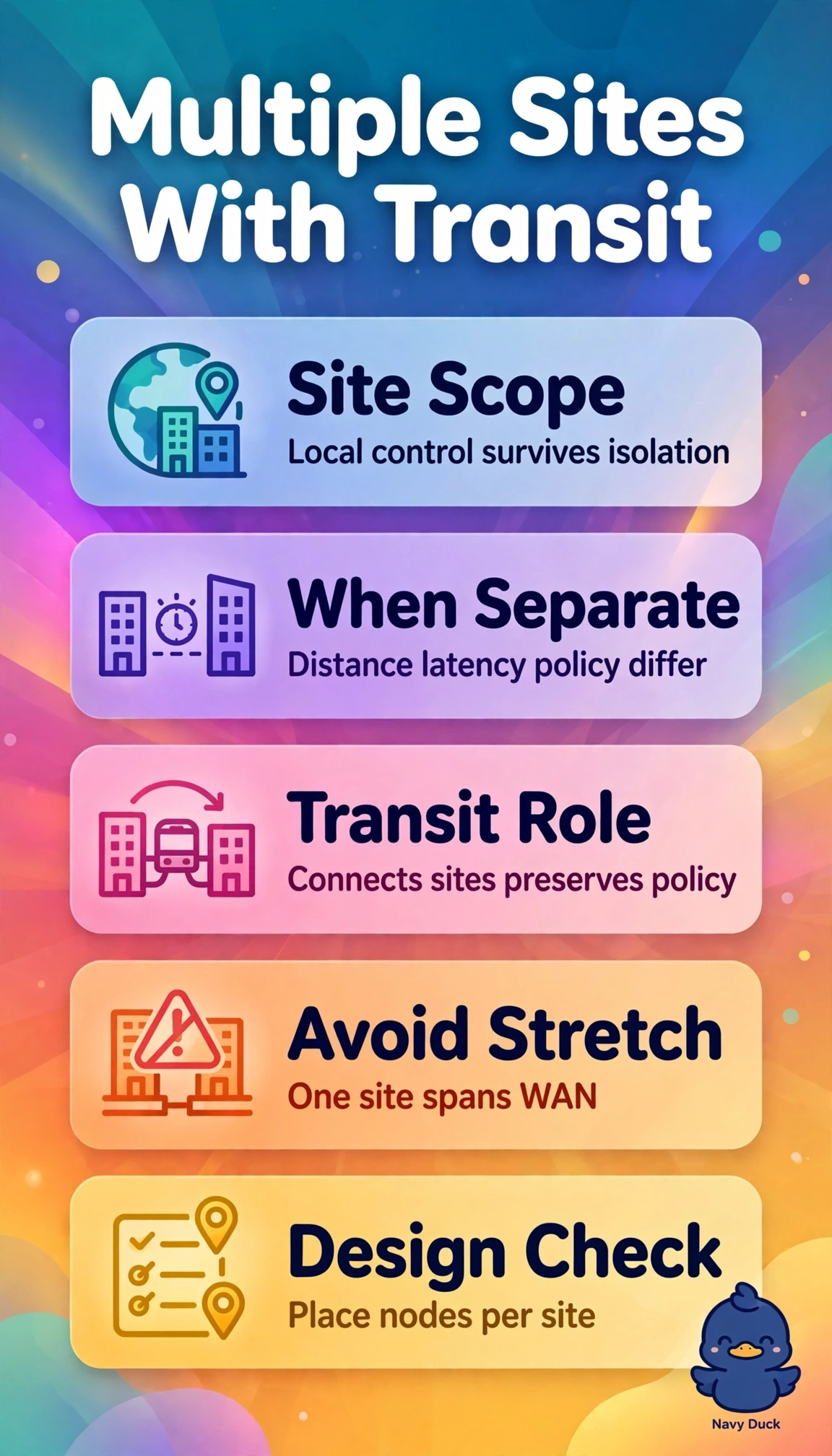
You have distance, latency, and independent policy domains pulling these locations apart, so stretching one fabric across all of them is a poor fit. Separate sites keep each fault domain small, while IP transit connects them and supports consistent inter-site policy routing.
Full Explanation
Three separate fabric sites give each geography its own control-plane nodes, map system, and policy scope. This limits the blast radius, respects round-trip limits, and supports local survivability when a WAN or VPN fails; IP transit carries traffic between sites and enables consistent inter-site policy routing. SD-Access transit preserves VN and SGT end to end, but requires a high-bandwidth, low-latency WAN with jumbo-MTU support, which an Internet VPN may not provide. With IP transit, the border hands traffic to the IP network in a VRF-aware way, and group policy is carried through re-classification or SXP rather than inline SGT. Stretching one site across the high-latency VPN centralizes control-plane functions, increases convergence time, makes locations fate-share, and can exceed underlay and overlay scale or MTU expectations. Full-mesh overlays between separate sites without transit leave inter-site traffic dependent on ad hoc tunnels, complicating consistent policy, troubleshooting, and loop control. Creating a site per main-campus building fragments a local failure domain that can share a low-latency control plane, adding unnecessary borders, configuration, and transit hops; one site with redundant borders is cleaner. Exam caveat: a site is a fault and policy scope, while transit is inter-site connectivity. In practice, verify underlay latency, MTU, and control-plane node placement at each site before choosing the transit type.