
A regional health system marks voice, video, clinical apps, general data, and scavenger traffic internally, but its MPLS provider offers only strict-priority voice, business-critical, and default classes. Traffic must keep low latency for voice across the WAN without starving other apps. Which enterprise-to-provider QoS mapping preserves voice while fitting the provider class model?
Select an answer to reveal the explanation.
Short Explanation
Boarding groups work when first class stays small and everyone else finds a fitting seat. Aggregation funnels your markings into provider classes so voice stays fast without crowding others out.
Full Explanation
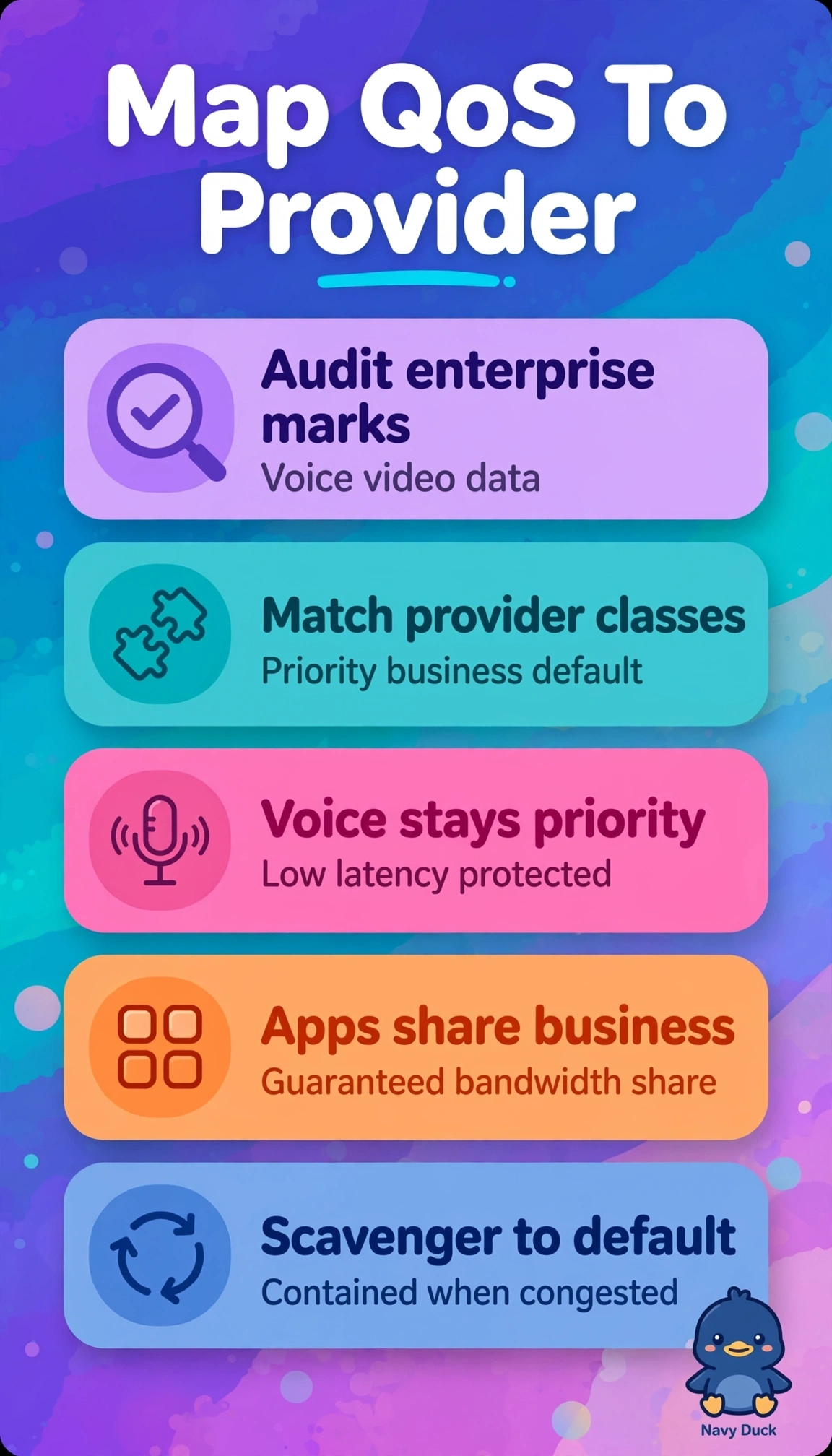
Mapping enterprise QoS to a smaller service provider model requires aggregation at the enterprise edge where multiple internal DSCP values are re-marked into the provider-supported classes, with real-time voice assigned to strict-priority for latency and jitter control, transactional applications to business-critical with bandwidth guarantees, and scavenger to default or drop-first treatment. Sending markings transparently assumes the provider honors arbitrary enterprise values, which breaks when the core supports fewer classes and leads to unpredictable queuing and remarking. Placing clinical apps, video, and data together with voice in strict-priority oversubscribes the priority queue, adds delay and jitter to voice, and risks starvation of other queues contrary to stable design. Marking everything as default best-effort simplifies configuration but abandons differentiation, so voice loses protection and clinical performance degrades under congestion. For the exam remember to aggregate many to few with voice protected and scavenger contained, then in practice verify provider mapping, edge trust boundaries, and priority-queue policing.