
A manufacturing campus runs EIGRP across 80 sites with flapping remote links causing core queries, needs encrypted neighbor authentication, and must limit query scope from unstable branches. Which EIGRP authentication and stability design best contains this query problem?
Select an answer to reveal the explanation.
Short Explanation
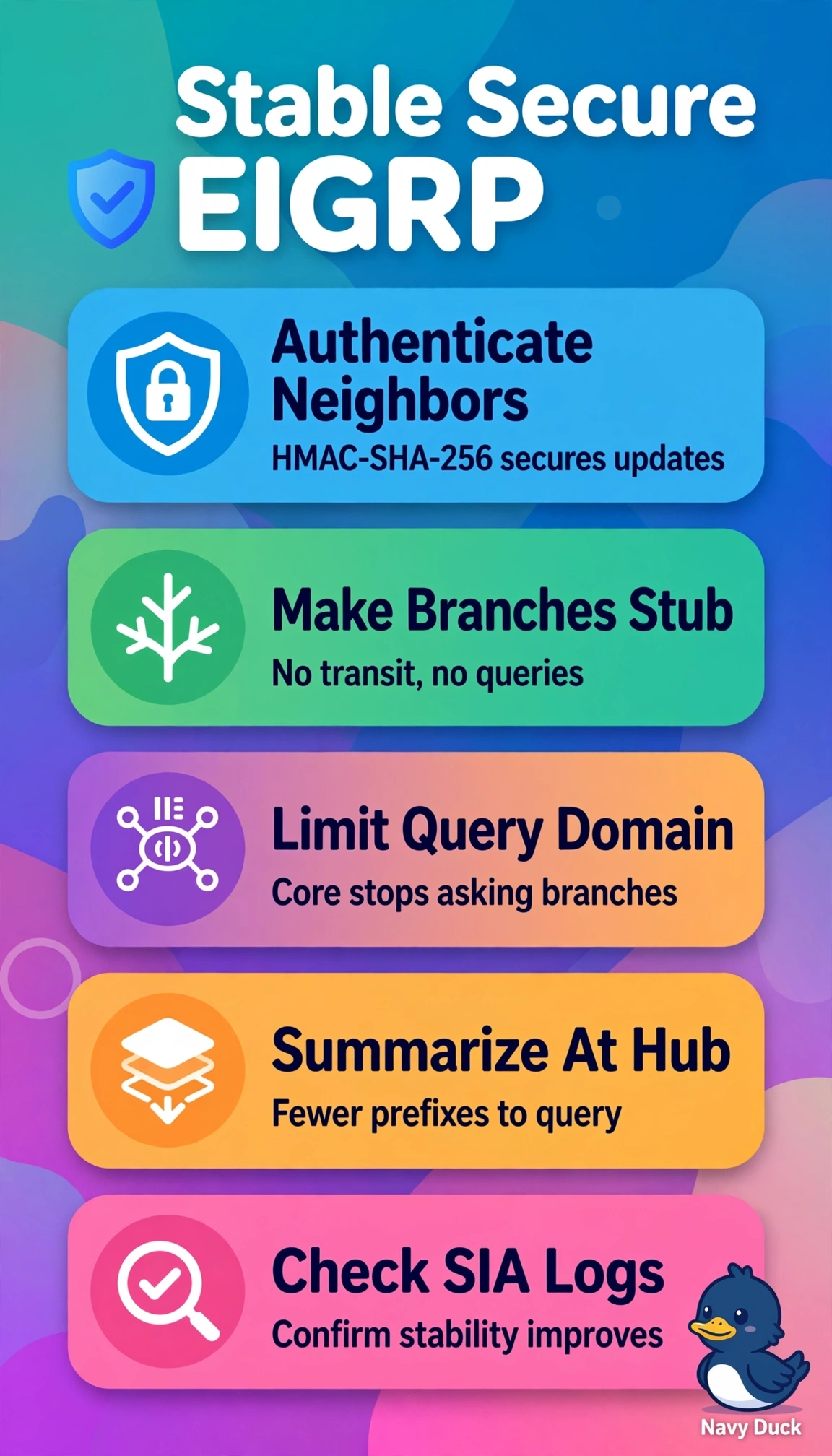
You're getting swamped by queries every time a remote link hiccups. Stub routing tells the core to stop asking unstable branches for alternate paths, while strong auth keeps neighbors honest.
Full Explanation
HMAC-SHA-256 provides cryptographic authentication of EIGRP packets to secure adjacency formation, while stub configuration advertises branch reachability but signals the hub not to send queries to those routers, which bounds the query domain and prevents SIA conditions when remote links flap. Strong authentication with full peering and core summarization secures neighbors but leaves branches as transit-capable, so queries still propagate to all 80 sites and instability persists. MD5 authentication with ordinary transit-capable branches is weaker than HMAC-SHA-256 and, without stub configuration, leaves the core sending queries to every unstable branch. Strong authentication with increased hello timers slows failure detection and does not limit query scope, so flaps still trigger network-wide queries with slower convergence. For the exam, remember stub limits queries and authentication secures them, with named mode supporting SHA-256; in practice verify stub status and authentication key alignment before troubleshooting SIA events.