
A manufacturer with 80 spokes on DMVPN needs hub-routed traffic today but wants direct spoke-to-spoke voice for new plants without permanent full mesh, using multipoint GRE and NHRP. Which DMVPN phase behavior should the designer specify to enable on-demand direct spoke tunnels?
Select an answer to reveal the explanation.
Short Explanation
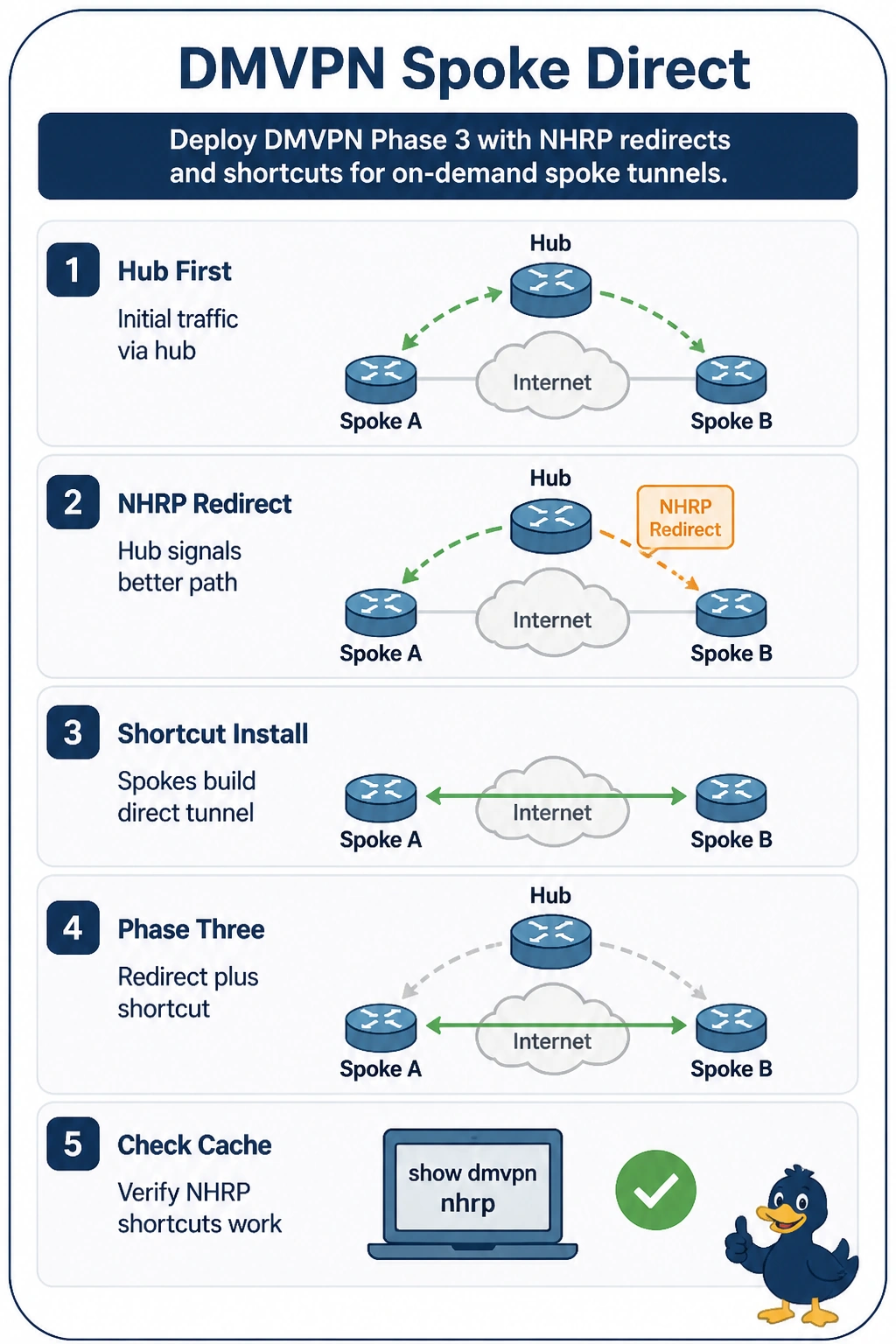
You want introductions on demand, not everyone on speed dial forever. NHRP shortcuts let spokes find each other when traffic flows. Hub helps first, spokes talk direct after.
Full Explanation
DMVPN Phase 2 allows spoke-to-spoke tunnels through NHRP resolution requests but needs specific routes with the original spoke next hop preserved, so the hub cannot summarize, while Phase 3 improves scale by using NHRP redirect messages from the hub and shortcut switching on the spokes so a spoke can dynamically install a direct tunnel and the hub can advertise summaries or a default route, preserving hub-routed default with on-demand direct voice paths over multipoint GRE. Phase 1 supports only hub-and-spoke traffic and does not provide NHRP redirects or shortcuts for direct spoke tunnels. Static point-to-point GRE with static NHRP maps cannot dynamically discover spoke addresses and defeats NHRP dynamic mapping and IPsec scaling. Phase 2 with summarized spoke subnets at the hub breaks Phase 2 direct tunnel logic because Phase 2 spokes need specific next-hop information, which is why Phase 3 route and redirect handling is preferred with summarization. For the exam, remember Phase 1 equals hub-only, Phase 2 gives spoke-to-spoke through NHRP resolution with specific routes, and Phase 3 adds NHRP redirects and shortcuts, and in practice verify NHRP cache, shortcut switching, and voice performance on direct versus hub paths.