
A global enterprise carries voice, video, and bulk data across a 500-site WAN needing scalable class-based treatment without per-flow setup, while two data-center clusters need guaranteed bandwidth for replication. Which DiffServ versus IntServ with RSVP design meets the scale properties?
Select an answer to reveal the explanation.
Short Explanation
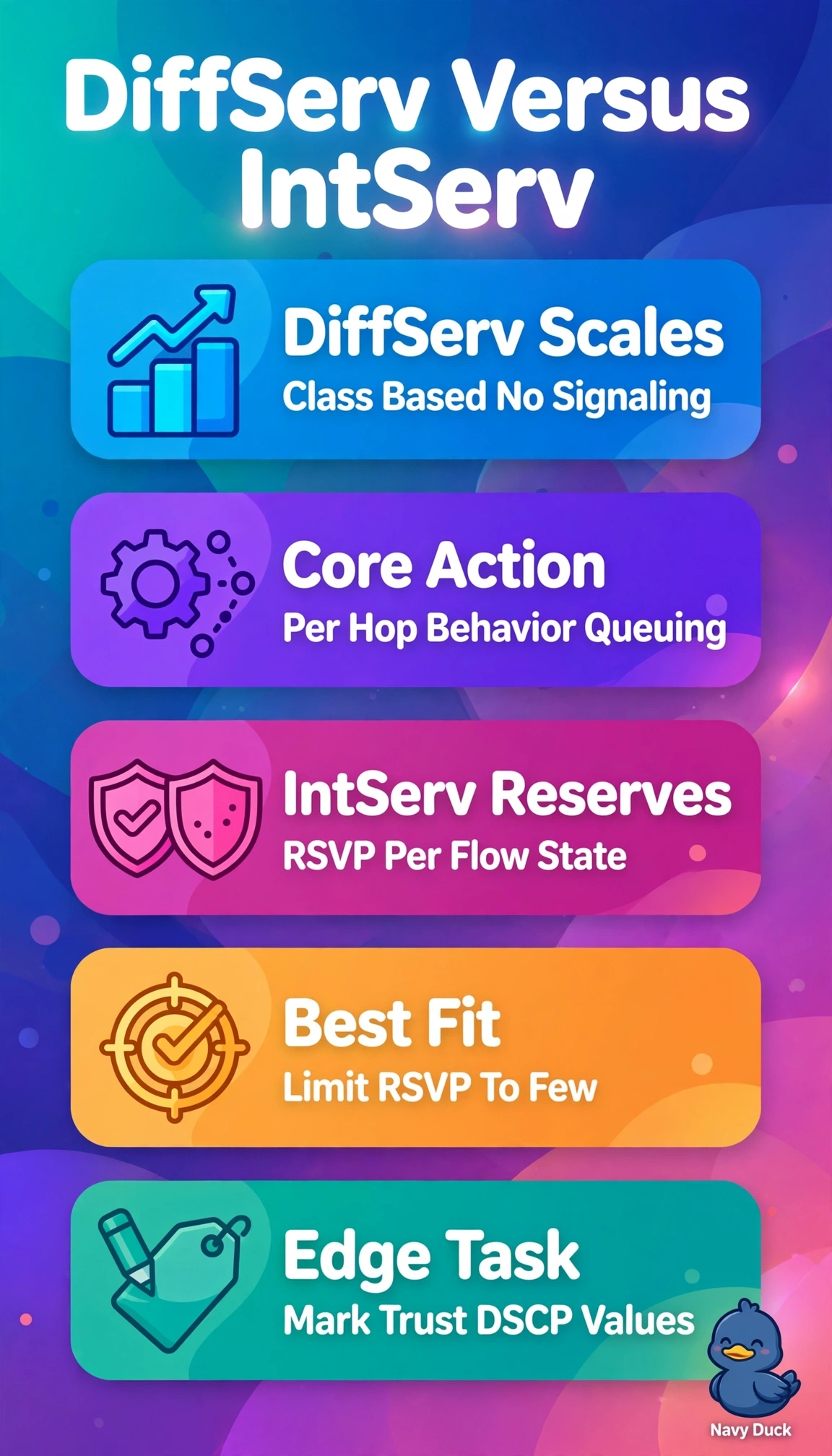
You can scale class-based treatment across 500 WAN sites with DiffServ, while reserving RSVP for the data-center replication flows that need guaranteed bandwidth. This assurance keeps per-flow state where it is manageable.
Full Explanation
DiffServ PHB marking across the WAN fits the 500-site scale because DSCP markings and per-hop behaviors—such as Expedited Forwarding for voice, Assured Forwarding for video, and best-effort for bulk—avoid per-flow signaling and require only class state in the core. IntServ with RSVP for data-center replication flows provides admission control and explicit bandwidth reservations, which are manageable for the critical flows between the two clusters. DiffServ class queuing without RSVP for replication can prioritize traffic and control drop precedence, but it cannot guarantee capacity under congestion. Deploying RSVP for every voice, video, and bulk flow at every WAN site and data-center cluster would provide per-flow QoS, but per-flow signaling, refreshes, and reservation state create unsustainable control and memory overhead at this scale. Limiting RSVP to inside one data center leaves inter-site replication between the clusters unreserved. Exam caveat: high-priority marking is not the same as guaranteed service; bandwidth assurance requires admission-controlled reservation. Practical check: audit WAN trust boundaries and queues for the intended PHBs, then verify active RSVP reservations and measured inter-cluster replication throughput at peak.