
A large campus SD-Access deployment will support 8000 endpoints, 40 virtual networks, roaming wireless users, and two data-center exits. The design must keep host tracking responsive and survive a node failure without fabric-wide outage. Which control plane node placement and scale approach should the designer recommend?
Select an answer to reveal the explanation.
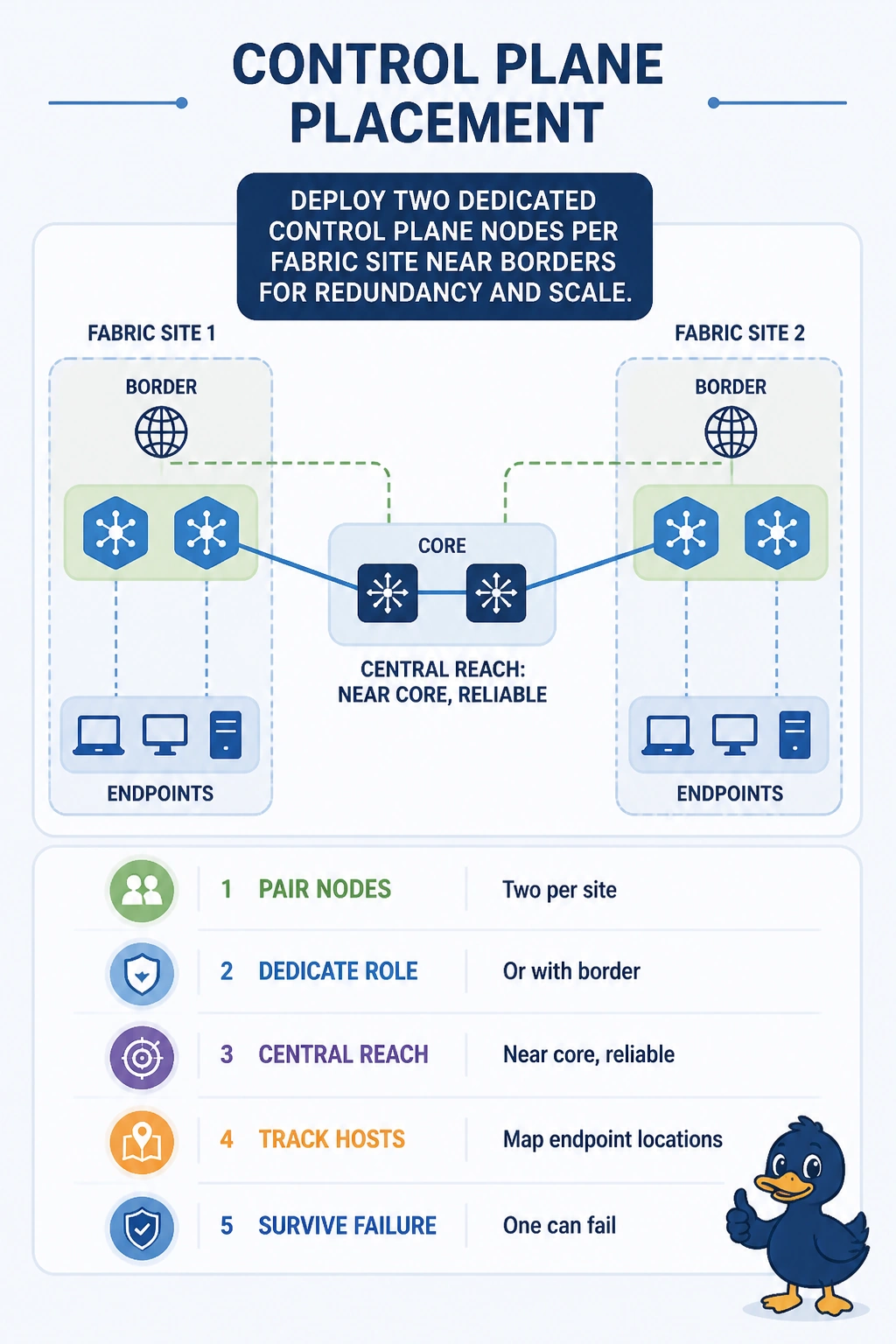
Short Explanation
You're tracking thousands of roamers without breaking a sweat, so give the directory dedicated help. A redundant pair near the core delivers resilient scale, like twin librarians who both know where every book lives.
Full Explanation
Large campus guidance calls for dedicated per-site redundant control plane near borders because two nodes eliminate single-point fabric outage, isolate faults per site, provide LISP resolver capacity for 8000 endpoints and 40 virtual networks, and keep queries close to dual data-center exits for fast roaming resolution. A shared redundant centralized pair across all sites is valid for small multisite designs seeking simple roaming mobility, but it breaks distributed scale by hauling resolution across longer paths and concentrating load, causing sluggish host tracking at this size. Collocating control plane on border nodes is a proven footprint-saving pattern that streamlines exit policy, but it breaks dedication by forcing map-resolution to contend with forwarding load, which risks CPU pressure and delayed responses under large endpoint counts. Placing two dedicated nodes at the access edge is useful to localize onboarding, but it breaks placement by distancing the database from borders and exits, adding stretch and inefficient convergence for inter-site traffic. For exams, prioritize endpoint scale, virtual-network count, and exit proximity over generic roaming or hardware-saving appeal. Practically, check border to control-plane latency, monitor CPU and map-cache during peak roams, and shut one node to prove hitless resolution.