
A multinational has headquarters in three continents, each with dual data centers and hundreds of branches that mostly access regional resources but occasionally need inter-region collaboration. The WAN must limit control overhead, keep latency low, and avoid hairpinning all traffic centrally. Which SD-WAN control-plane and overlay design should the designer propose for these regional traffic patterns?
Select an answer to reveal the explanation.
Short Explanation
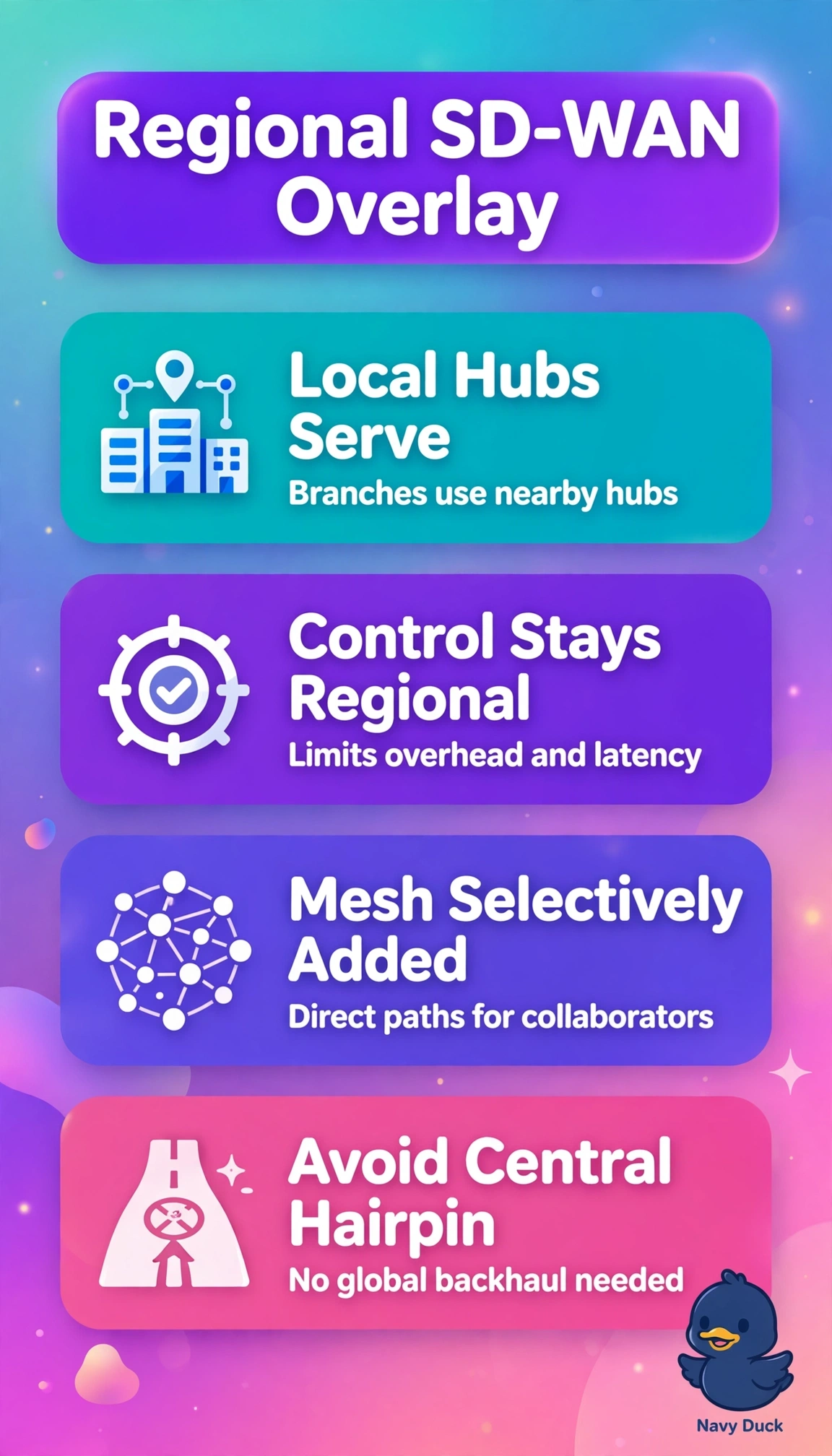
You've got mostly neighborhood traffic, so you'll want it to stay close to home like taking side streets instead of the highway. Use regional hubs to keep things tidy, then add direct shortcuts only when teams across regions need to collaborate.
Full Explanation
Regional hub-and-spoke with selective mesh fits locality with global reach because dual data centers per continent aggregate mostly regional flows, localizing routing state and policy to limit overhead, ensure redundancy, and enable local breakout for low latency, while direct tunnels form only for occasional inter-region collaboration to avoid hairpinning. Centralized backhaul through a global hub offers familiar inspection but violates latency and distribution goals by forcing intercontinental flows centrally, adding propagation delay, wasting long-haul bandwidth, and causing congestion and fate-sharing. Per-region dynamic mesh for branch-to-branch optimization suits small scale with dynamic discovery, but with hundreds of branches tunnel count, IPsec state, and updates scale quadratically with churn, violating overhead limits. Dual-hub intra-region with local breakout gives locality, redundancy, and efficient breakout but lacks cross-region path and policy, so inter-region sessions fail or need workarounds. As an exam caveat, prioritize scope qualifiers like regional versus centralized and selective versus pervasive over familiarity, as valid technology in the wrong scope is still wrong. As a practical check, review the traffic matrix, estimate per-hub and controller tunnel scale, then pilot failover and selective-mesh propagation while measuring inter-region latency and control load.