
A regional headquarters has 1,500 endpoints, an on-premises server farm with internal subnets, and a single Internet edge needing a default route. Only two high-end switches are budgeted for border duties and both must survive a single failure. Which border node design delivers internal and external connectivity on resilient devices?
Select an answer to reveal the explanation.
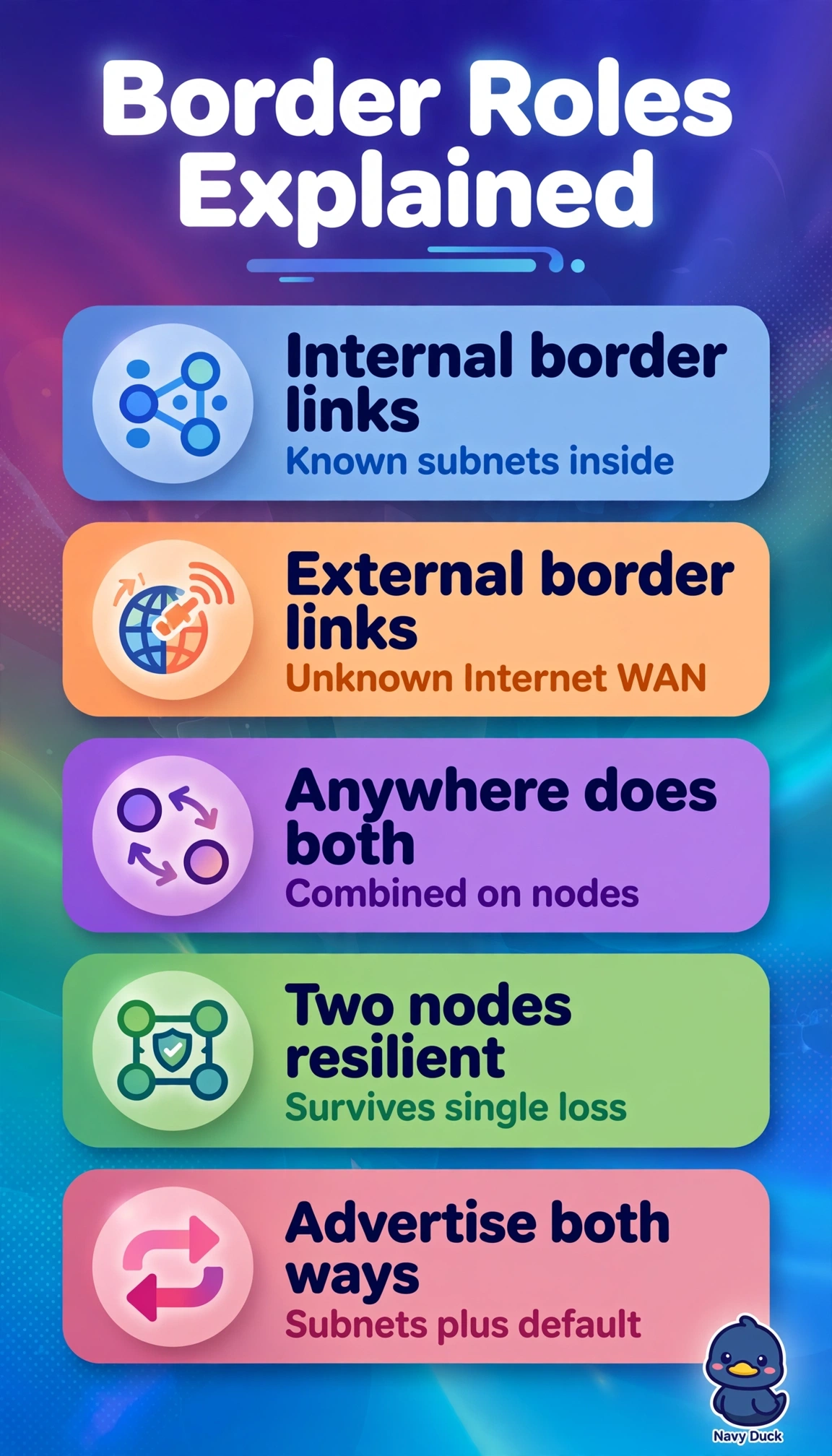
Short Explanation
You get more resilience when both guards know both doors. Anywhere borders carry internal routes and Internet exits together, so either switch can handle a failure alone.
Full Explanation
The combined anywhere border design is correct because with only two devices both must carry internal server subnets and the Internet default, so advertising both from each switch gives full internal and external connectivity that survives loss of either node for all 1500 endpoints with simple policy. The redundant internal border with the edge router for default fails on external resiliency because server reachability is protected but Internet access still depends on a single upstream edge device, leaving a single point of failure that violates the dual-survivable requirement. The resilient external border toward the core fails on internal completeness because redundant default origination is strong but on-premises server subnets lack survivable advertisement from the border, forcing extra redistribution and incomplete internal connectivity. The split-duties design with one switch for servers and one for Internet fails on fate sharing because functional separation is valid for scale yet loss of either chassis removes its entire service, so neither service survives a single failure as required. Exam caveat: distinguish anywhere from dedicated roles by verifying each node advertises both internal prefixes and default rather than assuming paired devices imply full redundancy. Practical check: confirm on both switches the publications for internal subnets plus default, then isolate one border and validate server and Internet flows continue.