
A service provider multicast network sees duplicate packets looping after a new link turned up, with PIM neighbors established on parallel paths toward the source. Which RPF-check multicast loop-prevention behavior best explains the correct forwarding decision on each router?
Select an answer to reveal the explanation.
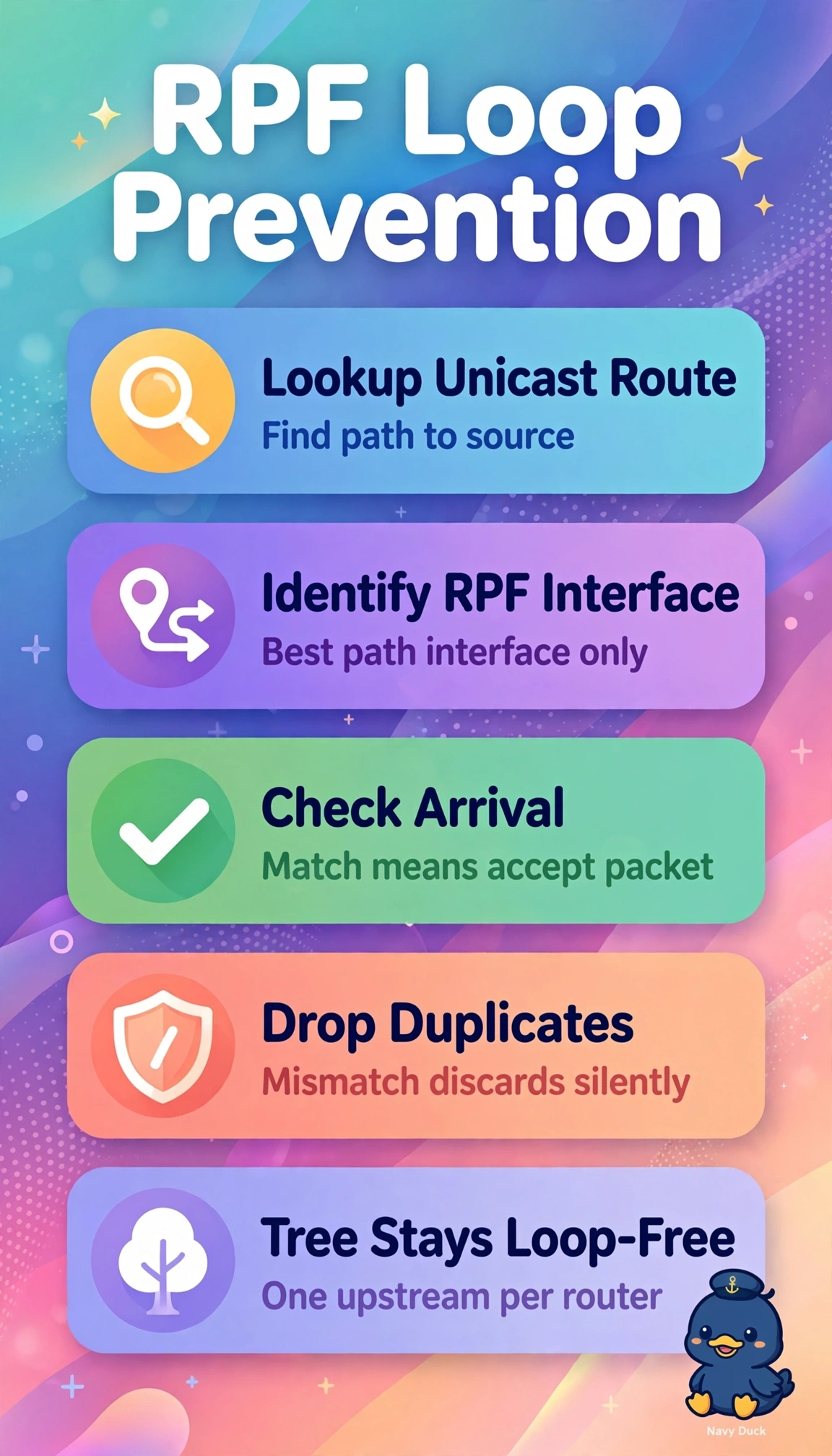
Short Explanation
You're hunting why copies multiply when a new link appears. RPF check admits packets only on the best unicast path to the source, like only accepting mail from your known sender's street.
Full Explanation
Reverse path forwarding is the central multicast loop-prevention mechanism that uses the unicast routing table to break loops when parallel PIM paths toward the same source exist, so each router identifies the unicast best path back to the source address as the single RPF interface for that state, accepts multicast only when it arrives on that interface, and discards the same packet arriving on any other PIM neighbor interface while still replicating accepted packets to the correct outgoing interfaces. The rendezvous-point best-path approach is valid for shared-tree forwarding where traffic is initially evaluated toward the RP, but it misses the stated source-specific requirement and will select the wrong upstream interface when duplicates are looping on parallel paths toward the source. The downstream-receiver best-path approach reflects normal unicast destination-based forwarding, but it inverts RPF logic because multicast loop prevention must look backward toward the source rather than forward toward receivers and would therefore accept looping packets. The PIM assert elected-forwarder approach is a commonly used LAN optimization where multiple forwarders on one segment elect one to continue forwarding, but it resolves only downstream duplicate forwarding on a shared segment and cannot replace the upstream per-router RPF interface selection across routed parallel paths. The exam caveat is to separate source-tree RPF from shared-tree RP checks and LAN assert behavior, since mention of neighbors and loops toward the source signals source-based RPF. The practical check is to compare the multicast incoming interface in show ip mroute with show ip route and show ip rpf for the source and confirm PIM neighbor state and RPF failure drops after the new link.