
A global enterprise with 500 sites needs voice, video, and bulk data treatment across a large MPLS core, with thousands of flows per second and no per-flow signaling overhead on core routers. A small telehealth pilot separately needs strict per-flow admission control. Which QoS model choice should the designer recommend for the large enterprise core to meet its scaling need?
Select an answer to reveal the explanation.
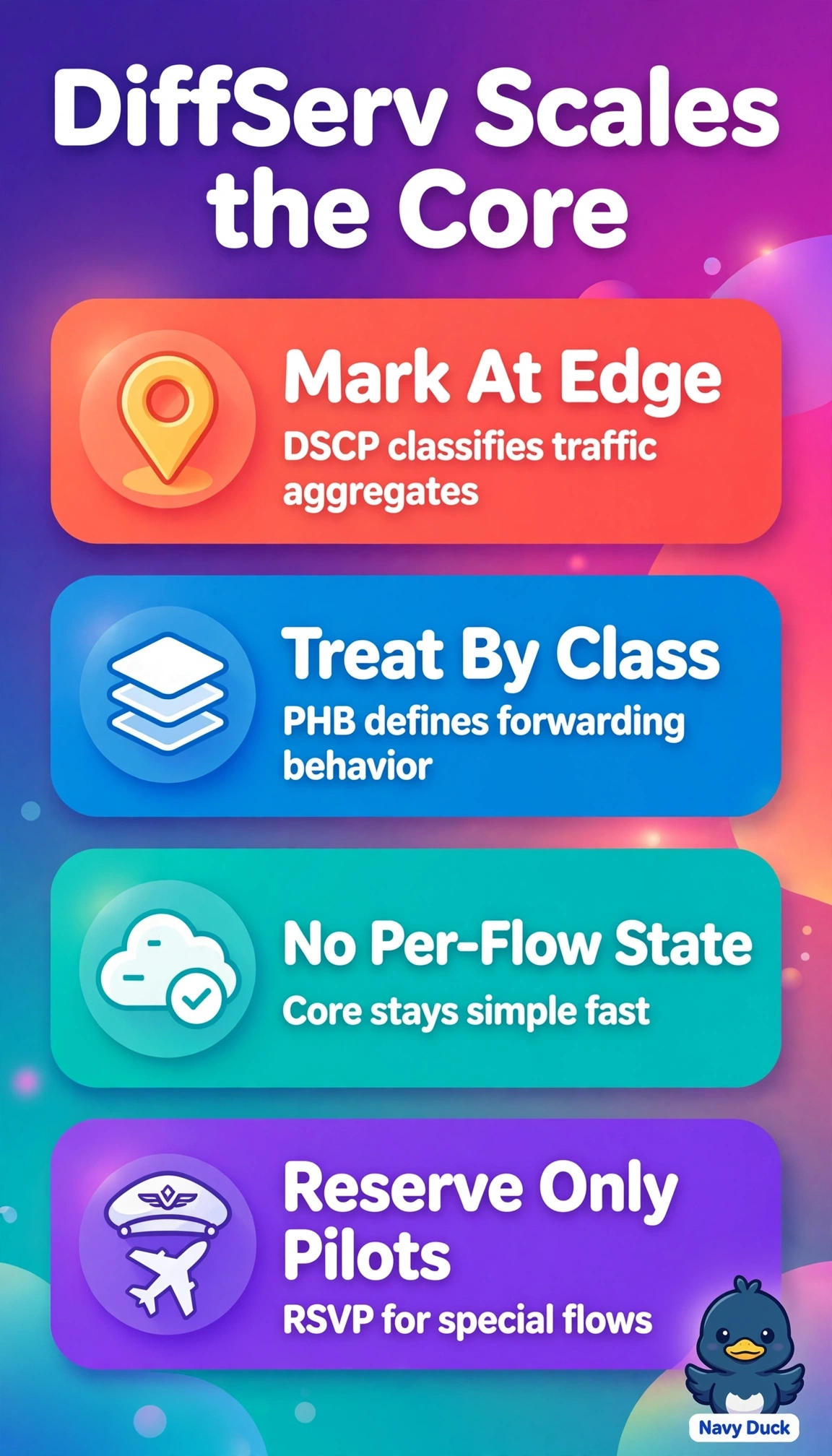
Short Explanation
Thousands of flows can't each reserve a lane downtown. DiffServ sorts traffic into a few behaved classes, keeping your core fast and simple.
Full Explanation
DiffServ with PHB marking is correct for the large MPLS core because edge routers classify voice, video and bulk data once into few aggregates via DSCP mapped to MPLS EXP bits and core routers then apply per-hop behaviors like expedited forwarding for voice, assured forwarding for video and default for bulk without per-flow signaling or state, which delivers differentiated treatment while scaling to thousands of flows per second. IntServ with RSVP reservations is valid for guaranteed service but fails for the core because it creates and refreshes reservation state for every flow on every router, violating the no per-flow overhead and scaling need and fitting only the small telehealth pilot. Overprovisioned bandwidth with uniform queuing is a common scalability approach that avoids signaling, but it fails because a single queue provides no prioritization, leaving voice vulnerable to delay and jitter under congestion despite extra capacity. MPLS traffic engineering with RSVP-TE tunnels is widely used for path optimization and bandwidth efficiency, but it fails here because it selects paths for tunnels rather than providing aggregate class-based queuing and dropping, while still adding tunnel signaling state. The exam caveat is to separate scope cues: aggregate, scalable and no signaling points to DiffServ for the core, while strict per-flow admission points to IntServ for the pilot only. The practical check is to verify edge trust boundaries, consistent DSCP to EXP mapping, and EF and AF queue depths and drops on core interfaces.