
A growing logistics firm has exhausted its 10.0.0.0/8 plan after acquisitions, with overlapping addresses, complex NAT on WAN edges, and new IoT networks demanding thousands of subnets. Leadership wants simpler routing and sustainable growth. Which private IPv4, NAT, and IPv6 strategy should the designer recommend for scalable expansion?
Select an answer to reveal the explanation.
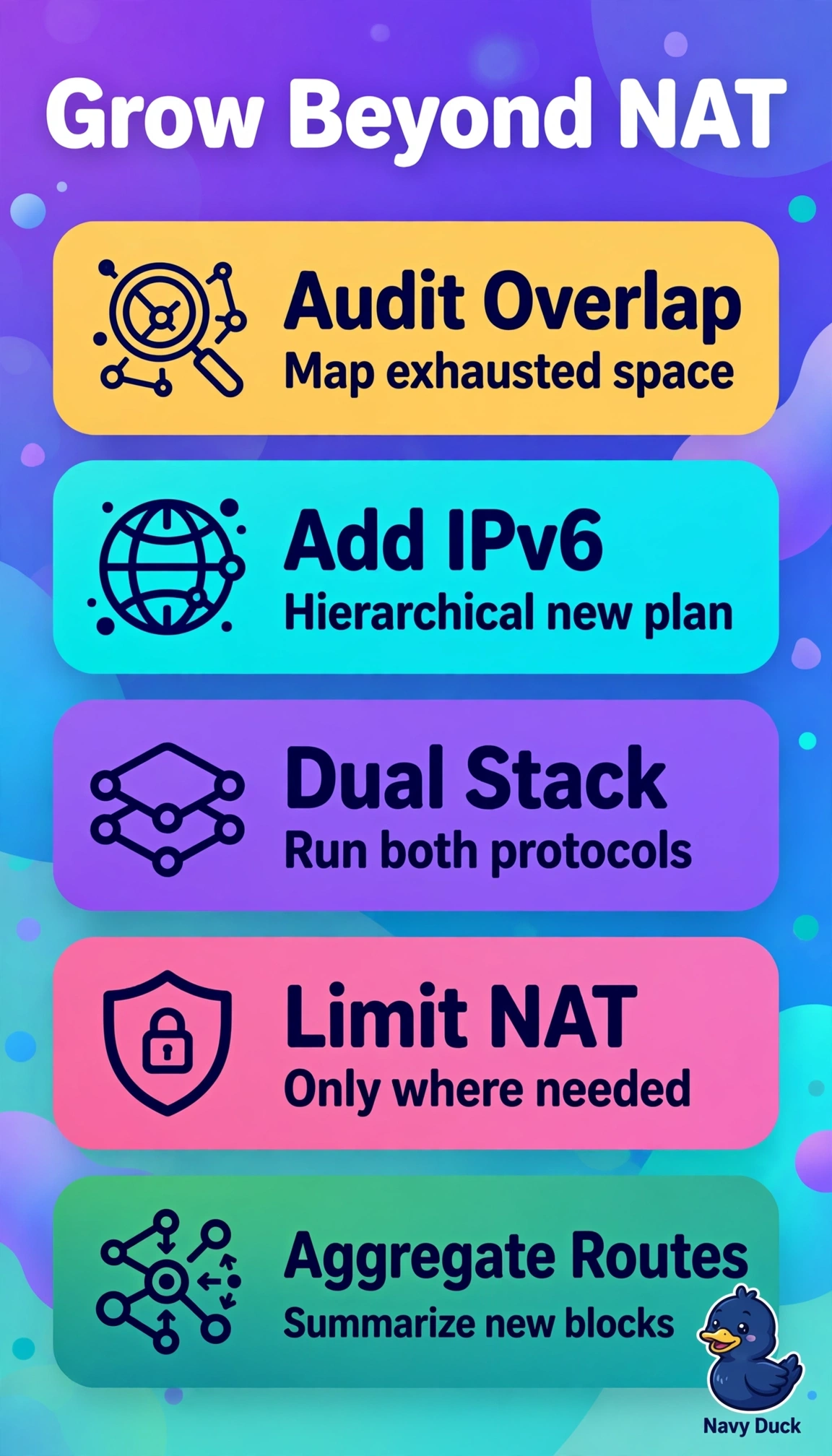
Short Explanation
You’re buried in overlapping numbers and NAT band-aids, so give your network fresh air. Dual-stack IPv6 with focused NAT gives you room to grow while preserving legacy IPv4 access, supporting growth while keeping the old avenues open.
Full Explanation
Hierarchical IPv6 provides vast, aggregatable address space for thousands of IoT subnets, while dual-stack preserves application compatibility and targeted NAT contains existing IPv4 overlap without extending translation everywhere. Together, these choices support simpler routing and sustainable growth. Consolidating the private IPv4 blocks 10.0.0.0/8, 172.16.0.0/12, and 192.168.0.0/16 with optimized WAN-edge NAT is familiar and can relieve immediate exhaustion, but it remains IPv4-only and retains WAN translation complexity, so it does not deliver sustainable expansion or simpler routing. An IPv6-only core using NAT64 and DNS64 can suit a greenfield transition, but acquired hosts, embedded systems, and applications may require native IPv4 and cannot all depend on DNS-driven translation. Renumbering acquisitions into a hierarchical 10.0.0.0/8 plan with centralized Internet NAT may improve tidiness, but readdressing overlapping sites is disruptive, and IPv4’s 32-bit space still limits long-term growth. Exam caveat: distinguish sustainable hierarchical IPv6 expansion from short-term RFC1918 expansion; IPv6 addresses exhaustion and routing growth together. Practical check: inventory overlapping prefixes, NAT state points, and IPv6 readiness across WAN, security, and IoT platforms before setting allocation sizes and translation boundaries.